
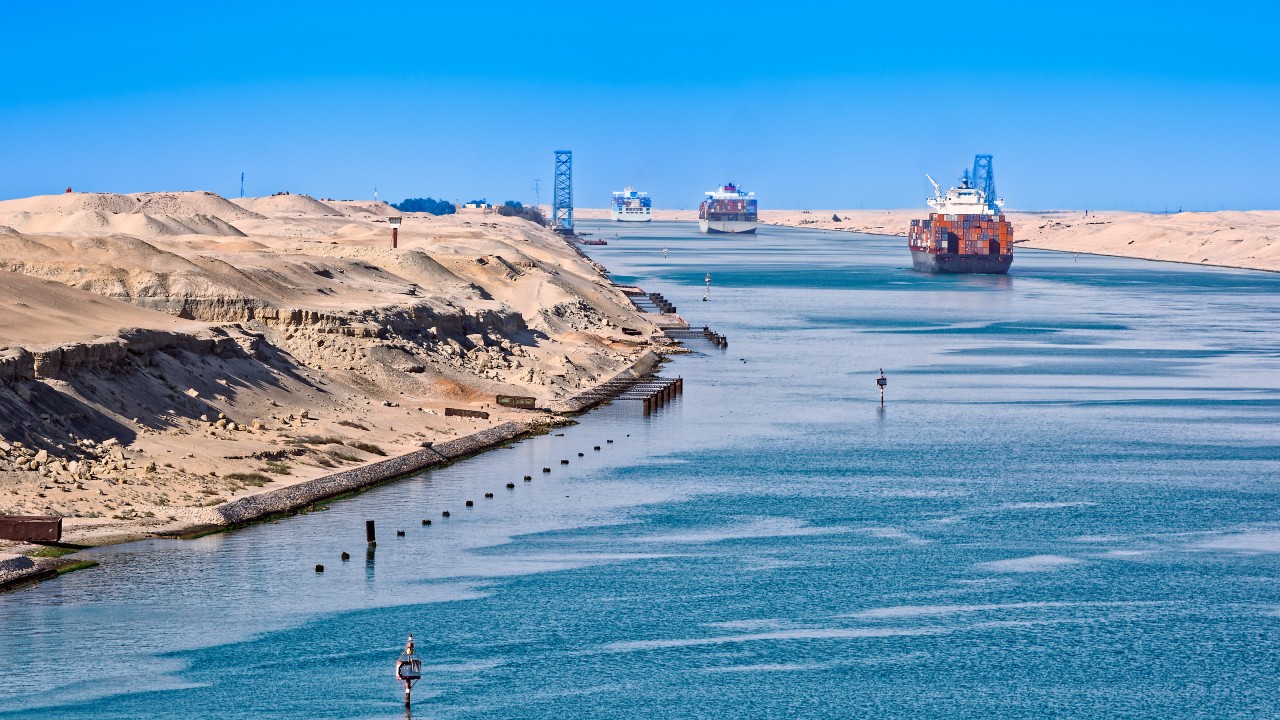
Weekly container capacity through the Suez Canal has topped half its 2023 level for the first time since attacks disrupted the route, but the recovery remains vulnerable to renewed security risks.
Container traffic through the Suez Canal is regaining ground as the world’s biggest shipping lines cautiously restore services through the Red Sea, although the route remains well below its pre-crisis strength. According to Clarksons Research data cited by BIMCO, average container ship capacity passing through the canal reached 753,000 TEU a week in the first two weeks of October, taking it to more than half of the roughly 1.46 million TEU a week recorded in 2023 before the disruption.
The rebound has been driven by a series of route changes by major carriers. Maersk and Hapag-Lloyd said in September that four further Gemini Cooperation services would move from the longer Cape of Good Hope diversion back to the Suez route, linking Asian and Indian markets with northern Europe and the Mediterranean. The companies argued the adjustment would improve transit times, while stressing that any longer-term decision would still depend on stability in the Red Sea. MSC has also been edging back, first with the partial return of selected east-west services in August and then with the westbound Indusa service, which connects the Indian subcontinent with the US and Mexico, in September.
The improvement is visible in the broader traffic numbers. Lloyd’s List Intelligence reported that container traffic through Suez rose to 2.19 million TEU in September, up 40 per cent month on month, although that was still far short of the 5.9 million TEU handled in September 2023. MarineLink and other industry outlets said the latest figures marked the first time since the Red Sea attacks began that weekly transits have topped half of the pre-disruption level, underscoring how far the channel has come from the depths of the crisis.
Even so, the recovery remains fragile. Freightos said on 15 October that all container alliances, together with MSC, were expected to be sending at least some vessels through the Red Sea by the end of October, but warned that any renewed security deterioration could quickly undo the gains. For shippers and logistics operators, a more durable return to Suez would cut dependence on the Cape of Good Hope detour and reshape both voyage times and available container capacity between Asia and Europe.
Source Reference Map
Inspired by headline at: [1]
Sources by paragraph:
– Paragraph 1: [2], [3], [4]
– Paragraph 2: [1], [2], [3]
– Paragraph 3: [1], [4], [5], [6], [7]
– Paragraph 4: [1], [2], [3], [7]
Source: Noah Wire Services
Verification / Sources
- https://www.globaltrailermag.com/suez-canal-container-traffic-rebounds/ – Please view link – unable to able to access data
- https://portsidereport.com/articles/suez-canal-container-traffic-passes-half-2023/ – In early October 2026, container traffic through the Suez Canal reached 753,000 TEU per week, surpassing 50% of the pre-disruption level of 1.46 million TEU per week in 2023. This recovery follows major shipping lines, including Maersk and Hapag-Lloyd, returning selected services to the Suez route, aiming to provide more efficient transit times. However, future routing decisions remain dependent on the stability of the Red Sea region.
- https://crewmirror.com/news/news-maritime/suez-canal-container-ship-traffic-shows-strong-recovery/ – As of early October 2026, weekly container ship capacity transiting the Suez Canal averaged 753,000 TEU, marking a significant recovery from the 330,000 TEU recorded by the end of December 2023. This rebound follows the Gemini Alliance’s return to the Suez Canal for its Asia-Mediterranean services in July 2026, leading to a gradual normalization of shipping routes. Despite the progress, the recovery remains incomplete, with ongoing regional security risks potentially reversing the gains.
- https://es2019.marinelink.com/news/suez-canal-container-ship-transits-543667 – In early October 2026, weekly container ship capacity transiting the Suez Canal averaged 753,000 TEU, compared to 1,457,000 TEU during the same period in 2023. This marks the first time since the Houthi attacks in the Red Sea that transits have exceeded 50% of pre-disruption levels. The decline in traffic was due to security concerns, leading container lines to divert ships around the Cape of Good Hope. The recent increase indicates a cautious return to the Suez route.
- https://waybillwire.com/articles/suez-canal-container-transits-rebound-marine-link-reports-483a1d1f – Suez Canal container ship transits have rebounded, according to Marine Link reports. Major carriers, including Maersk, MSC, Hapag-Lloyd, CMA CGM, ONE, and Evergreen, had previously diverted ships around the Cape of Good Hope due to security concerns in the Red Sea. The recent rebound suggests a shift back to the Suez route, although the exact figures and sustainability of this trend remain to be seen.
- https://www.worldports.org/suez-canal-container-ship-transits-exceed-50-of-pre-disruption-levels/ – In October 2026, container ship transits through the Suez Canal exceeded 50% of pre-disruption levels for the first time since the Houthi attacks in the Red Sea. This recovery follows the return of major carriers, such as Maersk and Hapag-Lloyd, to the Suez route, aiming to provide more efficient transit times. However, the recovery remains incomplete, with ongoing regional security risks potentially reversing the progress.
- https://container-news.com/suez-canal-container-ship-transits-exceed-half-of-pre-crisis-levels/ – Container ship traffic through the Suez Canal has reached its highest level since the Red Sea disruptions began, with weekly transiting capacity exceeding half of pre-crisis levels for the first time. This increase follows a series of decisions by major container shipping lines to restore services through the Red Sea after nearly three years of widespread diversions around the Cape of Good Hope. The recovery remains incomplete, with ongoing regional security risks potentially reversing the progress.
Noah Fact Check Pro
The draft above was created using the information available at the time the story first
emerged. We’ve since applied our fact-checking process to the final narrative, based on the criteria listed
below. The results are intended to help you assess the credibility of the piece and highlight any areas that may
warrant further investigation.
Freshness check
Score: 8
Notes: The article was published on October 19, 2026, and reports on container traffic data from early October 2026. Similar information has been reported by other sources, such as Maritime News on October 17, 2026 (maritimenews.com) and India Seatrade News on October 15, 2026 (indiaseatradenews.com). The data appears to be current and not recycled from older sources.
Quotes check
Score: 7
Notes: The article includes direct quotes from Maersk and Hapag-Lloyd regarding their service adjustments. These quotes are consistent with statements from the companies in September 2026. However, the article does not provide direct links to the original sources of these quotes, making independent verification challenging. The lack of direct citations raises concerns about the authenticity and accuracy of the quotes.
Source reliability
Score: 6
Notes: The article is published by Global Trailer, a niche publication focusing on the trailer business. While it is a specialised source, it may not have the same level of credibility as major news organisations. The article cites data from Clarksons Research and BIMCO, which are reputable within the maritime industry. However, the lack of direct citations for the quotes from Maersk and Hapag-Lloyd diminishes the overall reliability of the source.
Plausibility check
Score: 7
Notes: The claims about the rebound in Suez Canal container traffic are plausible and align with industry trends. The article mentions that container traffic reached 2.19 million TEU in September 2026, up 40% month-on-month, though still below the 5.9 million TEU recorded in September 2023. The recovery is attributed to major carriers returning services to the Suez route. However, the article does not provide specific details about the factors contributing to the recovery, such as regional security improvements or changes in global trade patterns.