
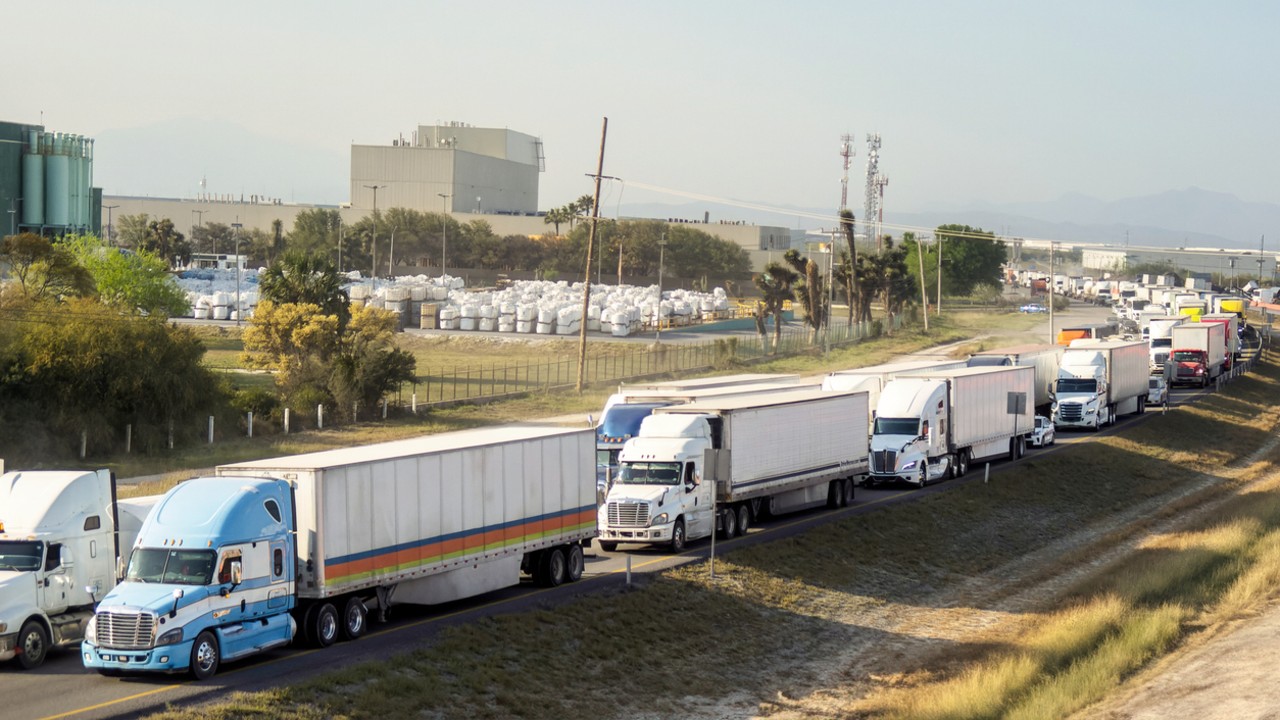
The revocation of about 25,000 Mexican truck-driver visas has intensified capacity shortages on key US-Mexico lanes, driving rejection rates and spot prices higher despite relatively subdued demand.
U.S. authorities’ revocation of about 25,000 Mexican truck-driver visas has left cross-border freight markets short of capacity and pushed rates higher on some of the busiest North American lanes, according to FreightWaves. The publication said the effect is being felt most sharply on routes into and out of the United States-Mexico border, where the pool of qualified drivers has thinned even though demand has not surged dramatically.
FreightWaves data show the tightest conditions at El Paso, where tender rejections reached roughly 24 to 25 per cent in early July and remain close to 20 per cent. San Diego and Otay Mesa are also under pressure, with rejection rates near 10 per cent, up from 3.9 per cent a year earlier, while Laredo has moved back up after briefly easing in early October. Nationally, rejection rates have also climbed, but the border markets have experienced a far more pronounced squeeze, a sign that the issue is rooted in supply rather than a sudden jump in freight volumes.
That is also reflected in pricing. Spot rates on major Mexico-origin lanes, including San Diego to Phoenix, Laredo to Dallas, Laredo to Chicago and El Paso to Dallas, have risen by between 28 per cent and 57 per cent year on year. FreightWaves said the Mexico Contract Volume Index has been broadly stable, suggesting that the higher rates are being driven by fewer available trucks and drivers rather than a dramatic increase in freight demand. The publication also noted that cross-border Mexican volume data tend to arrive with a lag, which can make the market harder to read in real time.
The Canadian border is facing a different problem. Rather than a driver shortage, the pressure there stems from a trade imbalance: exports remain firm, but weak northbound return freight makes backhauls harder to secure. According to FreightWaves, that has lifted rejection rates and forced some carriers to avoid certain lanes or demand higher pay, with select corridor rates up 20 per cent to 35 per cent over the past six weeks. The broader message for shippers and brokers is that cross-border capacity is constrained on both fronts, even if demand itself is relatively subdued. FreightWaves expects the strain to persist well into 2027, with key border lanes likely to remain far tighter than they were a year ago.
Source Reference Map
Inspired by headline at: [1]
Sources by paragraph:
– Paragraph 1: [2], [4], [5]
– Paragraph 2: [2], [4]
– Paragraph 3: [2], [3], [4]
– Paragraph 4: [2], [3], [6], [7]
Source: Noah Wire Services
Verification / Sources
- https://www.freightwaves.com/news/25000-drivers-lost-us-mexico-border-crisis-explained – Please view link – unable to able to access data
- https://www.freightwaves.com/news/25000-drivers-lost-us-mexico-border-crisis-explained – The article discusses the revocation of approximately 25,000 Mexican truck driver visas by U.S. authorities, leading to a significant shortage of qualified operators for cross-border freight. This shortage has resulted in increased tender rejection rates and elevated spot rates on key southbound lanes, with expectations that these constraints will persist into 2027. The capacity crunch is most severe at El Paso, where tender rejections peaked at around 24-25% in early July and remain near 20%. Spot rates on major Mexico-origin corridors have risen by 28% to 57% year over year. The article also notes that the Canadian border faces a different challenge, with a freight imbalance leading to higher rejection rates and increased rates on select corridors. Overall, the article highlights the impact of driver shortages and visa revocations on cross-border freight capacity and rates.
- https://www.mgn.com/news/trucker-shortages-visa-restrictions-cross-border-freight-capacity – This article examines the sustained pressure on cross-border freight capacity along the US-Mexico and US-Canada borders, attributing it to driver shortages, visa complications, and rising operating costs. The constraints are particularly acute on the US-Mexico border, where a shortage of qualified drivers and complications surrounding work visa eligibility have reduced the pool of carriers able to handle cross-border loads. Higher operating costs, driven by fuel, insurance, and regulatory compliance expenses, are further discouraging smaller carriers from maintaining cross-border operations. The article underscores the multifaceted challenges facing cross-border freight capacity and the need for strategic solutions to address these issues.
- https://www.hylios.com/intelligence/25000-mexican-drivers-lost-border-freight-crisis-hits-2027 – The article reports on the revocation of B-1 visas for approximately 25,000 Mexican truck drivers, leading to a severe capacity shortage at the US-Mexico border. Tender rejection rates at El Paso have reached 20-25%, nearly four times the national average, while spot rates on major Mexico-origin corridors have climbed 28-57% year over year. The article emphasizes that this tightening is not demand-driven but stems from reduced driver availability. FreightWaves analysis projects that this constraint will persist well into 2027, indicating a structural shift rather than a temporary disruption.
- https://wisevoter.com/world/2026/10/13/us-revokes-mexican-truck-driver-visas – This article reports that U.S. authorities have revoked 25,000 visas for Mexican truck drivers, triggering a severe capacity shortage along the U.S.-Mexico border. This policy shift has caused a significant rise in freight tender rejections and inflated spot rates for major trade corridors. The reduction in available drivers has caused significant spikes in tender rejections and cross-border freight costs. The article highlights the impact of this policy change on cross-border freight operations and the broader logistics industry.
- https://www.carrieratlas.com/news/phantom-capacity-shrinks-cross-border-lanes-despite-flat-demand – The article discusses the tightening of the US-Mexico trucking market in Q1 2026, attributing it not to increased demand but to a reduction in the pool of carriers legally and safely able to move cross-border freight. The term ‘phantom capacity’ is used to describe trucks that appear in load-board searches but cannot actually haul the load due to compliance and security constraints. The article highlights the challenges posed by these constraints and the need for strategic solutions to address the tightening market.
- https://www.freightwaves.com/news/phantom-capacity-tightens-us-mexico-trucking-market-uber-freight-says – This article reports that the US-Mexico trucking market is tightening in early 2026, not due to demand shifts but because of capacity constraints tied to security, compliance, and driver qualification. Uber Freight describes this as ‘phantom capacity,’ where trucks show up in load-board searches but can’t actually haul the load. The article emphasizes that these constraints are reshaping how freight moves across the border and are driven more by compliance and security constraints than demand shifts.
Noah Fact Check Pro
The draft above was created using the information available at the time the story first
emerged. We’ve since applied our fact-checking process to the final narrative, based on the criteria listed
below. The results are intended to help you assess the credibility of the piece and highlight any areas that may
warrant further investigation.
Freshness check
Score: 8
Notes: The article was published on October 13, 2026, and reports on the revocation of 25,000 Mexican truck-driver visas by U.S. authorities. Similar reports have appeared in other publications, such as Wisevoter and Waybill Wire, on October 13, 2026. (wisevoter.com) This suggests the information is current and not recycled. However, the presence of multiple sources reporting the same event indicates a potential for redundancy. (freightwaves.com)
Quotes check
Score: 7
Notes: The article includes direct quotes attributed to Julie Van de Kamp, who presented the SONAR analysis on the October 13 broadcast. However, no direct links to the original broadcast or transcript are provided, making independent verification of these quotes challenging. (freightwaves.com)
Source reliability
Score: 9
Notes: The article originates from FreightWaves, a reputable source within the logistics and freight industry. However, the article is based on data from FreightWaves SONAR, which is proprietary and not independently verifiable. (freightwaves.com)
Plausibility check
Score: 8
Notes: The claims about the revocation of 25,000 Mexican truck-driver visas leading to increased tender rejections and spot rates are plausible and align with industry trends. However, the article does not provide specific data or sources to substantiate these claims, making independent verification difficult. (freightwaves.com)