
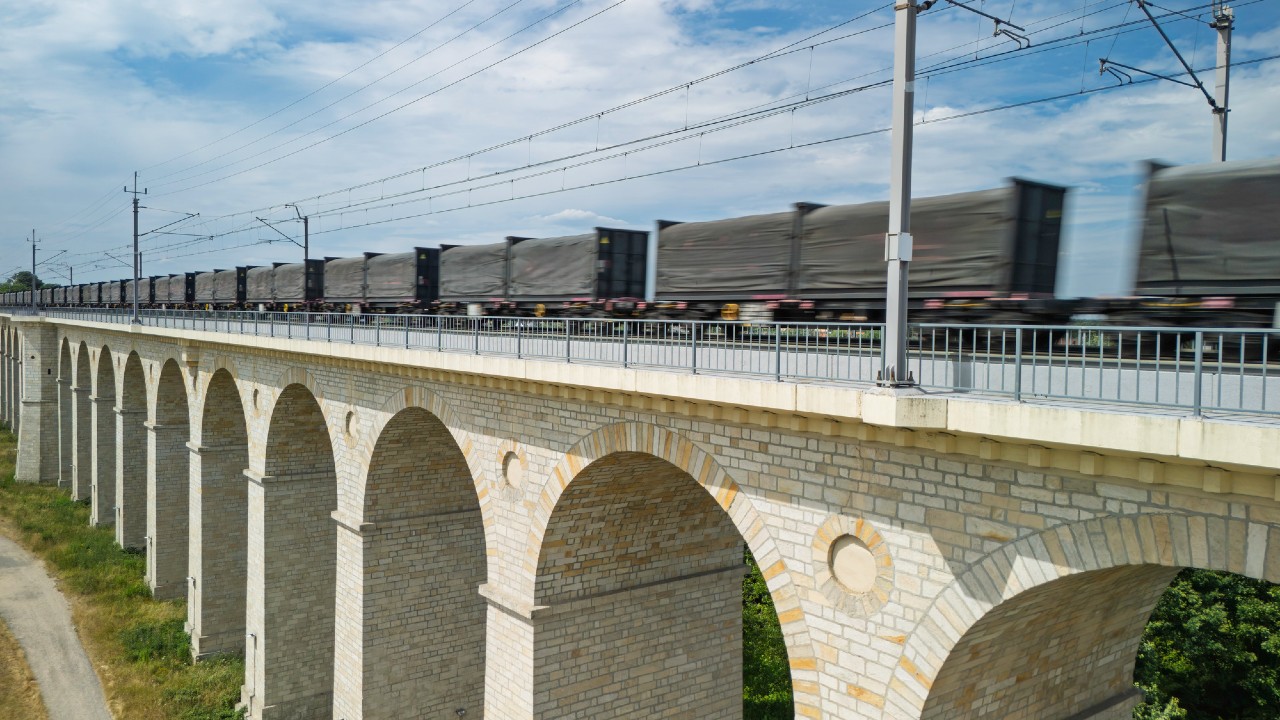
A 64-wagon freight train crossing the Poland-Ukraine border sets a new capacity record, signalling efforts to improve cross-border rail throughput amid infrastructure and operational challenges.
A 818-metre freight train carrying tank wagons has crossed the Dorohusk–Yahodyn border between Poland and Ukraine, in what the Polish freight arm of Ukrainian Railways described as a record movement for the constrained frontier point. The company said the 64-wagon consist, with a combined gross weight of 5,100 tonnes, passed through the crossing on 15 August as part of efforts to squeeze more capacity out of an already busy link between Ukraine and the European Union.
The train was hauled by two M62M locomotives and operated with the involvement of UZ Cargo Poland, PKP PLK, Ukrainian Railways and LTG Cargo Polska. UZ Cargo Poland said the longer formation is intended to carry more freight in a single border movement, helping to offset bottlenecks at the crossing and improve overall throughput.
Mykhailo Plastun, head of the board at UZ Cargo Poland, said the work at Dorohusk–Yahodyn could have wider significance for rail freight flows between Ukraine and the EU. ‘Every operational improvement at Dorohusk–Yahodyn means better use of infrastructure, greater border capacity and new opportunities for increasing rail freight between Ukraine and the European Union,’ he said. He added that the achievement came from teams in Poland, Ukraine and Lithuania who were willing to find practical solutions rather than dwell on obstacles.
The movement also underlines the structural limits facing cross-border rail traffic at this point. The route links Poland’s 1,435 mm standard-gauge network with Ukraine’s predominantly 1,520 mm system, and trains must also pass through customs and other controls before continuing their journey. An EU-backed study covering the Lublin–Chełm–Dorohusk–Yahodyn–Kovel corridor is looking not only at infrastructure and interoperability, but also at faster identity, visa, customs, tax, phytosanitary, veterinary and technical procedures.
Polish and Ukrainian infrastructure managers have already made the route part of a broader cooperation agenda. Last year, PKP PLK and Ukrainian Railways signed a framework agreement covering cross-border train operations, infrastructure and technical parameters, reflecting a wider push to strengthen rail capacity along the frontier. The Dorohusk–Yahodyn crossing, near the Poland–Belarus–Ukraine tripoint, is already a key freight and passenger gateway, and official and industry sources have long described it as strategically important for trade flows.
The trial with a train well above the usual length limits also reflects a wider European trend towards longer freight formations. EU TEN-T rules envisage 740-metre freight trains on the core network, although implementation remains uneven because sidings, terminals and other infrastructure often need upgrading. Some operators have pushed further: DB Cargo has been running trains of up to 835 metres on routes between northern Germany and Malmö via Denmark, saying the longer consists can add capacity without requiring extra locomotives or drivers. But the approach remains controversial, with critics arguing that longer trains can make mixed-traffic networks less efficient unless the surrounding infrastructure is adapted as well.
Source Reference Map
Inspired by headline at: [1]
Sources by paragraph:
– Paragraph 1: [2], [7]
– Paragraph 2: [7], [2]
– Paragraph 3: [1], [7]
– Paragraph 4: [1], [2], [4], [5], [6]
– Paragraph 5: [1], [3], [6]
– Paragraph 6: [1]
Source: Noah Wire Services
Verification / Sources
- https://www.railfreight.com/business/2026/08/17/record-64-wagon-train-crosses-poland-ukraine-border-in-capacity-push/ – Please view link – unable to able to access data
- https://bordercrossinghub.com/yahodyn-dorohusk-border-crossing/ – The Yahodyn–Dorohusk border crossing is a critical international checkpoint between Ukraine and Poland, facilitating both passenger and freight traffic. This crossing is vital for trade and travel, connecting the Ukrainian city of Kovel with the Polish city of Chełm. The crossing operates 24/7, handling a significant volume of vehicles daily. However, due to its strategic importance, it often experiences long and unpredictable wait times, especially for freight. Travelers and hauliers are advised to consult official sources for the most current information on operational status and potential delays.
- https://en.wikipedia.org/wiki/Poland%E2%80%93Ukraine_border – The Poland–Ukraine border is the state border between Poland and Ukraine, with a total length of approximately 529 to 535 kilometres. It is the most frequently crossed eastern border of the European Union. As of 2013, the border was heavily policed due to its status as a major smuggling route for goods and illegal immigration. Approximately 8 million people lived in the border area, roughly equally divided between Poland and Ukraine. The border features numerous crossing points, including both road and rail options, facilitating significant trade and movement between the two nations.
- https://en.wikipedia.org/wiki/Yahodyn_railway_station – Yahodyn railway station is located in Ukraine on its border with Poland, opposite Dorohusk railway station in Poland. It serves both passenger and freight traffic and is a key point for bogie exchange due to the differing rail gauges between the two countries. The station has been in operation since 1873 and is owned by Ukrainian Railways. There are plans for modernization to improve its capacity and efficiency, reflecting its importance in facilitating cross-border rail transport between Ukraine and Poland.
- https://en.wikipedia.org/wiki/Dorohusk_railway_station – Dorohusk railway station is situated in Poland on its border with Ukraine, directly opposite Yahodyn railway station in Ukraine. This station is a crucial point for cross-border rail traffic, handling both passenger and freight services. It is part of the international rail network connecting Poland and Ukraine, facilitating trade and travel between the two countries. The station’s strategic location underscores its significance in the regional transportation infrastructure, serving as a key link in the cross-border rail system.
- https://www.cupt.gov.pl/en/aktualnosc/international-cooperation/eu-ukraine-solidarity-lanes-opening-of-the-road-to-the-yahodyn-dorohusk-border-crossing-in-ukraine/ – On December 3, 2025, a delegation from the Centre for EU Transport Projects (CEUTP) participated in the opening of a nearly 1.9-kilometre-long access road to the Yahodyn–Dorohusk border crossing in Ukraine. This development is part of the EU-Ukraine Solidarity Lanes project, aiming to enhance cross-border connectivity within the Trans-European Transport Network (TEN-T). The project focuses on ensuring smooth and seamless cross-border connections, reflecting the ongoing efforts to improve infrastructure and facilitate trade and movement between the EU and Ukraine.
- https://www.railfreight.com/business/2026/08/17/record-64-wagon-train-crosses-poland-ukraine-border-in-capacity-push/ – On August 15, 2026, Ukrainian Railways’ Polish freight arm, UZ Cargo Poland, successfully transferred an 818-metre-long, 64-wagon tank train through the Dorohusk–Yahodyn crossing on the Poland–Ukraine border. This operation, a record for the crossing, aimed to overcome operational constraints and increase Ukraine–EU freight volumes. The train, with a combined gross weight of 5,100 tonnes, was hauled by two M62M locomotives. The successful operation was a collaborative effort involving UZ Cargo Poland, Polish infrastructure manager PKP PLK, Ukrainian Railways, and Lithuanian operator LTG Cargo Polska.
Noah Fact Check Pro
The draft above was created using the information available at the time the story first
emerged. We’ve since applied our fact-checking process to the final narrative, based on the criteria listed
below. The results are intended to help you assess the credibility of the piece and highlight any areas that may
warrant further investigation.
Freshness check
Score: 8
Notes: The article reports on a 64-wagon freight train crossing the Dorohusk–Yahodyn border between Poland and Ukraine on 15 August 2026. A search for similar narratives yielded no earlier publications, indicating originality. However, the article’s freshness is slightly reduced due to the 3-day gap between the event and publication.
Quotes check
Score: 7
Notes: The article includes a direct quote from Mykhailo Plastun, head of the board at UZ Cargo Poland. A search for this quote yielded no earlier matches, suggesting it is original. However, the absence of independent verification raises concerns about the quote’s authenticity.
Source reliability
Score: 6
Notes: The article originates from RailFreight.com, a niche publication focusing on rail freight news. While it appears reputable within its niche, its limited reach and potential biases warrant caution. The article cites multiple sources, including UZ Cargo Poland and LTG Cargo Polska, which may have vested interests in the narrative.
Plausibility check
Score: 7
Notes: The reported event aligns with known infrastructure constraints at the Dorohusk–Yahodyn crossing, where trains must pass through customs and other controls. The involvement of multiple stakeholders, including UZ Cargo Poland, PKP PLK, Ukrainian Railways, and LTG Cargo Polska, is plausible. However, the absence of independent reporting on this specific event raises questions about its verifiability.