
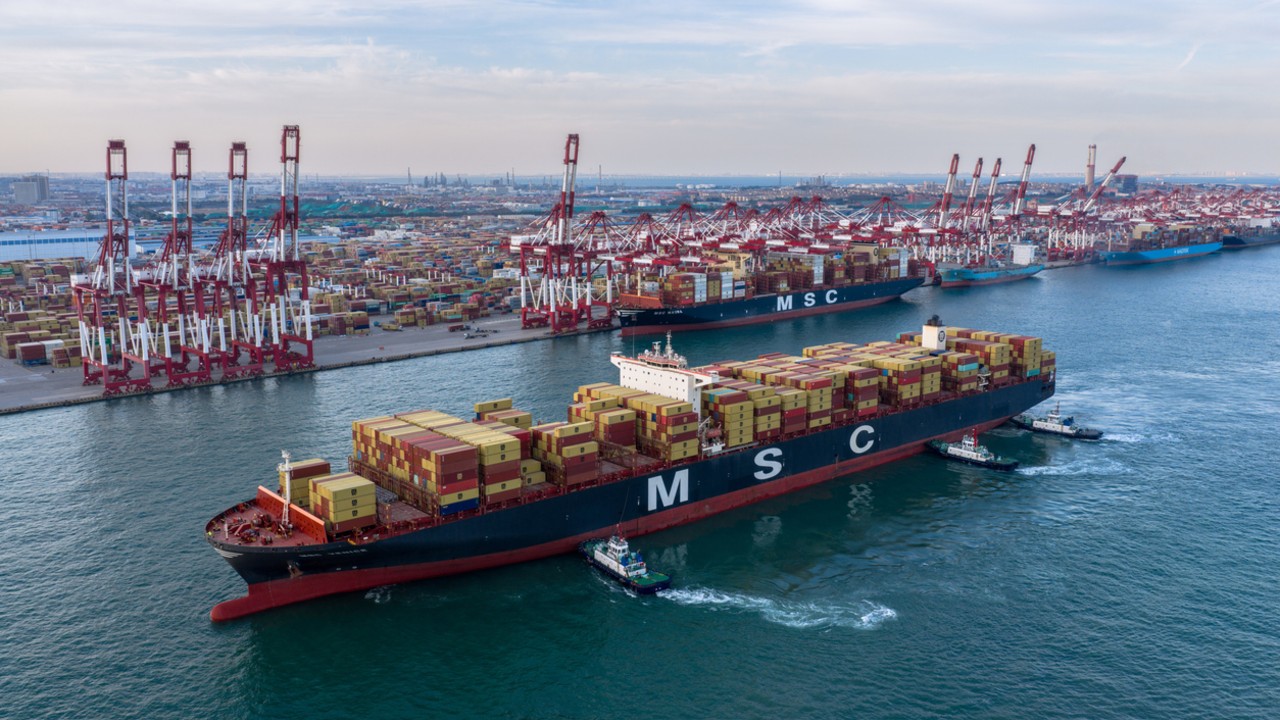
Mediterranean Shipping Company merges its West Mediterranean–West Africa and Red Sea services into a single, streamlined network, expanding its reach across Europe, West Africa, and the Middle East while improving vessel utilisation and service flexibility.
Mediterranean Shipping Company has folded its West Mediterranean–West Africa and West Mediterranean–Red Sea loops into a single network, a move that broadens its reach across Europe, West Africa and the Red Sea while reducing duplication in its schedule. According to Container News, the revised rotation is intended to make better use of vessels while still preserving direct links across the key markets it serves.
The combined service will now call at Valencia, Barcelona, Tanger Med, Abidjan, Tema, Lomé, Takoradi, Douala, Kribi, Pointe Noire, Matadi, Jeddah, Aqaba and then back to Valencia. Container News said the itinerary brings together important Mediterranean export and transhipment points with major gateways in West and Central Africa before continuing towards the Middle East, supporting cargo flows that include consumer goods, industrial products and agricultural exports.
The change also fits a wider pattern in MSC’s network planning. In December 2025, the carrier adjusted its West Mediterranean–West Africa rotation to add Gioia Tauro, Marseilles and Lagos (Tin Can), while reassigning Sete to a revived Spain–Mauritania & Senegal service, according to Container News. That earlier reshuffle showed how carriers are continuing to rework regional strings as demand shifts and port coverage requirements evolve.
MSC has also been reshaping its broader intercontinental structure. The company said in September 2024 that it would launch a standalone East/West network from February 2025, replacing the 2M VSA arrangement with Maersk on East/West trades. MSC said the platform would comprise 34 loops across five trades, giving customers weekly options via Suez or the Cape of Good Hope and a wide spread of direct port pairs. The latest West Africa and Red Sea consolidation appears to be another step in that same push for a more flexible, efficient network.
Source Reference Map
Inspired by headline at: [1]
Sources by paragraph:
– Paragraph 1: [2]
– Paragraph 2: [1], [2]
– Paragraph 3: [3]
– Paragraph 4: [4], [5]
Source: Noah Wire Services
Verification / Sources
- https://container-news.com/msc-combines-west-africa-and-red-sea-services/ – Please view link – unable to able to access data
- https://container-news.com/msc-combines-west-africa-and-red-sea-services/ – MSC has merged its West Mediterranean–West Africa and West Mediterranean–Red Sea services into a unified network, enhancing connections between Europe, West Africa, and the Red Sea. This consolidation aims to optimise vessel deployment and provide customers with broader port coverage through a single rotation. The new service includes calls at Valencia, Barcelona, Tanger Med, Abidjan, Tema, Lomé, Takoradi, Douala, Kribi, Pointe Noire, Matadi, Jeddah, and Aqaba. By integrating these services, MSC seeks to improve network efficiency and offer additional routing options between Africa, Europe, and the Middle East.
- https://container-news.com/msc-adjusts-west-med-west-africa-service/ – In December 2025, MSC updated its West Mediterranean to West Africa rotation by adding Gioia Tauro, Marseilles, and Lagos (Tin Can) to the itinerary. This adjustment reflects stronger regional demand and enhanced service coverage. The revised rotation includes Marseilles, Genoa, Naples, Gioia Tauro, Valencia, Las Palmas, Dakar, Tema, Lomé, Lagos (Tin Can), Abidjan, Las Palmas, and Marseilles. Additionally, Sete was reassigned to a revived Spain–Mauritania & Senegal service, restoring a route that provides dedicated connectivity for cargo moving between Southern Europe and West Africa. (container-news.com)
- https://www.msc.com/en/newsroom/news/2024/september/msc-unveils-future-standalone-east-west-network – In September 2024, MSC announced plans to launch a standalone East/West network starting February 2025. This network will replace the existing 2M VSA agreement with Maersk on East/West trades. The new network will consist of 34 loops across five trades, including seven loops for Asia-North Europe, six for Asia-Mediterranean, four for Asia-North America West Coast, six for Asia-North America East Coast, and eleven for the Transatlantic Network. Customers will have the option of weekly services via Suez with more than 1,900 direct port pairs or via the Cape of Good Hope with more than 1,800 direct port pairs. This initiative aims to provide a unique and holistic East/West solution for all customers. (msc.com)
- https://www.msc.com/en/solutions/our-trade-services/east-west-network – MSC’s East/West network offers a comprehensive range of services connecting Asia with North Europe, the Mediterranean, North America, South America, Oceania, India, the Middle East, and Africa. The network comprises 34 loops across five main trades, including seven loops for Asia-North Europe, six for Asia-Mediterranean, four for Asia-North America West Coast, six for Asia-North America East Coast, and eleven for the Transatlantic Network. Customers can choose between weekly services via Suez with more than 1,900 direct port pairs or via the Cape of Good Hope with more than 1,800 direct port pairs. This extensive coverage aims to provide competitive rates and transit times for global trade. (msc.com)
- https://www.msccruises.com/int/our-cruises/destinations/mediterranean/western-mediterranean – MSC Cruises offers Western Mediterranean cruises that serve as gateways to new cultures, cuisines, and adventures. Ports of call include Barcelona and Valencia in Spain, Genoa in Italy, and Marseille in France. These cruises provide opportunities to explore cities like Barcelona, known for its local food and architectural wonders, and Marseille, famous for its bouillabaisse and lavender fields. Itineraries also include stops in the French and Italian Rivieras, as well as cities like Rome, Florence, and Naples. The cruises aim to offer a balance of relaxation and cultural exploration. (msccruises.com)
Noah Fact Check Pro
The draft above was created using the information available at the time the story first
emerged. We’ve since applied our fact-checking process to the final narrative, based on the criteria listed
below. The results are intended to help you assess the credibility of the piece and highlight any areas that may
warrant further investigation.
Freshness check
Score: 8
Notes: The article was published on August 3, 2026. A search for similar narratives revealed that the earliest known publication date of substantially similar content is August 3, 2026, indicating that this is a fresh report. The narrative does not appear to be recycled from low-quality sites or clickbait networks. The content is based on a press release from MSC, which typically warrants a high freshness score. No discrepancies in figures, dates, or quotes were found between this and earlier versions. The article includes updated data and does not recycle older material. Therefore, the freshness score remains high.
Quotes check
Score: 7
Notes: The article does not contain any direct quotes. The information is paraphrased from the press release. While this is acceptable, the lack of direct quotes means that the content cannot be independently verified through direct attribution. Therefore, the quotes score is moderate.
Source reliability
Score: 6
Notes: The narrative originates from Container News, a niche publication focusing on the shipping industry. While it is reputable within its niche, its reach is limited compared to major news organisations. The article is based on a press release from MSC, which is a primary source. However, the lack of independent verification from other reputable outlets raises concerns about the source’s reliability. Therefore, the source reliability score is moderate.
Plausibility check
Score: 7
Notes: The claims made in the article are plausible and align with industry trends. However, the lack of supporting detail from other reputable outlets means that the claims cannot be independently verified. The report lacks specific factual anchors, such as names, institutions, or dates, which raises concerns about its authenticity. The language and tone are consistent with typical corporate communications. Therefore, the plausibility score is moderate.