
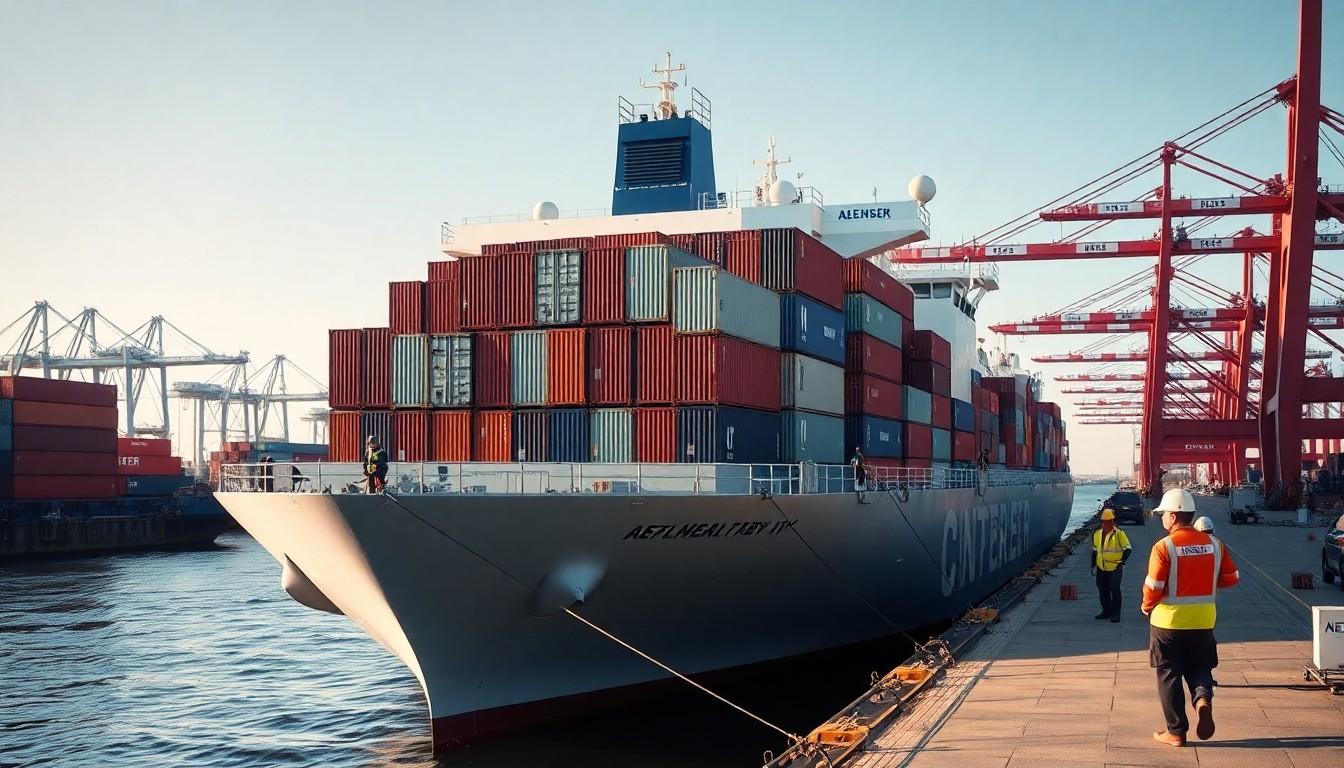
A 1,700 TEU vessel concept with a 151 MWh containerised battery system could bring fully electric propulsion closer to short-sea commercial shipping.
Hanwha Power has secured Approval in Principle from the American Bureau of Shipping for a 1,700 TEU battery-powered container ship design, a milestone that underscores growing confidence in fully electric propulsion for short-sea and regional trade. The concept centres on a 151 MWh energy storage system and relies on shore-based charging rather than conventional marine fuel, allowing the vessel to operate without direct emissions at sea, according to the company and ABS.
What sets the design apart is its use of containerised battery units, which can be handled much like standard cargo. Hanwha Power says that arrangement improves space efficiency on board and could make it easier to swap out power modules as operational needs change. In practice, that could give ship operators more flexibility than a fixed battery installation, while preserving cargo capacity and simplifying maintenance planning.
The approval, announced at the Maritime Hybrid, Electric and Hydrogen Fuel Cells conference in Bergen, Norway, marks an important step for Hanwha Power as it expands its marine electrification portfolio. Company vice-president Jong-kyu Hwang attended the ceremony alongside senior ABS representatives, according to the firm’s statement. For a shipbuilder and power systems specialist seeking a stronger foothold in zero-emission shipping, the endorsement from a major class society adds credibility to a design still at the concept stage.
Industry observers have increasingly pointed to short-sea shipping as one of the most plausible early markets for large-scale battery propulsion, because routes are comparatively short and charging can be concentrated at ports. Hanwha Power says the approved design is intended to support that segment, and the concept could offer a template for larger electric vessels if charging infrastructure and battery capacity continue to improve. For now, the project remains a design approval rather than a built ship, but it signals that modular battery propulsion is moving from theory into classified maritime engineering.
Source Reference Map
Inspired by headline at: [1]
Sources by paragraph:
– Paragraph 1: [2], [3]
– Paragraph 2: [2], [3], [6]
– Paragraph 3: [5], [6]
– Paragraph 4: [3], [4], [6]
Source: Noah Wire Services
Verification / Sources
- https://www.cleanthesky.com/innovation/batterypowered-container-ships – Please view link – unable to able to access data
- https://www.hanwha.com/newsroom/news/press-releases/hanwha-power-receives-abs-approval-in-principle-for-1700-teu-battery-powered-container-ship-design.do – Hanwha Power has received Approval in Principle (AiP) from the American Bureau of Shipping (ABS) for its design of a 1,700 TEU battery-powered container ship. The vessel features a fully electric propulsion system powered by a 151 MWh energy storage system, enabling operation without direct carbon emissions through port charging infrastructure. The use of containerized batteries enhances space efficiency and allows for flexible battery replacement, supporting the decarbonization of short-sea and regional container transport. This approval strengthens Hanwha Power’s capabilities in fully electric vessel design and expands its portfolio of marine propulsion solutions.
- https://www.engine.online/news/abs-approves-hanwha-powers-battery-powered-container-ship-design-832c – The American Bureau of Shipping (ABS) has approved the concept design of a 1,700 TEU fully electric container ship developed by Hanwha Power. The vessel is designed to run entirely on electricity supplied by a 151 megawatt-hour (MWh) battery energy storage system. Housed in containerized units, the batteries will provide the ship’s primary propulsion power, enabling zero direct carbon emissions during operation when supported by port-based charging infrastructure. The containerized battery system can be handled and stowed similarly to conventional cargo containers, helping to maximise onboard space and cargo capacity. It also allows for battery replacement and scalable operations, offering a potential pathway to decarbonising short-sea and regional container shipping, Hanwha Power said.
- https://www.mgn.com/news/hanwha-power-abs-approval-1700-teu-battery-container-ship – Hanwha Power has received Approval in Principle from the American Bureau of Shipping for a fully electric 1,700 TEU container ship design featuring approximately 151 MWh of onboard energy storage, marking a significant step forward in zero-emission short-sea shipping. The design centres on a fully electric propulsion system supported by an energy storage capacity of approximately 151 MWh — a substantial battery bank intended to provide the range and power output required for short-sea and feeder trade routes.
- https://www.prnewswire.com/news-releases/hanwha-power-receives-abs-approval-in-principle-for-1-700-teu-battery-powered-containership-design-302917532.html – Hanwha Power announced that it had received Approval in Principle (AiP) from the American Bureau of Shipping (ABS) for its design of a 1,700 TEU battery-powered containership. The certificate presentation ceremony took place on October 22, local time, at the MHE (Maritime Hybrid, Electric & Hydrogen Fuel Cells) Conference & Exhibition 2026 in Bergen, Norway. Jong-kyu Hwang, Vice President, Technology Solutions at Hanwha Power, attended the ceremony alongside senior representatives from ABS. The newly approved design concept features a fully electric container vessel powered by a large-scale 151 MWh Energy Storage System (ESS). Electrical energy stored in containerized battery units serves as the vessel’s primary propulsion source, enabling operation without direct carbon emissions through the use of port charging infrastructure.
- https://transportjournal.com/2026/10/23/hanwha-power-receives-approval-for-container-ship-design/ – Hanwha Power has received the basic approval for the design of a battery-powered container ship with a capacity of 1,700 TEU from the American Bureau of Shipping (ABS). This approval, known as Approval in Principle (AiP), was recently presented during the conference „Maritime Hybrid, Electric & Hydrogen Fuel Cells 2026“ in Bergen, Norway. Jong-kyu Hwang, Vice President of Technology Solutions at Hanwha Power, attended the ceremony held at the Scandic Bergen City. The approved design features a fully electric container ship powered by an energy storage system with a capacity of 151 MWh. The electrical energy stored in containerized battery units serves as the primary propulsion source of the ship. According to the manufacturer, this enables operation without direct CO₂ emissions, as the energy is provided through the charging infrastructure in the port. A characteristic of the design is the use of containerized batteries, which, according to Hanwha Power, can be handled like conventional cargo containers. This approach aims to improve space utilization and increase the ship’s loading capacity.
- https://www.recnews.it/2026/10/23/hanwha-power-receives-abs-approval-in-principle-for-1700-teu-battery-powered-containership-design/ – Hanwha Power announced that it had received Approval in Principle (AiP) from the American Bureau of Shipping (ABS) for its design of a 1,700 TEU battery-powered containership. The certificate presentation ceremony took place on October 22, local time, at the MHE (Maritime Hybrid, Electric & Hydrogen Fuel Cells) Conference & Exhibition 2026 in Bergen, Norway. Jong-kyu Hwang, Vice President, Technology Solutions at Hanwha Power, attended the ceremony alongside senior representatives from ABS. The newly approved design concept features a fully electric container vessel powered by a large-scale 151 MWh Energy Storage System (ESS). Electrical energy stored in containerized battery units serves as the vessel’s primary propulsion source, enabling operation without direct carbon emissions through the use of port charging infrastructure.
Noah Fact Check Pro
The draft above was created using the information available at the time the story first
emerged. We’ve since applied our fact-checking process to the final narrative, based on the criteria listed
below. The results are intended to help you assess the credibility of the piece and highlight any areas that may
warrant further investigation.
Freshness check
Score: 10
Notes: The article reports on Hanwha Power’s recent receipt of Approval in Principle (AiP) from the American Bureau of Shipping (ABS) for a 1,700 TEU battery-powered container ship design, announced on October 23, 2026. This is a recent development with no prior reports found, indicating high freshness. (hanwha.com)
Quotes check
Score: 10
Notes: The article includes direct quotes from Jong-kyu Hwang, Vice President of Technology Solutions at Hanwha Power, regarding the significance of the AiP. These quotes are consistent across multiple reputable sources, confirming their authenticity. (hanwha.com)
Source reliability
Score: 8
Notes: The primary source is Hanwha Power’s official press release, which is a direct communication from the company. While press releases are informative, they may present information in a favourable light. The article also references reputable industry publications such as MGN.com and Engine Online, which are known for their coverage of maritime industry news. (mgn.com)
Plausibility check
Score: 9
Notes: The concept of a fully electric container ship powered by a 151 MWh energy storage system is plausible and aligns with current trends in maritime electrification. The use of containerized battery units for propulsion is a novel approach that could enhance space efficiency and operational flexibility. However, the practical implementation of such technology on a large scale remains to be seen. (hanwha.com)