
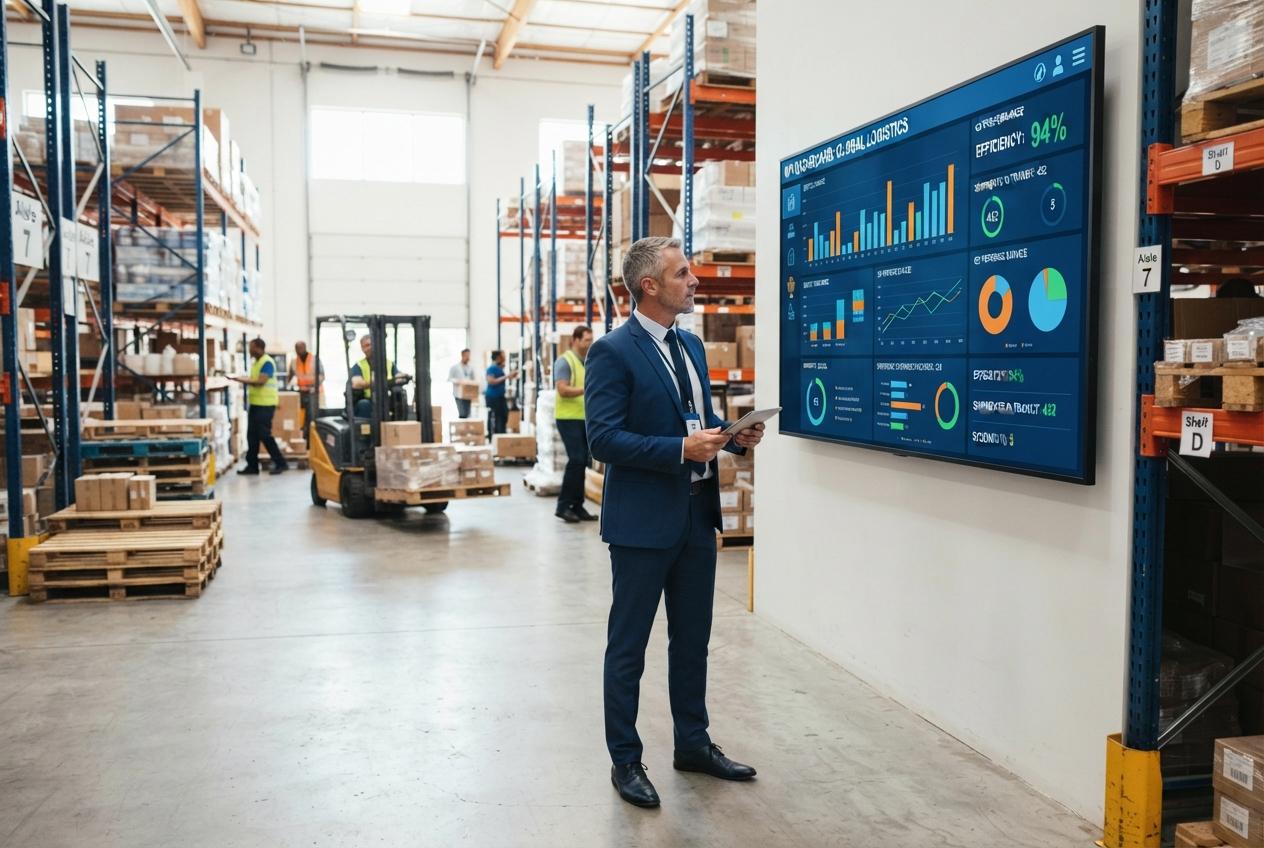
While AI adoption accelerates in logistics for efficiency and sustainability, industry experts warn that fragmented data remains a critical barrier. Achieving unified, real-time insights could unlock AI’s full potential in supply chain management.
Artificial intelligence is moving quickly from experiment to everyday tool across logistics and transport. The 2026 Annual Third-Party Logistics Study found that AI is now being used by 67 per cent of shippers and 73 per cent of third-party logistics providers, while the 2026 State of Sustainable Fleets market brief said 48 per cent of fleet practitioners and managers are already using it. The appeal is clear: under pressure from higher costs, tighter regulation and faster customer expectations, operators are looking for ways to sharpen planning, cut wasted mileage and make maintenance and routing more efficient.
Much of the enthusiasm also rests on sustainability. In the State of Sustainable Fleets brief, 61 per cent of fleet managers said they expect AI to support sustainability efforts, particularly through better route design and improved maintenance. Yet the technology’s promise depends heavily on the quality of the information behind it. PwC’s 2025 Digital Trends in Operations Survey found that 57 per cent of operations and supply chain leaders have introduced AI in at least some functions, but 92 per cent said their technology investments had not fully delivered the expected outcome, with integration complexity and data problems among the biggest obstacles.
That gap between ambition and results is central to the challenge facing supply chain leaders. According to PwC, fragmented data and poor availability remain major barriers to scaling AI in operations, while the separation of transport, warehouse and order management systems often leaves managers piecing together an incomplete picture. In practice, that can mean tracking loads manually, chasing inventory updates and spotting service issues only after the opportunity to act has passed. The article argues that the first step towards more effective AI is not another algorithm, but a cleaner, more connected data environment.
The solution, it suggests, is to bring disparate systems into a unified view so teams can see loads, orders, inventory and performance metrics in real time. Modern visibility and analytics platforms can connect ERP, WMS, TMS, planning tools and partner systems through APIs, EDI feeds, file transfers and scheduled pipelines, depending on how modern or fragmented the underlying architecture is. The hardest work is usually not the software itself, but normalising data and agreeing shared definitions across partners. Once that is done, supply chain teams can move from reacting to disruptions to managing them proactively, with customers and operators drawing from the same version of the truth.
Source Reference Map
Inspired by headline at: [1]
Sources by paragraph:
– Paragraph 1: [2]
– Paragraph 2: [2], [3]
– Paragraph 3: [2], [3], [4], [6]
– Paragraph 4: [1], [5], [7]
Source: Noah Wire Services
Verification / Sources
- https://www.thescxchange.com/tech-infrastructure/technology/to-unlock-ais-potential-to-reshape-supply-chains-start-by-integrating-your-data – Please view link – unable to able to access data
- https://www.pwc.com/us/en/services/consulting/supply-chain-operations/digital-supply-chain-survey.html – PwC’s 2025 Digital Trends in Operations Survey reveals that 57% of operations and supply chain leaders have integrated AI into selected functions or throughout their organisation. However, 92% of these leaders cited at least one reason why their technology investments haven’t fully delivered the expected results, with integration complexity (47%) and data issues (44%) being the most commonly cited challenges. This underscores the importance of addressing data integration and quality issues to fully realise the benefits of AI in supply chain operations.
- https://www.pwc.com/gx/en/issues/c-suite-insights/the-leadership-agenda/four-digital-priorities-for-coos.html – An article by PwC discusses the challenges Chief Operating Officers (COOs) face in leveraging digital technologies like AI to enhance supply chain operations. Despite 57% of operations and supply chain leaders integrating AI into their organisations, 92% reported that their technology investments haven’t fully delivered the expected results. The article highlights that integration complexity (47%) and data issues (44%) are the most commonly cited reasons for this shortfall, emphasising the need for effective data integration and management strategies.
- https://www.pwc.com/us/en/services/consulting/supply-chain-operations/procurement-sourcing/cost-of-delay-in-operations-supply-chains.html – PwC’s analysis of their 2025 Digital Trends in Operations Survey highlights the costs associated with delaying reinvention in operations and supply chains. The survey found that 91% of operations and supply chain leaders are significantly changing their supply chain strategies due to US trade policy changes. Additionally, 87% of respondents believe that geopolitical risks are driving them to adopt more flexible operations. This underscores the urgency for organisations to modernise their supply chain strategies to remain competitive.
- https://www.pwc.com/gx/en/1/services/consulting/technology/ai-operations.html – PwC’s article discusses how AI is revolutionising the manufacturing industry by improving productivity, reducing costs, and strengthening supply chains. It notes that leaders in industrial manufacturing, retail, and transport and logistics face pressure to scale AI quickly or risk weaker competitiveness and slower growth. The article suggests that companies can strengthen AI impact by building shared data platforms, central governance models, and responsible AI practices across their operations.
- https://www.pwc.com/us/en/services/consulting/supply-chain-operations/library/technology-investments-operations-supply-chain.html – Insights from PwC’s 2024 Digital Trends in Operations Survey reveal that 69% of operations executives and supply chain officers cited at least one reason why their technology investments didn’t fully deliver the expected results. The article discusses the gap between expected and actual outcomes of technology investments in operations and supply chains, highlighting the need for organisations to address integration complexity and data issues to achieve desired results.
- https://www.pwc.de/en/digitale-transformation/connected-and-autonomous-supply-chain-ecosystems-2025.html – PwC’s study on connected and autonomous supply chain ecosystems highlights that digital champions invested approximately 9% of their supply chain costs in advanced capabilities in 2019. These champions achieved cost savings of around 7% and increased revenues by about 8%. The study underscores the importance of digital transformation in supply chain management to enhance efficiency and competitiveness.
Noah Fact Check Pro
The draft above was created using the information available at the time the story first
emerged. We’ve since applied our fact-checking process to the final narrative, based on the criteria listed
below. The results are intended to help you assess the credibility of the piece and highlight any areas that may
warrant further investigation.
Freshness check
Score: 8
Notes: The article was published on July 20, 2026, making it current. However, the data cited from the 2026 Annual Third-Party Logistics Study and the 2026 State of Sustainable Fleets Market Brief are from earlier in the year, which may affect the freshness of the information presented.
Quotes check
Score: 7
Notes: The article includes specific statistics and percentages, such as ‘67% of shippers and 73% of third-party logistics providers’ using AI, and ‘48% of fleet practitioners and managers’ using AI. These figures are consistent with data from the 2026 State of Sustainable Fleets Market Brief. However, the exact wording of these statistics cannot be independently verified, as the original sources are not provided.
Source reliability
Score: 6
Notes: The article references reputable sources like the 2026 Annual Third-Party Logistics Study and the 2026 State of Sustainable Fleets Market Brief. However, without direct access to these reports, it’s challenging to fully assess their credibility. The article’s author, Vishwa Ram, is identified as the vice president of data science and analytics at Penske Logistics, which may introduce a potential conflict of interest.
Plausibility check
Score: 8
Notes: The claims about AI adoption rates in logistics and supply chain management are plausible and align with industry trends. However, the article’s emphasis on the importance of data integration for AI effectiveness is a common industry perspective and may not offer new insights.