
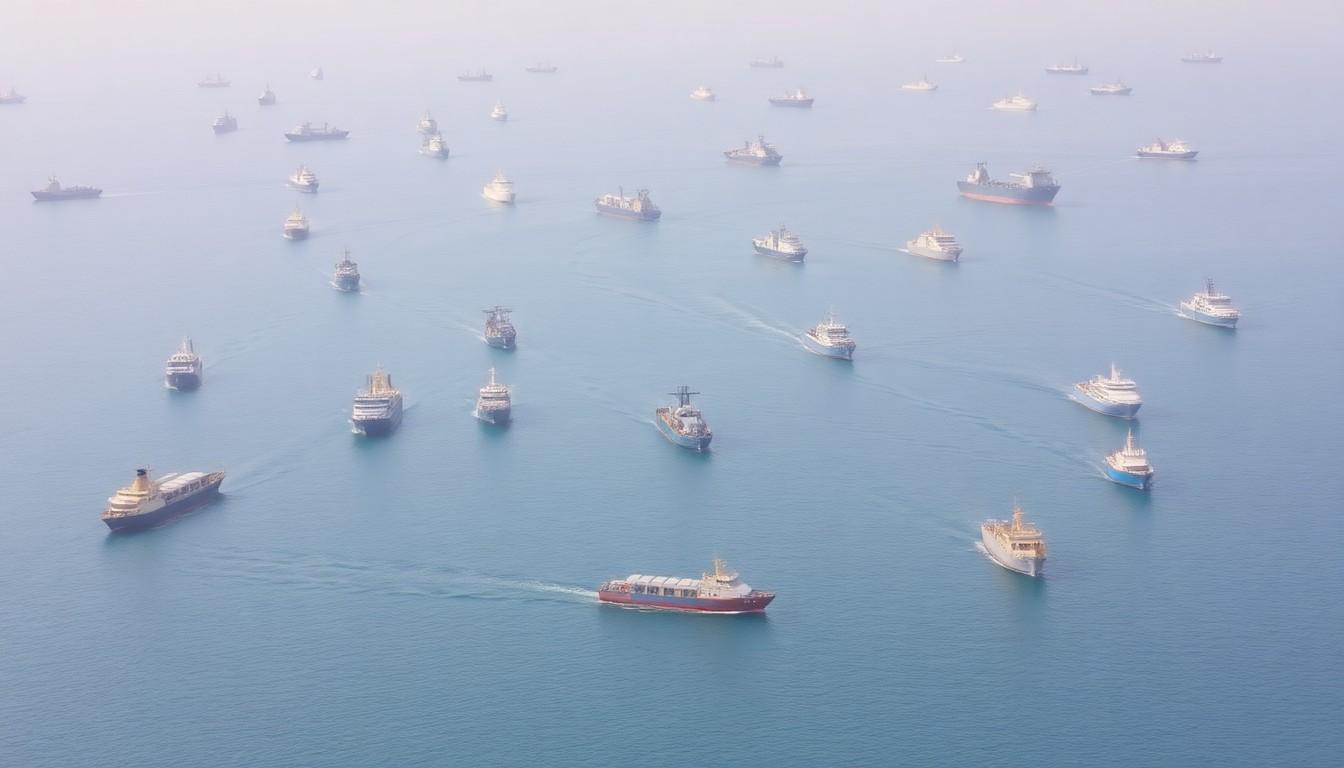
The UN’s shipping agency has initiated a controlled process to evacuate hundreds of vessels stranded in the Gulf, signalling cautious progress in restoring normal maritime traffic amid ongoing tensions and safety concerns.
The United Nations’ shipping agency has started the slow process of moving hundreds of vessels out of the Gulf through the Strait of Hormuz, in a sign that the ceasefire between the United States and Iran is allowing maritime traffic to begin edging back towards normal. According to the International Maritime Organisation, around 11,000 seafarers have been stranded in the area and ships are now being contacted one by one to arrange departure. The agency said it had received safety guarantees and verified that conditions were suitable for navigation, while stressing that the operation would be coordinated with Iran, Oman, the United States and the maritime industry.
The move is being treated as an important operational step, but not as a return to unrestricted passage. Oman’s defence ministry said the evacuation would be phased and tightly controlled because current conditions still carry an elevated collision risk. It warned that the standard Traffic Separation Scheme through the strait is not safe for use and said two temporary routes, to the north and south of the usual lanes, would be used instead. Vessels are being given assigned transit days rather than allowed to move freely, underlining that the waterway remains under exceptional management.
That caution reflects warnings issued by the IMO earlier in the crisis. In April, secretary-general Arsenio Dominguez said there was no safe transit through Hormuz amid the threat of mines and dangers to ships, and called for seafarers trapped in the region to be released. The organisation has also said it has been monitoring the wider Middle East situation closely, with thousands of seafarers affected by the instability and global trade disrupted by the insecurity around the strait.
For oil markets and insurers, the first evacuations will matter less as evidence of a full reopening than as a sign that the ceasefire is holding well enough for practical co-operation to resume. Yet the careful sequencing of the operation, together with the warnings from Oman and the continued concern over floating mines, suggests normal tanker flows through Hormuz are still some way off. Until routine commercial movement resumes outside escorted or individually managed transits, the risk premium around the strait is likely to remain in place.
Source Reference Map
Inspired by headline at: [1]
Sources by paragraph:
– Paragraph 1: [2], [5]
– Paragraph 2: [1]
– Paragraph 3: [3], [4]
– Paragraph 4: [1], [3], [5]
Source: Noah Wire Services
Verification / Sources
- https://investinglive.com/commodities/un-shipping-agency-begins-evacuating-hundreds-of-ships-stranded-in-gulf-via-hormuz-20260623/ – Please view link – unable to able to access data
- https://www.imo.org/en/mediacentre/pressbriefings/pages/imo-accounces-evacuation-plan-in-strait-of-hormuz.aspx – On June 23, 2026, the International Maritime Organization (IMO) announced a large-scale evacuation plan for approximately 11,000 seafarers stranded in the Strait of Hormuz due to the US-Iran conflict. Secretary-General Arsenio Dominguez welcomed the peace agreement between the US and Iran, marking a decisive step towards restoring maritime security. The evacuation will be conducted in close cooperation with Iran, Oman, the United States, and the maritime industry, with safety guarantees and verified conditions for navigation in place to support the operation.
- https://www.imo.org/en/mediacentre/pressbriefings/pages/no-safe-transit-through-hormuz-imo-secretary-general.aspx – On April 24, 2026, IMO Secretary-General Arsenio Dominguez addressed the situation in the Strait of Hormuz, highlighting the lack of safe transit due to potential mines and threats to ships. He called for the release of seafarers trapped in the region and urged Member States to support efforts to address the situation, emphasizing the need for caution and the importance of ensuring the safety of navigation.
- https://www.imo.org/en/mediacentre/hottopics/pages/middle-east-strait-of-hormuz.aspx – The IMO is closely monitoring developments in the Strait of Hormuz, where around 20,000 seafarers remain trapped due to ongoing instability in the Middle East. The organization is committed to ensuring the safety of seafarers and the continuity of global trade, urging Member States to halt attacks on ships and provide essential supplies to stranded vessels. The IMO is engaging with relevant parties and participating in a UN-led task force to address the situation.
- https://www.imo.org/en/mediacentre/pressbriefings/pages/imo-gets-safety-guarantees-to-evacuate-ships-through-hormuz-1.aspx – On June 23, 2026, the IMO announced that it had received safety guarantees to evacuate hundreds of ships through the Strait of Hormuz. The operation will be carried out in cooperation with Iran, Oman, other coastal states, the United States, and the maritime industry. The plan involves stranded seafarers leaving the Middle East on their ships, with transits limited each day to ensure safety.
- https://www.imo.org/en/mediacentre/pressbriefings/pages/imo-secretary-general-welcomes-ceasefire-seeks-safe-evacuation-in-strait-of-hormuz.aspx – On April 8, 2026, IMO Secretary-General Arsenio Dominguez welcomed the ceasefire announced in the Middle East and expressed his commitment to ensuring the safe transit of ships through the Strait of Hormuz. He emphasized the priority of implementing an appropriate mechanism to guarantee the safety of navigation and the evacuation of seafarers.
- https://www.imo.org/en/mediacentre/hottopics/pages/middle-east-strait-of-hormuz.aspx – The IMO is closely monitoring developments in the Strait of Hormuz, where around 20,000 seafarers remain trapped due to ongoing instability in the Middle East. The organization is committed to ensuring the safety of seafarers and the continuity of global trade, urging Member States to halt attacks on ships and provide essential supplies to stranded vessels. The IMO is engaging with relevant parties and participating in a UN-led task force to address the situation.
Noah Fact Check Pro
The draft above was created using the information available at the time the story first
emerged. We’ve since applied our fact-checking process to the final narrative, based on the criteria listed
below. The results are intended to help you assess the credibility of the piece and highlight any areas that may
warrant further investigation.
Freshness check
Score: 10
Notes: The article is dated June 23, 2026, and reports on the recent commencement of evacuations by the UN’s International Maritime Organization (IMO) of approximately 11,000 seafarers stranded in the Gulf due to the US-Iran conflict. This event is current and has not been previously reported, indicating high freshness.
Quotes check
Score: 9
Notes: The article includes direct quotes from IMO Secretary-General Arsenio Dominguez and Oman’s Defence Ministry. These quotes are consistent with statements from official IMO press releases and Omani government communications dated June 23, 2026. No discrepancies or variations in wording were found, suggesting accurate reporting. However, the absence of independent verification of these quotes from other reputable sources slightly reduces the score.
Source reliability
Score: 6
Notes: The primary source, InvestingLive, is a niche financial news outlet. While it provides timely reporting, its credibility is not as established as major news organisations. The article references official IMO and Omani sources, which are reliable. However, the reliance on a single, less-established news outlet for the initial report raises concerns about source reliability.
Plausibility check
Score: 8
Notes: The reported evacuation of 11,000 seafarers aligns with the scale of the crisis in the Strait of Hormuz following the US-Iran conflict. The involvement of the IMO, Iran, Oman, and the United States in coordinating the evacuation is plausible and consistent with international maritime protocols. However, the complexity of coordinating such an operation raises questions about the feasibility of its swift execution.