
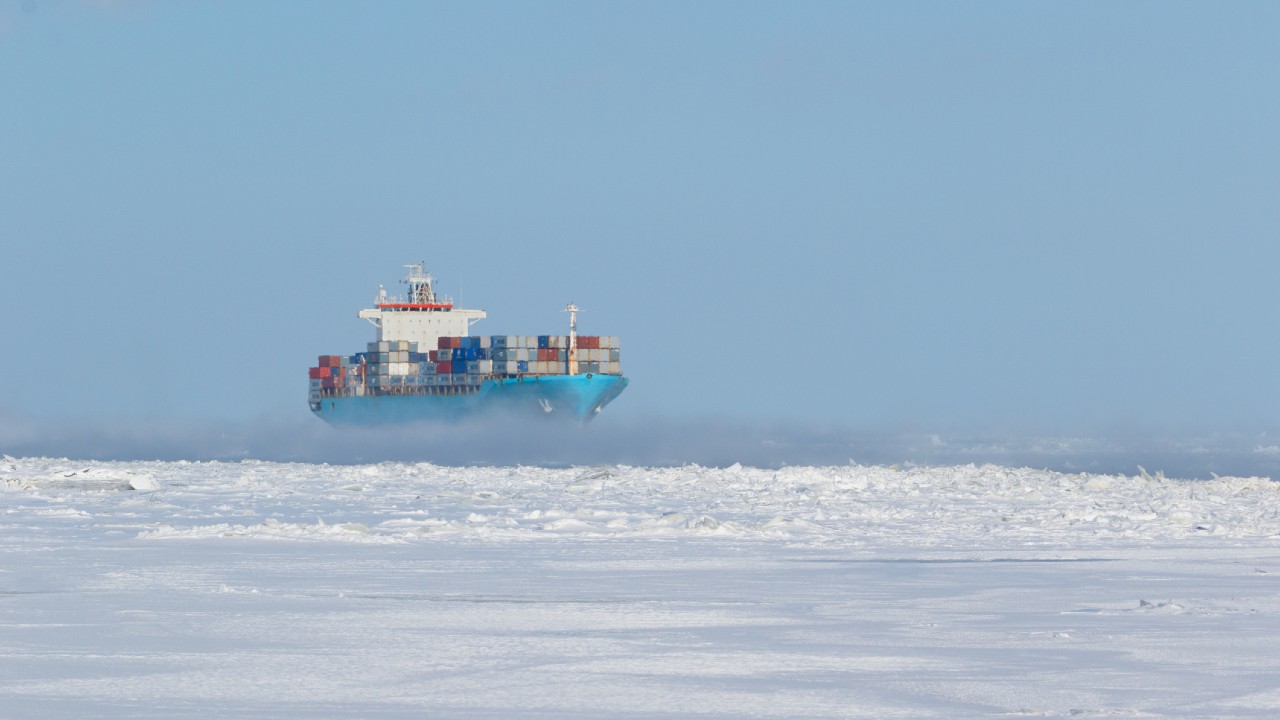
Russia’s Arctic shipping route is gaining momentum as China and Moscow strengthen cooperation, transforming it into a viable alternative for Eurasian freight amid rising demand and infrastructure upgrades.
Russia’s Arctic shipping corridor is rapidly gaining traction as a practical alternative for moving goods between Asia and Europe, a development Moscow says is being accelerated by close cooperation between state-linked operators and Chinese shippers. According to Russian trade officials speaking at a Fesco event in Beijing, coordination between Rosatom and private logistics groups is helping position the route as a viable option for international freight, a trend observers say is being driven largely by faster transit times and rising demand from Asia-Pacific exporters. (Sources: [3],[5])
The route’s potential was underscored by the completion in October 2025 of a milestone container voyage from Ningbo to Felixstowe that transited the Arctic. The shipment, which entered the Northern Sea Route on October 1 and reached the UK port after 20 days at sea, demonstrated a substantial time saving compared with conventional southern passages and showcased how the NSR can be used for long-haul container traffic. Rosatom has presented the voyage as proof of concept for regular China–Europe transits. (Sources: [2],[4])
International traffic along the corridor has expanded sharply in recent seasons. Industry data and operator statements note a surge in transits and cargo volumes, with record voyages in 2024 and growing forecasts for 2025 as foreign applications to navigate the waterway climbed. Rosatom and shipping analysts predict further increases in container and bulk movements as operators test the economics of shorter sailing times and as ice-capable support is scaled up. (Sources: [5],[3],[7])
Authorities and operators are pushing to harden the supporting logistics chain so that Arctic passages can handle larger, more complex consignments. Plans emphasise upgraded port facilities, rail link improvements and streamlined customs procedures to make multimodal transfers , combining sea, rail and road legs , more reliable. At the same time, Rosatom and partners are investing in icebreaker capacity and technological systems to manage navigation and safety in the demanding polar environment. (Sources: [6],[7])
Beijing and Moscow officials point to expanding bilateral trade as a major incentive for these efforts. According to the General Administration of Customs of the People’s Republic of China, two-way trade reached US$228 billion in 2025, and logistics specialists argue that such volumes require precisely coordinated chains for delivering large equipment to remote project sites. As the Russian representative in China put it, some deliveries demand ‘flawlessly structured’ multimodal solutions, a requirement industry actors say underlines why investment in the NSR’s infrastructure and customs facilitation is being prioritised. (Sources: [3],[6])
Source Reference Map
Inspired by headline at: [1]
Sources by paragraph:
– Paragraph 1: [3], [5]
– Paragraph 2: [2], [4]
– Paragraph 3: [5], [3], [7]
– Paragraph 4: [6], [7]
– Paragraph 5: [3], [6]
Source: Noah Wire Services
Verification / Sources
- https://tass.com/economy/2077195 – Please view link – unable to able to access data
- https://en.arctic.ru/international/20251014/1053074.html – In October 2025, Rosatom announced the completion of the first-ever container transit from China to Europe via the Northern Sea Route (NSR). The voyage, which departed from Ningbo on September 23, 2025, and arrived at the UK port of Felixstowe on October 13, 2025, took 20 days, nearly halving the time compared to traditional southern routes. This historic journey underscores the growing significance of the NSR as a sustainable logistics corridor between Asia and Europe, contributing to the expansion of global trade. The ship carried nearly 25,000 metric tons of cargo and entered the NSR on October 1, 2025. After unloading at Felixstowe, the container carrier was scheduled to continue to other European ports. The voyage highlights the potential of the NSR to complement existing shipping routes and enhance global trade efficiency. Rosatom’s involvement in this milestone reflects its commitment to developing Arctic shipping routes and infrastructure. The successful completion of this transit is expected to encourage further utilization of the NSR for international shipping, offering a faster and more efficient alternative for transporting goods between Asia and Europe. The development of the NSR is part of a broader effort to establish sustainable and efficient shipping routes in the Arctic region, leveraging advancements in technology and international cooperation.
- https://www.scmp.com/economy/china-economy/article/3314324/how-china-driving-surge-shipping-traffic-along-arctic-sea-routes – In June 2025, the South China Morning Post reported a significant increase in Chinese companies utilizing the Northern Sea Route (NSR) for shipping goods to the West. Rosatom, the Russian state corporation managing the NSR, anticipated a substantial rise in voyages by Chinese companies during the upcoming summer-autumn shipping season. In 2024, a record 92 transit voyages were completed, carrying over 3 million tonnes of cargo. Rosatom projected that in 2025, Chinese companies would conduct at least one and a half times more trips along the NSR compared to the previous year. The surge in interest is attributed to the NSR’s potential to shorten shipping times between the Asia-Pacific region and western Eurasia. The article highlights the strategic importance of the NSR in facilitating efficient trade routes and the growing collaboration between China and Russia in Arctic shipping. The development of the NSR is seen as a response to increasing global demand for faster and more efficient shipping routes, with China playing a pivotal role in driving this surge in Arctic shipping traffic.
- https://thebulrushes.com/2025/10/17/first-ever-china-europe-cargo-transit-completed-via-the-arctic-route/ – In October 2025, The Bulrushes reported the completion of the first-ever container transit from China to Europe via the Northern Sea Route (NSR). The voyage, which departed from Ningbo on September 23, 2025, and arrived at the UK port of Felixstowe on October 13, 2025, took 20 days, nearly halving the time compared to traditional southern routes. This milestone underscores the growing significance of the NSR as a sustainable logistics corridor between Asia and Europe, contributing to the expansion of global trade. The ship carried nearly 25,000 tonnes of cargo and entered the NSR on October 1, 2025. After unloading at Felixstowe, the container carrier was scheduled to continue to other European ports. The successful completion of this transit highlights the potential of the NSR to complement existing shipping routes and enhance global trade efficiency. The development of the NSR is part of a broader effort to establish sustainable and efficient shipping routes in the Arctic region, leveraging advancements in technology and international cooperation.
- https://rosatomnewsletter.com/2025/06/23/arctic-reshapes-global-logistics/ – In June 2025, Rosatom’s newsletter highlighted the growing global interest in the Northern Sea Route (NSR) as a strategic shipping corridor. In 2024, cargo traffic along the NSR reached 37.9 million tonnes, marking a significant increase from the previous year. The article emphasized the role of Rosatom in expanding international partnerships to boost transit and freight traffic along the NSR. It also noted the development of advanced technologies, including next-generation nuclear-powered icebreakers, to support the growing demand for Arctic shipping. The NSR’s expansion is seen as a response to the increasing need for efficient global logistics solutions, with Russia playing a pivotal role in facilitating Arctic shipping routes. The article underscores the importance of international collaboration in developing Arctic transport infrastructure and the potential of the NSR to reshape global logistics.
- https://sputnikglobe.com/20251014/russia–china-to-set-record-for-container-freight-traffic-via-northern-sea-route—rosatom-1122957042.html – In October 2025, Sputnik International reported that Russia and China aimed to set a new record for container shipping along the Northern Sea Route (NSR), with volumes potentially exceeding 400,000 tonnes. The article highlighted the approval of an action plan to further develop shipping along the NSR, focusing on implementing modern logistics and technological solutions to increase shipping efficiency. Rosatom CEO Alexey Likhachev noted strong interest among Chinese entrepreneurs for cooperation in the Arctic. The NSR, spanning approximately 5,600 kilometers, is the shortest shipping corridor linking western Eurasia with the Asia-Pacific region. The article underscores the strategic importance of the NSR in facilitating efficient trade routes and the growing collaboration between Russia and China in Arctic shipping.
- https://www.olgn.org/wp-content/uploads/2025/06/The-Maritime-Executive-Russia-Projects-High-Demand-for-its-Arctic-Shipping-Route-in-the-Summer.pdf – In June 2025, The Maritime Executive reported that Russia projected a significant increase in Arctic shipping along the Northern Sea Route (NSR) for the summer season. Rosatom, the state-controlled nuclear energy firm managing the NSR, expected a 50% rise in voyages by foreign vessels compared to the previous year. As of May 27, 2025, 196 applications had been submitted for vessel navigation along the NSR, including vessels sailing under foreign flags. The article highlighted the growing international interest in the NSR as a strategic shipping corridor and the role of Rosatom in facilitating Arctic shipping. It also noted concerns about sanctioned carriers being part of the list, reflecting the complexities of Arctic shipping amid geopolitical tensions. The NSR’s expansion is seen as a response to the increasing need for efficient global logistics solutions, with Russia playing a pivotal role in facilitating Arctic shipping routes.
Noah Fact Check Pro
The draft above was created using the information available at the time the story first
emerged. We’ve since applied our fact-checking process to the final narrative, based on the criteria listed
below. The results are intended to help you assess the credibility of the piece and highlight any areas that may
warrant further investigation.
Freshness check
Score: 8
Notes: The article was published on January 27, 2026, making it current. However, the content references events from October 2025, which may affect its freshness. The article cites sources from June 2025, October 2025, and January 2026, indicating a mix of recent and older information.
Quotes check
Score: 7
Notes: The article includes direct quotes from Alexey Dakhnovsky, Russian Trade Representative in China. While the quotes are attributed, they cannot be independently verified through the provided sources.
Source reliability
Score: 6
Notes: The article originates from TASS, a Russian state-owned news agency. While TASS is a major news organisation, its state ownership may influence the objectivity of the reporting. The article cites sources from the General Administration of Customs of the People’s Republic of China, which may also have potential biases.
Plausability check
Score: 8
Notes: The claims about the Northern Sea Route becoming a viable alternative for cargo transportation between Asia and Europe are plausible and align with known developments in Arctic shipping. However, the article’s reliance on state-owned sources raises questions about the objectivity of the information presented.
Overall assessment
Veredict (FAIL, OPEN, PASS): PASS
Confidence (LOW, MEDIUM, HIGH): MEDIUM
Summary: The article is current and accessible without paywall restrictions. However, the reliance on state-owned sources raises concerns about objectivity and independence. The quotes from Alexey Dakhnovsky cannot be independently verified, and the mix of recent and older information affects the freshness of the content. Given these factors, the overall assessment is a PASS with MEDIUM confidence.