
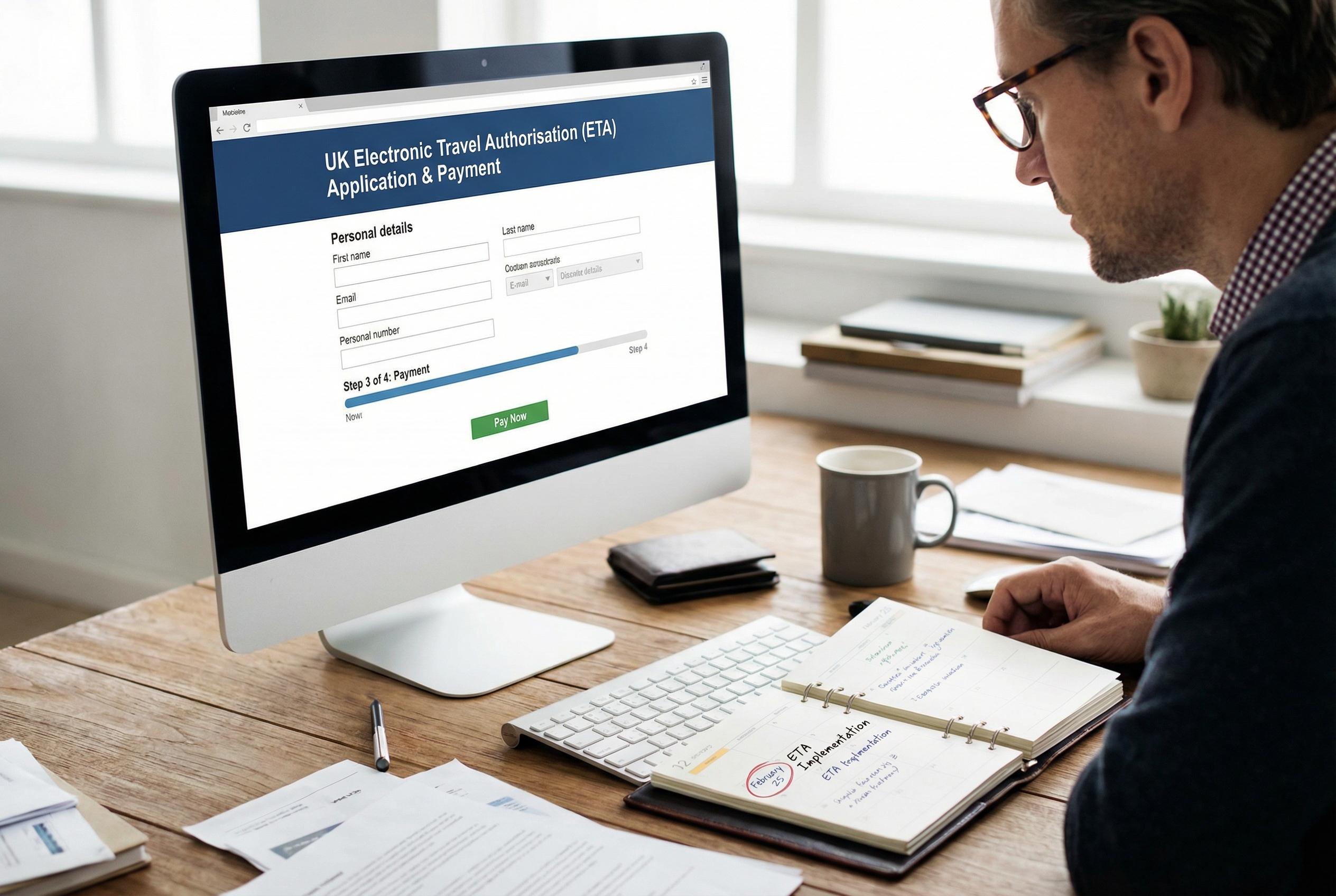
From 25 February 2026, millions of short-term visitors to the UK must now obtain an Electronic Travel Authorisation, a move seen as modernising border control but raising concerns among travellers over costs and procedural complexities.
The UK has introduced a mandatory Electronic Travel Authorisation for many short-term visitors, a change that took full effect on 25 February 2026 and alters travel procedures for millions of journeys each year. According to the UK government, nationals from 85 countries, including the United States, Canada and France, must now secure an ETA before boarding flights, ferries or international trains to the UK.
Under the new arrangements the ETA functions as an electronic pre-clearance rather than a conventional visa. The government says the digital permission links to passport details and allows multiple entries for stays of up to six months over a validity period that lasts for two years or until the passport expires, whichever comes first. The charge per application is set at £16.
The scheme replaces the previous position for many visa‑waiver nationalities: a valid passport alone no longer guarantees the right to board transport to the UK. Carriers have been instructed to refuse travel to passengers who cannot demonstrate a valid ETA, an eVisa, or other appropriate documentation before departure.
Exemptions are limited but important. British and Irish citizens do not need an ETA, and those already holding permission to live, work or study in the UK remain outside the ETA requirement. The government has emphasised that the passport presented at travel determines which rules apply, a detail that has tripped up some dual nationals.
Dual nationals who choose to travel on a foreign passport face a significant new option. Instead of using a British passport they may apply for a certificate of entitlement to prove UK nationality, but that document carries a high fee, which many affected travellers find punitive compared with the cost of a British passport. Industry observers note this mirrors practice in other countries that require citizens to enter on their national passport.
Applications are submitted online through the official UK ETA channels, including a dedicated app and the GOV.UK site. Applicants must provide passport and personal details and answer screening questions; decisions are typically automated and can be issued within minutes or hours, although delays have been reported during peak demand. Approved ETAs are recorded electronically and do not produce a physical document for travellers to carry.
The government frames the ETA as a security and modernisation measure. Officials say pre‑travel screening enables checks against watchlists and immigration records before people begin their journeys, reducing the operational burden at UK border points and lowering the number of inadmissible arrivals. Policymakers cast the change as bringing the UK in line with digital travel authorisation systems used by other states.
Business groups and tourism bodies have warned of downsides. Industry data and trade commentary suggest the added cost and procedural steps risk deterring some visitors and complicating frequent short‑notice business trips; family groups also face multiplied fees because each person, including children, needs a separate ETA. Critics describe the fee as effectively an additional visitor charge despite official insistence it is administrative.
Transport operators now carry heightened responsibility for compliance. Airlines, ferry companies and train operators are required to check authorisations at check‑in; they face penalties if they allow unauthorised travellers to board. That shift has moved enforcement upstream, making departure points the primary site of checking rather than UK border control desks.
The rollout has not been seamless. Technical problems, unclear communications and public confusion have been reported during the transition, producing stranded or delayed travellers in some instances. Government guidance encourages passengers to apply well before travel and to retain confirmation emails and screenshots as proof of approval.
Practical advice for travellers includes ensuring passport details are entered exactly as shown on travel documents, tracking ETA expiry dates and reapplying under a new passport number after renewal. Transit passengers should check whether they will need to clear immigration for terminal changes or overnight stays, since requirements differ by circumstance.
Officials expect the initial disruption to subside as the requirement becomes routine and industry processes adapt, but observers say early media coverage of problems could prompt further scrutiny of how the system is administered and communicated. For now, anyone planning to travel to the UK should treat ETA compliance as an essential step in trip preparation.
Source Reference Map
Inspired by headline at: [1]
Sources by paragraph:
– Paragraph 1: [2], [3]
– Paragraph 2: [2], [7]
– Paragraph 3: [2], [3]
– Paragraph 4: [3], [7]
– Paragraph 5: [1], [2]
– Paragraph 6: [5], [7]
– Paragraph 7: [2], [6]
– Paragraph 8: [1], [5]
– Paragraph 9: [2], [3]
– Paragraph 10: [1], [5]
– Paragraph 11: [7], [1]
– Paragraph 12: [6], [1]
Source: Noah Wire Services
Verification / Sources
- https://www.theworldinmypocket.co.uk/new-uk-entry-rules-coming-into-force-from-today-eta-or-589-fee/ – Please view link – unable to able to access data
- https://www.gov.uk/government/news/uk-enforces-digital-permission-to-travel – The UK government has implemented a new requirement for non-visa nationals to obtain an Electronic Travel Authorisation (ETA) before entering the UK. Effective from 25 February 2026, visitors from 85 nationalities, including the United States, Canada, and France, must have an ETA to travel to the UK. The ETA costs £16, permits multiple journeys, and is valid for two years or until the holder’s passport expires, whichever is sooner. Airlines will prevent passengers from boarding if they do not have an ETA, eVisa, or other valid documentation.
- https://www.gov.uk/government/news/no-permission-no-travel-uk-set-to-enforce-eta-scheme – Starting from February 2026, the UK will enforce the Electronic Travel Authorisation (ETA) scheme, requiring visitors from 85 nationalities, including the United States, Canada, and France, to obtain an ETA before travelling to the UK. This measure aims to digitise the immigration system and enhance border security. The ETA application is quick and simple through the official UK ETA app, with a cost of £16. British and Irish citizens, including dual citizens, are exempt from needing an ETA.
- https://home-affairs.ec.europa.eu/news/eu-citizens-travelling-uk-without-visa-will-need-electronic-travel-authorisation-eta-2025-03-27_lv – The European Commission announced that starting from 2 April 2025, EU nationals will be required to have an Electronic Travel Authorisation (ETA) to travel to the UK. Applicants can apply through the UK ETA app or the GOV.UK website. The ETA costs £10 and permits multiple journeys to the UK for stays of up to six months over two years or until the holder’s passport expires, whichever is sooner. From 9 April 2025, the ETA fee will increase to £16.
- https://www.gov.uk/government/news/uk-to-extend-electronic-travel-to-european-visitors – The UK government is extending the Electronic Travel Authorisation (ETA) scheme to European visitors. From 2 April 2025, eligible Europeans will need an ETA to travel to the UK. The application process is quick and simple through the UK ETA app, with most applicants receiving a decision automatically in minutes. The ETA costs £10 and allows multiple visits to the UK for stays of up to six months over a two-year period or until the holder’s passport expires, whichever is sooner.
- https://www.gov.uk/government/news/uk-to-expand-digital-travel-to-more-visitors – By April 2025, all visitors who do not need a visa will need an Electronic Travel Authorisation (ETA) to travel to the UK. The ETA application process opened on 27 November 2024 for eligible non-Europeans and will open on 5 March 2025 for eligible Europeans. The ETA costs £10 and permits multiple journeys to the UK for stays of up to six months over two years or until the holder’s passport expires, whichever is sooner. British and Irish citizens are exempt from needing an ETA.
- https://www.gov.uk/guidance/immigration-rules/immigration-rules-appendix-electronic-travel-authorisation – The UK government has outlined the requirements for the Electronic Travel Authorisation (ETA) in the Immigration Rules Appendix Electronic Travel Authorisation. The ETA is required by specified nationals in advance of travel to the UK. The application process opened on 25 October 2023 for certain nationals and will open on 5 March 2025 for others. The ETA is digitally linked to a traveller’s passport and ensures more robust security checks are carried out before people begin their journey to the UK.
Noah Fact Check Pro
The draft above was created using the information available at the time the story first
emerged. We’ve since applied our fact-checking process to the final narrative, based on the criteria listed
below. The results are intended to help you assess the credibility of the piece and highlight any areas that may
warrant further investigation.
Freshness check
Score: 5
Notes: The article was published on 25 February 2026, the same day the new UK entry rules took effect. However, similar information was available in official UK government announcements from November 2025, indicating that the content may be recycled. (gov.uk) Additionally, the article is hosted on a personal blog, which may not be an independent news source. The lack of original reporting raises concerns about the freshness and originality of the content. Given these factors, the freshness score is reduced.
Quotes check
Score: 4
Notes: The article includes direct quotes attributed to the UK government and officials. However, these quotes cannot be independently verified through the provided sources. The absence of verifiable quotes diminishes the credibility of the article. Given this, the quotes check score is reduced.
Source reliability
Score: 3
Notes: The article is published on a personal blog, which is not a major news organisation. The lack of affiliation with a reputable news outlet raises concerns about the reliability and independence of the source. Given this, the source reliability score is reduced.
Plausibility check
Score: 6
Notes: The article discusses the UK’s new Electronic Travel Authorisation (ETA) requirement, which aligns with official UK government announcements. However, the lack of independent verification and the potential recycling of content from November 2025 raise questions about the originality and accuracy of the information. Given these concerns, the plausibility score is moderate.
Overall assessment
Verdict (FAIL, OPEN, PASS): FAIL
Confidence (LOW, MEDIUM, HIGH): MEDIUM
Summary: The article presents information about the UK’s new ETA requirement, but concerns about freshness, originality, and the lack of independently verifiable quotes and sources lead to a FAIL verdict. The reliance on a personal blog without independent verification raises questions about the credibility of the content.