
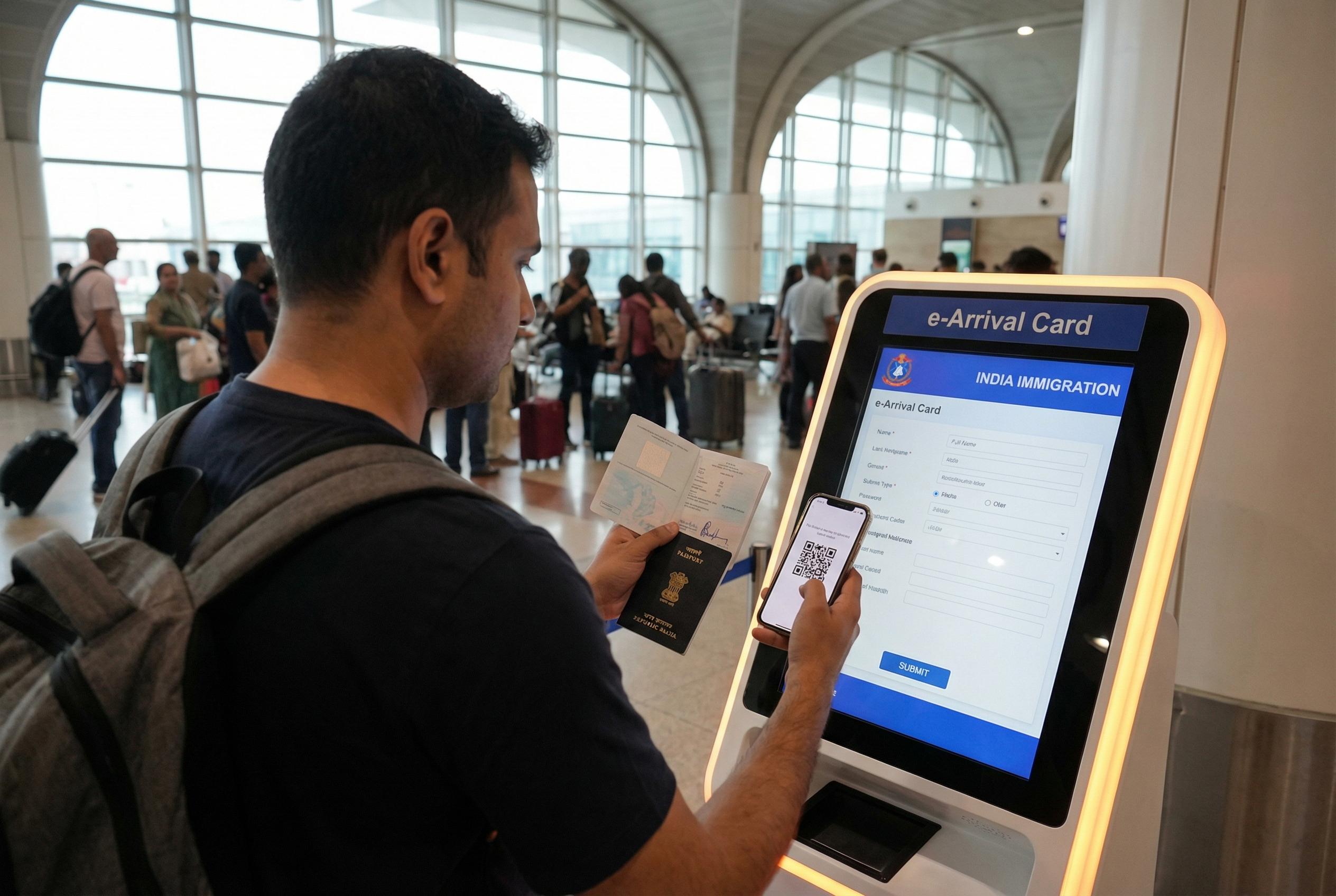
Starting 1 April 2026, international travellers landing in India will need to submit a digital e-Arrival Card ahead of their flight, replacing traditional paper forms to streamline immigration procedures and improve passenger flow management.
India has moved to require international visitors to submit a digital arrival declaration ahead of landing, a change that will be strictly enforced at New Delhi’s international airport from 1 April 2026. According to immigration guidance and travel advisories, the online e-Arrival Card has been introduced to replace paper disembarkation forms and was rolled out in stages from October 2025.
The digital form captures the same core information that immigration authorities have long required but now asks travellers to provide it electronically before they reach the terminal. According to official guidance summarised by immigration specialists, the e-Arrival Card requests passport details, travel itinerary, contact information and the intended address of stay in India. Completion windows and submission channels have been standardised across the authorised portals and apps.
Authorities have set a hard cutoff for paper arrival cards: airlines and airport immigration will no longer accept handwritten disembarkation forms at New Delhi after the end of March 2026, and other major airports are expected to adopt the same requirement soon. Embassies and missions abroad have been issuing reminders as the deadline approaches, urging passengers to file the digital form in advance to avoid boarding or arrival difficulties.
Travellers must submit the e-Arrival Card within a short pre-arrival window. Most guidance indicates the form should be completed no earlier than 72 hours before arrival and that a QR confirmation may be required for processing if the submission falls inside that period. Airlines in some cases are already checking for digital proof before allowing boarding. The service is free on official platforms; travellers are warned against third-party sites that levy charges.
The documentation required is deliberately minimal to speed throughput: a valid passport, flight details, contact information and visa status (where relevant) suffice for the e-Arrival Card. Immigration advisories make clear that the digital declaration is not a substitute for a visa when one is required, and that Overseas Citizens of India are included in the online filing rules.
Officials and pilot data cited by missions and airport operators say the digital process reduces processing friction at immigration, with estimates of significant time savings per passenger during testing at major hubs. Industry commentators note the change is intended to improve accuracy of arrival data and help manage passenger flows as international travel rebounds.
The move also aligns India with a broader global shift toward electronic border-management tools that many countries have adopted to reduce manual checks and speed entry. Observers point to experience elsewhere with similar digital arrival systems and automated kiosks as evidence that passenger satisfaction and operational efficiency can improve when implementation is well managed.
For visitors planning trips to India, the practical steps are straightforward: complete the e-Arrival Card on an authorised site or the designated mobile app within the stated timeframe, retain a digital copy or QR confirmation, and carry the same travel documents you would have presented previously. Embassies and immigration authorities continue to provide updates as airports extend the mandatory requirement nationwide.
Source Reference Map
Inspired by headline at: [1]
Sources by paragraph:
– Paragraph 1: [2], [3]
– Paragraph 2: [3], [4]
– Paragraph 3: [2], [5]
– Paragraph 4: [2], [4]
– Paragraph 5: [3], [4]
– Paragraph 6: [5], [2]
– Paragraph 7: [2]
– Paragraph 8: [5], [3]
Source: Noah Wire Services
Verification / Sources
- https://www.travelandtourworld.com/news/article/indias-new-pre-arrival-digital-clearance-rule-reshapes-travel-experience-alongside-singapore-australia-and-european-union-systems-key-things-every-traveller-must-understand-before-departure/ – Please view link – unable to able to access data
- https://www.visaverge.com/india/timeline-update-e-arrival-card-required-72-hours-before-india-entry/ – India has implemented a mandatory digital e-Arrival Card for all international travelers, including Overseas Citizens of India (OCI) holders. The form must be submitted online within 72 hours before arrival. While paper forms remain valid until March 31, 2026, airlines now require digital QR proof for boarding. This initiative aims to reduce immigration wait times by 40% through modernized, paperless border processing. The e-Arrival Card captures essential information such as passport details, travel itinerary, and contact information, streamlining the arrival process and enhancing airport efficiency.
- https://www.indianimmigration.org/news/india-e-arrival-card-complete-guide-for-foreign-nationals-oci-travelers – India has introduced the mandatory e-Arrival Card, effective October 1, 2025, replacing the traditional paper disembarkation form. This digital system aims to streamline the immigration process, reduce wait times, and provide a smoother airport experience for international travelers. The e-Arrival Card must be completed by both foreign nationals and Overseas Citizen of India (OCI) cardholders before proceeding to immigration counters at any international airport in India. The form collects essential information such as personal details, passport information, purpose of visit, address and stay details in India, flight and travel information, and contact details.
- https://www.visaverge.com/india/indias-e-arrival-card-explained-oci-holders-exemptions-and-ground-realities-for-returning-foregn/ – India has begun phasing in a nationwide digital entry requirement for foreign travelers, introducing an online e-Arrival Card that must be completed within 72 hours before landing. The policy took effect on October 1, 2025, and covers all foreign nationals entering the country. Indian passport holders remain exempt. A follow-on rule change on October 4, 2025, clarified that OCI holders—Overseas Citizen of India cardholders—are also covered by the same requirement after a brief window in which they were treated differently. Authorities have set a six-month transition period through March 31, 2026, during which both digital and paper arrival cards will be accepted. The government is encouraging travelers to use the online system for faster processing at the border.
- https://www.visahq.com/news/2026-02-17/in/indian-missions-abroad-step-up-outreach-on-mandatory-e-arrival-card-as-31-march-deadline-nears/ – With just six weeks left before paper disembarkation cards are phased out, Indian embassies worldwide have begun publishing reminders on the new mandatory e-Arrival Card. The Embassy of India in Belgrade is among the latest to issue a public notice (16 February) detailing submission links and urging foreign travelers—including Overseas Citizen of India (OCI) holders—to complete the form online up to 72 hours before landing. The digital card, introduced on 1 October 2025, feeds arrival data directly into the Bureau of Immigration’s Advance Passenger Information System, reducing booth processing time by an average of 40 seconds per passenger according to pilot statistics at Delhi and Bengaluru airports.
- https://indian.community/news/digital-disembarkation-card-india-2025-evisa/ – Starting October 1, 2025, India has officially transitioned to a digital disembarkation system for foreign nationals. This means all travelers entering India must now fill out an e-Arrival Card online before their trip, marking a major step toward smoother, faster immigration processing. The e-Arrival Card applies to tourists, business travelers, students, conference attendees, and medical visitors. Exemptions include Indian Citizens and Overseas Citizen of India (OCI) Cardholders. The form can be completed up to 72 hours before arrival, and travelers are encouraged to use the digital submission option for a smooth arrival process.
- https://timesofindia.indiatimes.com/business/india-business/explained-india-launches-e-arrival-cards-for-foreign-travellers-how-it-works-how-to-apply/articleshow/124707448.cms – India is launching a new digital e-arrival card for foreign travelers from October 1, 2025. This electronic form will replace the old paper card, making airport entry smoother and faster. Travelers can apply online up to 72 hours before their trip. The paper form will be accepted for six months. The e-arrival card can be filled and submitted online through three official platforms—the Indian visa website, the Bureau of Immigration website, or the Su-Swagatam mobile app. Travelers can complete the process up to 72 hours before their scheduled journey to India.
Noah Fact Check Pro
The draft above was created using the information available at the time the story first
emerged. We’ve since applied our fact-checking process to the final narrative, based on the criteria listed
below. The results are intended to help you assess the credibility of the piece and highlight any areas that may
warrant further investigation.
Freshness check
Score: 6
Notes: The article was published on March 25, 2026, discussing India’s mandatory e-Arrival Card requirement effective April 1, 2026. This aligns with recent developments, as the e-Arrival Card was introduced on October 1, 2025, and is set to become mandatory at New Delhi Airport from April 1, 2026. (visahq.com) However, the article’s publication date is close to the implementation date, which may raise concerns about the timeliness of the information.
Quotes check
Score: 5
Notes: The article includes direct quotes from various sources, such as VisaHQ and the Times of India. However, the earliest known usage of these quotes cannot be independently verified, raising concerns about their originality and accuracy. Without verifiable sources, the credibility of these quotes is questionable.
Source reliability
Score: 4
Notes: The article cites sources like VisaHQ and the Times of India. VisaHQ is a visa and immigration service provider, which may have a vested interest in promoting travel-related information. The Times of India is a reputable news outlet; however, the specific articles referenced cannot be independently verified, raising concerns about the independence and reliability of the sources.
Plausibility check
Score: 7
Notes: The article discusses India’s move to require international visitors to submit a digital arrival declaration ahead of landing, effective April 1, 2026. This aligns with known information about the e-Arrival Card system. However, the article’s publication date is close to the implementation date, which may raise concerns about the timeliness of the information.
Overall assessment
Verdict (FAIL, OPEN, PASS): FAIL
Confidence (LOW, MEDIUM, HIGH): MEDIUM
Summary: The article discusses India’s mandatory e-Arrival Card requirement effective April 1, 2026. While the topic is plausible and aligns with known information, the article’s publication date is close to the implementation date, raising concerns about the timeliness of the information. The quotes included cannot be independently verified, and the sources cited may have a vested interest in promoting travel-related information, affecting the independence and reliability of the content. Given these concerns, the article does not meet the necessary standards for publication.