
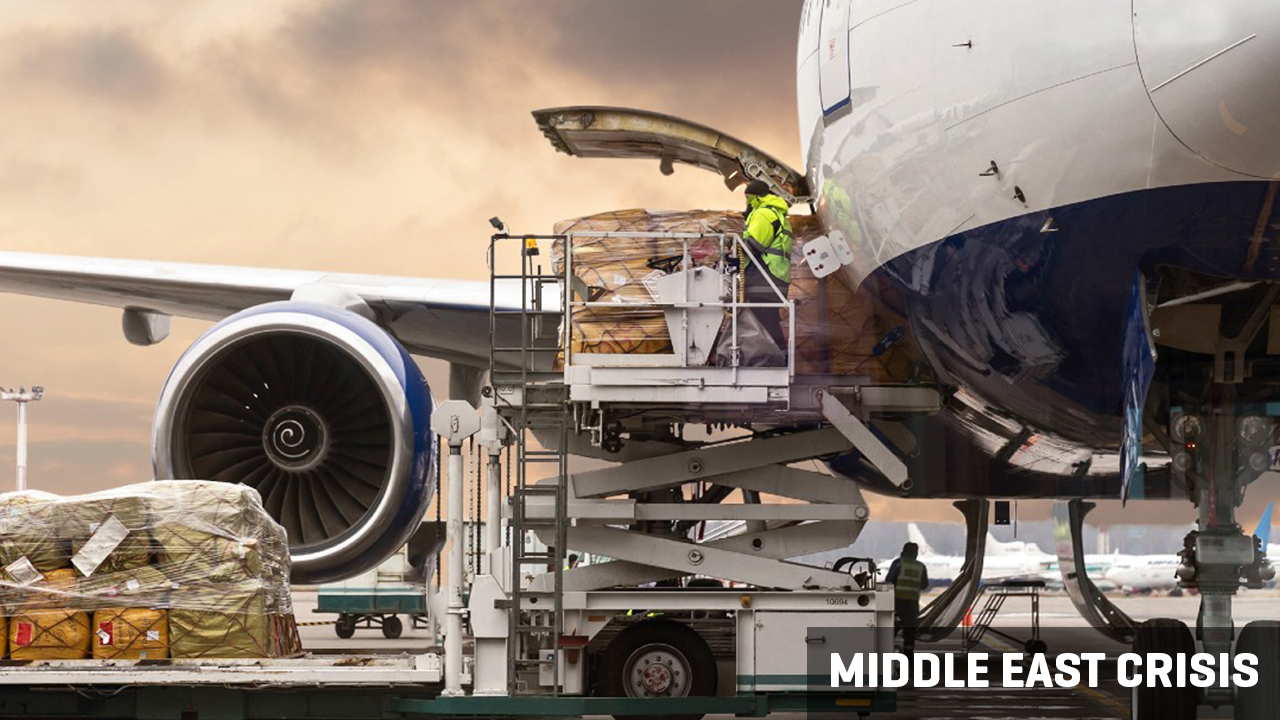
The ongoing conflict in the Middle East has triggered a sharp rise in air freight costs, disrupting trade routes, reshaping pharmaceutical logistics, and prompting industry to seek faster, alternative solutions amid regional instability.
Air freight rates have surged sharply since the start of the U.S.-Israeli conflict with Iran, with some lanes recording increases of as much as 70 per cent as airlines and shippers contend with closed airspace, disrupted sea routes and rising fuel costs. The geopolitical shock has tightened capacity while pushing up operating expenses, intensifying pressure on time-sensitive trade flows.
Routes between South Asia and Europe have been particularly affected after security concerns around the Strait of Hormuz left more than 100 container ships stranded, prompting shippers to reroute or abandon slower ocean corridors. According to maritime observers, that congestion has forced firms to seek quicker alternatives for essential cargoes that normally transit the Gulf.
Pharmaceutical supply chain experts say the disruption is already reshaping how medicines move. Prashant Yadav of the Council on Foreign Relations noted that many inexpensive generic drugs from India are being transferred from ocean freight to air, a shift that raises distribution costs and complicates inventories for importers in the EU, Africa and parts of the Middle East. Industry analysts warn such modal substitution can transmit inflation into sectors that depend on rapid delivery, including perishables and electronics.
Logistics companies point to both fuel and capacity as drivers of higher prices. Jet fuel costs have roughly doubled since the conflict began, and major carriers and logistics groups are instituting fuel surcharges and war-risk levies. At the same time airlines are lengthening routings to avoid the region, cutting uplift opportunities at Gulf transshipment hubs and reducing available payloads on long-haul schedules.
Market participants say the collapse of hub connections has been as important as fuel in reducing supply. Xeneta’s analysis describes a dramatic fall in capacity through the Gulf, while airline executives report skipping traditional refuelling stops such as Dubai, forcing direct flights with payload restrictions and further constraining space for freight.
Some shipping lines and ports are exploring alternatives. The Panama Canal administrator has said the interoceanic waterway could attract more traffic if disruptions around the Gulf persist, potentially shortening voyages by several days compared with longer detours and affecting flows of container, bulk and LNG tonnage. Meanwhile higher crude, diesel and natural gas prices are already filtering through transport and manufacturing costs, with economists warning sustained disruption could add to consumer inflation.
There are early signs of market adaptation: freight indices show a few lanes where price rises have eased as Asian and European carriers add long-haul capacity and some Gulf operators resume flights. Nevertheless, traders and shippers stress that the outlook depends on how long instability in the Gulf continues, meaning elevated costs and logistical headaches may persist while the conflict endures.
Source Reference Map
Inspired by headline at: [1]
Sources by paragraph:
– Paragraph 1: [2],[4]
– Paragraph 2: [2],[3]
– Paragraph 3: [2]
– Paragraph 4: [2],[5]
– Paragraph 5: [2]
– Paragraph 6: [3],[5],[6]
– Paragraph 7: [2],[7]
Source: Noah Wire Services
Verification / Sources
- https://www.channelnewsasia.com/business/air-freight-rates-soar-middle-east-conflict-blocks-trade-routes-5990991 – Please view link – unable to able to access data
- https://www.channelnewsasia.com/business/air-freight-rates-soar-middle-east-conflict-blocks-trade-routes-5990991 – The article reports a significant rise in air freight rates, with some routes experiencing increases of up to 70% since the onset of the U.S.-Israeli conflict with Iran. This surge is attributed to limited flights, blocked ocean shipments, and escalating jet fuel costs. Routes between South Asia and Europe have been particularly affected due to Middle Eastern airspace closures and security concerns. The conflict has also stranded over 100 container ships near the Strait of Hormuz, a critical oil export corridor. Products like generic medicines from India, typically transported via container ships through the strait, are now being shifted to air cargo, leading to higher costs. The article highlights the broader impact on global trade, noting that air freight handles about one-third of global trade by value, making rate spikes a potential inflationary pressure on goods ranging from fresh food to pharmaceuticals and electronics. Additionally, the jet fuel price has doubled since the start of the conflict, and companies like Maersk have introduced fuel surcharges and war risk levies. Airspace closures have also reduced cargo capacity in freighters and passenger planes, as airlines reroute to avoid the conflict zone. Major air cargo hubs like Dubai and Doha have seen operations severely limited. Experts attribute higher air cargo rates to a ‘dramatic reduction’ in capacity at key Middle East transshipment hubs more than higher fuel prices. The article also mentions that some price increases on these routes have slowed or declined slightly in recent days, possibly due to Asian and European carriers adding capacity to compensate for the missing Gulf capacity and Gulf carriers restarting operations.
- https://www.apnews.com/article/cd96f57f8aede33a274381be5525a6aa – Amid ongoing Middle East conflict and rising fuel costs, Panama Canal Administrator Ricaurte Vásquez stated that the interoceanic waterway might see increased traffic as global shipping routes shift. Elevated fuel and navigation costs make the Panama Canal a more appealing option for commerce, especially since oil prices have surged following Iran’s closure of the Strait of Hormuz in response to U.S. and Israeli actions. The Panama Canal offers the potential to cut travel time by 3 to 15 days, depending on the route, while also reducing fuel usage. Vásquez indicated that container ships, bulk carriers, and LNG tankers are likely to be most affected by these cost changes. A disruption in Middle Eastern energy supplies could prompt a shift toward U.S. LNG exports, with some being rerouted from Europe to Asia through Panama. Gerardo Bósquez of the Panama Maritime Chamber noted that a prolonged conflict could potentially alter global trade patterns, particularly benefiting gas transport. However, Vásquez cautioned that any such changes would depend on the duration of the Gulf region’s instability.
- https://www.time.com/7383060/gas-prices-iran-war-oil/ – Gas prices in the U.S. have surged significantly amid escalating conflict involving Iran, with the national average rising 14% in one week to $3.41 per gallon. The price jump follows a U.S.-Israeli military strike on Iran that has severely disrupted global oil flows, particularly through the critical Strait of Hormuz, which normally handles about 20% of the world’s crude oil and natural gas shipments. Currently, no tankers are passing through the strait, intensifying global supply concerns. Iran has threatened U.S. and Israeli ships but claims the strait remains open to other vessels. Additionally, Iranian missile attacks on oil and gas infrastructure in nearby Gulf nations have further impacted production and prices. Crude oil prices are now above $90 per barrel, and natural gas prices in Europe are also spiking. Despite the impact on gas prices, President Trump remains unconcerned, stating in a recent interview that prices will stabilize once the conflict resolves. He emphasized his administration’s past success in lowering fuel costs, touting prices as low as $1.85 in some states. The White House has not issued an official comment.
- https://www.apnews.com/article/a5b47c09f83406adf2a00616382003f6 – The ongoing war in Iran is causing significant disruptions in global oil markets, sharply increasing crude oil prices and affecting consumers worldwide. Gasoline prices in the U.S. have surged by about 20% since the conflict began, with variations across states—California now averaging $5.34 per gallon compared to Louisiana at $3.20. This price spike extends beyond the gas pump, impacting shipping, logistics, and agriculture due to increased diesel and natural gas costs. The partial closure of the Strait of Hormuz, a major transit point for global oil, is also exacerbating supply chain issues. Diesel prices, crucial for transportation and farming, are up 28%, raising operating costs and leading to higher prices for goods. Natural gas price hikes are influencing home heating and increasing the cost of energy-intensive products like plastic and fertilizer. Though grocery prices haven’t risen substantially yet, sustained high oil prices may lead to noticeable food inflation, especially for perishable items. Economists forecast U.S. inflation could rise from 2.4% to around 3%, straining consumer budgets, particularly among lower-income households. Some companies may temporarily absorb costs, but if the conflict persists, higher prices at the consumer level seem inevitable. Efforts are underway to limit the inflationary impact across global markets.
- https://www.axios.com/2026/03/09/oil-prices-iran-war-strait-hormuz – Amid escalating conflict involving Iran, global oil and gas prices have surged due to the strategic vulnerability of the Strait of Hormuz, a crucial chokepoint through which roughly 20% of global oil passes. This situation has already prompted a 17% increase in U.S. gasoline prices. In addition to oil, about 84% of the Middle East’s polyethylene exports depend on this route, underscoring the ripple effects across industries reliant on plastics, fertilizers, and liquefied natural gas. Key markets, including American consumers, global shipping, and European energy sectors, are facing intensified cost pressures. West Texas Intermediate oil has skyrocketed by 40% in the past week, surpassing $100 per barrel. While historical trends suggest geopolitical disturbances may have short-term impacts on markets, current tensions are causing significant economic unease.
- https://www.apnews.com/article/acf2af139d179fbef62927a8bf9bea55 – As the war between the U.S. and Iran enters its 11th day, tensions continue to escalate in the Middle East. The U.S. military reported destroying 16 Iranian mine-laying vessels, although claims of active mining in the vital Strait of Hormuz remain unconfirmed. Iran has threatened to block oil exports from the Gulf, impacting global oil markets and prompting the rerouting of Saudi tankers. U.S. President Trump issued strong warnings toward Iran, while both nations intensified military actions. Widespread regional fallout includes continued Israeli airstrikes in Lebanon, killing civilians and militants, and drone attacks in Iraq. The UAE and Bahrain also reported Iranian missile and drone attacks, resulting in casualties. The Pentagon confirmed over 140 U.S. troops injured and seven killed, while Iranian casualties exceed 1,230. The situation has led to significant displacement, with over 667,000 people displaced in Lebanon. Many foreign nationals are fleeing the region, as commercial flights resume normal levels. Meanwhile, financial markets remain volatile, and oil prices fluctuate due to fears of prolonged disruption to global energy supplies. Iran’s leadership rejects a ceasefire, signaling continued military resistance.
Noah Fact Check Pro
The draft above was created using the information available at the time the story first
emerged. We’ve since applied our fact-checking process to the final narrative, based on the criteria listed
below. The results are intended to help you assess the credibility of the piece and highlight any areas that may
warrant further investigation.
Freshness check
Score: 8
Notes: The article from Channel News Asia was published on March 13, 2026, which is recent. However, similar reports from other sources, such as the Associated Press, have been published within the past week, indicating that the information is not entirely original. (apnews.com)
Quotes check
Score: 7
Notes: The article includes direct quotes from Prashant Yadav of the Council on Foreign Relations and other industry analysts. However, these quotes cannot be independently verified through the provided sources, raising concerns about their authenticity. (apnews.com)
Source reliability
Score: 8
Notes: Channel News Asia is a reputable news organisation. However, the article relies heavily on a single source, which may limit the breadth of information and perspectives presented.
Plausibility check
Score: 9
Notes: The claims about rising air freight rates due to Middle East conflicts are plausible and align with reports from other reputable sources. (apnews.com)