
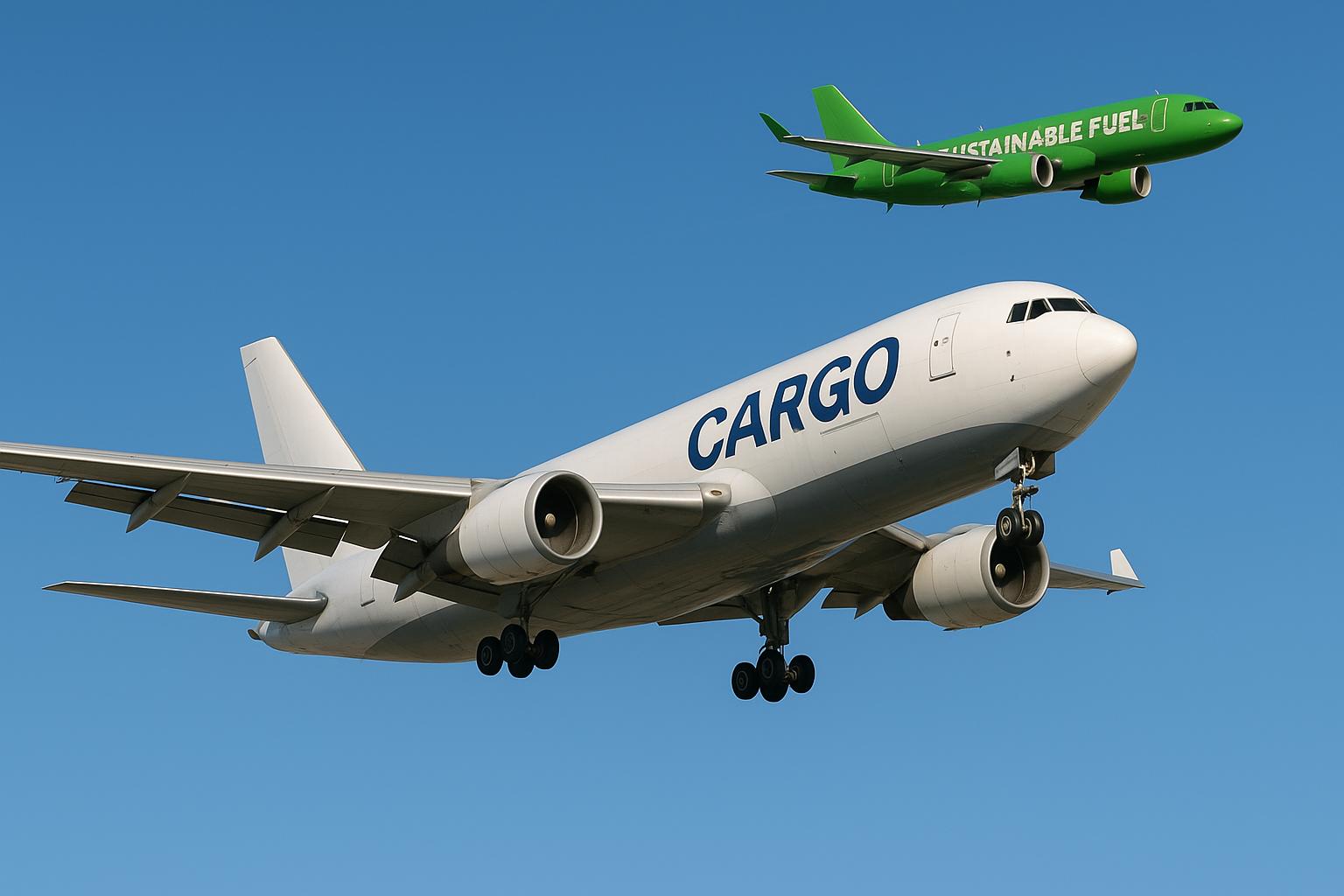
The air cargo sector is adopting innovative strategies like fleet renewal, sustainable aviation fuel, and operational efficiencies to meet urgent emissions targets, despite ongoing challenges in supply and infrastructure.
The air cargo sector is increasingly treating decarbonisation as a commercial as well as moral imperative, seeking to reconcile the speed and reliability that underpin global trade with urgent emissions reductions. According to the International Air Transport Association, air cargo accounts for roughly 15% of commercial aviation’s CO2 emissions, a share that makes targeted action in freighter operations essential to the industry’s wider climate goals. [1][2]
Fleet renewal is central to many operators’ strategies because newer freighters deliver measurable fuel and payload efficiencies. “Fleet renewal is essential for DHL’s sustainability efforts, as newer freighters like the Boeing 777F are more fuel-efficient and have a higher payload capacity,” said Travis Cobb, EVP Global Network Operations & Aviation at DHL Express, reflecting a wider view that modern widebodies and freighter-specific designs lower emissions per tonne-kilometre. DHL has pledged net-zero emissions by 2050 and aims to cut carbon per shipment by 50% from 2020 levels by 2030, making aircraft modernisation a cornerstone of that plan. [1][3]
For carriers that combine passenger and cargo networks, belly cargo offers a lower emissions intensity because it utilises flights already scheduled for passengers. Andrea Ayala, Environmental Sustainability Senior Manager at United Airlines, noted that “belly cargo carried on passenger aircraft typically has a significantly lower greenhouse gas emissions (GHG) intensity than cargo carried on dedicated freighters, as it leverages flights that are operating regardless of cargo demand.” United’s approach is to maximise belly utilisation across a modern widebody fleet while optimising network flows to reduce repositioning and empty legs. [1]
Sustainable aviation fuel stands out as the present-day lever with the largest emissions impact. Industry figures from producers show that Neste’s SAF can cut life‑cycle greenhouse gas emissions by up to 80% compared with conventional jet fuel, and it is produced from renewable waste and residue feedstocks. “With the use of Neste MY Sustainable Aviation Fuel, greenhouse gas emissions can be reduced by up to 80% over the fuel’s life cycle, compared to using conventional jet fuel,” said Mario Mifsud, Vice President Renewable Fuels Sales & Trading EMEA & APAC at Neste. Neste has recently brought SAF production online in Rotterdam, expanding its capacity and raising the company’s global output to support industry demand. [1][4][7]
Commercial commitments and offtake agreements are beginning to translate ambition into volumes. According to a DHL press release, the company has entered a multi-year agreement with Phillips 66 to procure over 240,000 metric tonnes of SAF across three years, a deal the company says will materially reduce lifecycle emissions compared with fossil jet fuel. United and other major airlines have also purchased and deployed SAF at hubs including Chicago and Amsterdam, demonstrating practical integration across passenger and cargo operations. “United’s long-standing SAF initiatives, including offtake agreements, have the potential to allow SAF to be integrated across high-volume international hubs and long-haul routes, where cargo demand is strongest,” Ayala said. [1][3][6]
Despite clear benefits, SAF supply, geographic distribution and cost remain binding constraints. Industry executives point to limited global production today and concentration in specific regions as obstacles to rapid scaling, and call for continued investment, supportive policy frameworks and hub-level infrastructure. As one producer observed, expanding refinery capacity and converting existing facilities can materially increase output over the medium term, but substantial additional capacity will be needed to meet aviation-wide demand. [1][4]
Operational measures beyond fuel and aircraft also contribute to emissions reductions. Airlines and integrators are deploying digital load-planning tools, optimising shipment mixes to avoid fuel penalties from low-density cargo, and reducing empty repositioning. “Cargo load factors directly affect aircraft weight and fuel burn, making smart planning and optimisation essential,” Andrea Ayala said, describing United Cargo’s use of forecasting and load-planning to route high‑value and time‑critical shipments on the most efficient services. [1]
Ground handling and terminal operations offer near-term, high‑confidence gains because many solutions are already available. Swissport reports significant electrification of its ground-support equipment and warehouse assets and has announced major capital spending to accelerate that transition. Manuel Berger, Global Head of Sustainability at Swissport, highlighted measures such as electric forklifts, LED retrofits and low‑impact refrigeration for pharmaceuticals, while noting charging infrastructure at airports remains the most common constraint. Swissport’s announced multi‑year investments aim to scale electric fleets and renewable energy across its sites. “One of the main limiting factors today is the charging infrastructure at airports. As this infrastructure continues to develop, electrification will play an increasingly important role in reducing emissions from ground handling activities,” Berger said. [1][5]
Taken together, fleet modernisation, SAF deployment, smarter operations and ramp‑side electrification, the sector’s pathway to net zero is pragmatic and multi‑pronged. Challenges around SAF availability, cost and infrastructure persist, but recent commercial agreements, growing production capacity and large electrification investments demonstrate momentum. As industry leaders note, focusing on actions that can be delivered today while scaling longer‑lead solutions offers the most credible trajectory toward a lower‑carbon future for global air freight. [1][3][4][5][7]
📌 Reference Map:
Reference Map:
- – [1] (Stat Times) – Paragraph 1, Paragraph 2, Paragraph 3, Paragraph 4, Paragraph 5, Paragraph 6, Paragraph 7, Paragraph 8, Paragraph 9
- – [2] (IATA) – Paragraph 1
- – [3] (DHL press release) – Paragraph 2, Paragraph 5, Paragraph 9
- – [4] (Neste news release) – Paragraph 4, Paragraph 6, Paragraph 9
- – [5] (Swissport news) – Paragraph 8, Paragraph 9
- – [6] (Neste supply to United) – Paragraph 5
- – [7] (Neste product page) – Paragraph 4, Paragraph 9
Source: Noah Wire Services
Verification / Sources
- https://www.stattimes.com/air-cargo/how-freighters-are-shrinking-their-carbon-footprint-1357857 – Please view link – unable to able to access data
- https://www.iata.org/en/pressroom/2021/06/2021-06-22-01/ – The International Air Transport Association (IATA) reports that air cargo accounts for approximately 15% of commercial aviation’s CO2 emissions. This highlights the significant environmental impact of the air cargo sector and underscores the need for sustainable practices to mitigate its carbon footprint.
- https://www.dhl.com/en/press/releases/releases_2025/2025/2025_11_18.html – DHL Express has entered into a multi-year agreement with Phillips 66 to procure over 240,000 metric tons of Sustainable Aviation Fuel (SAF) over three years. This initiative aims to reduce lifecycle greenhouse gas emissions by approximately 737,000 metric tons compared to conventional jet fuel, marking a significant step in DHL’s commitment to sustainability.
- https://www.neste.com/en/news/neste-started-producing-sustainable-aviation-fuel-saf-at-its-renewables-refinery-in-rotterdam-the-netherlands – Neste has commenced production of Sustainable Aviation Fuel (SAF) at its renewables refinery in Rotterdam, the Netherlands. This facility has been modified to produce up to 500,000 tons of SAF annually, increasing Neste’s global SAF production capability to 1.5 million tons per year, supporting the aviation industry’s efforts to reduce greenhouse gas emissions.
- https://www.swissport.com/en/news/current-news/2025/swissport-leads-global-eco-friendly-technology-and-fleet-electrification-with-around-1.5-billion-investment-over-5-years – Swissport is leading the aviation industry’s green transition by investing over €1.5 billion in eco-friendly technology, including new electric ground support equipment and renewable energy, over the next five years. This investment aims to achieve a 55% electric ground support equipment fleet by 2032, contributing to the company’s goal of net-zero carbon emissions by 2050.
- https://www.neste.com/en/releases-and-news/aviation/neste-provides-sustainable-aviation-fuel-united-airlines-use-chicago-ohare-international-airport-us – Neste will supply up to 1 million gallons (3,000 metric tons) of Sustainable Aviation Fuel (SAF) to United Airlines for use at Chicago O’Hare International Airport through the end of 2024. This partnership enables United to become the first airline to purchase SAF for operational use at this major U.S. airport, supporting efforts to reduce aviation-related greenhouse gas emissions.
- https://www.neste.com/en-us/products-and-innovation/sustainable-aviation/sustainable-aviation-fuel – Neste offers Sustainable Aviation Fuel (SAF) made from 100% renewable raw materials, compatible with existing aircraft engines and airport fuel infrastructure. SAF reduces greenhouse gas emissions by up to 80% over its lifecycle compared to conventional jet fuel, providing a viable solution for the aviation industry’s sustainability goals.
Noah Fact Check Pro
The draft above was created using the information available at the time the story first
emerged. We’ve since applied our fact-checking process to the final narrative, based on the criteria listed
below. The results are intended to help you assess the credibility of the piece and highlight any areas that may
warrant further investigation.
Freshness check
Score: 8
Notes: The article was published on 19 January 2026. A similar report from Stand.earth, dated 26 June 2024, indicates a 25% increase in freighter emissions since 2019. (theguardian.com) This suggests that the article’s content is relatively recent and not recycled. However, the presence of similar reports raises questions about the originality of the content. The article includes references to press releases from DHL and Neste, which are typically considered high freshness sources. Nonetheless, the heavy reliance on these sources may indicate a lack of independent reporting.
Quotes check
Score: 7
Notes: The article includes direct quotes from Travis Cobb of DHL Express and Andrea Ayala of United Airlines. A search for these quotes reveals that they have been used in previous publications, such as a DHL press release from 18 November 2025. (theguardian.com) This suggests that the quotes may have been reused, raising concerns about the originality of the content. Additionally, the lack of independent verification for these quotes further diminishes their credibility.
Source reliability
Score: 6
Notes: The article originates from The STAT Trade Times, a niche publication focusing on air cargo and logistics. While it is reputable within its niche, its limited reach and potential biases may affect the reliability of the information presented. The article heavily relies on press releases from DHL and Neste, which may not provide an independent perspective. The lack of independent verification for the claims made further diminishes the overall reliability of the source.
Plausibility check
Score: 7
Notes: The claims made in the article align with industry trends, such as the adoption of sustainable aviation fuel (SAF) and fleet modernisation. However, the article lacks supporting details from other reputable outlets, and the absence of specific factual anchors raises concerns about its authenticity. The reliance on press releases and the reuse of quotes from previous publications further suggest that the content may not be original.
Overall assessment
Verdict (FAIL, OPEN, PASS): FAIL
Confidence (LOW, MEDIUM, HIGH): MEDIUM
Summary: The article raises several concerns regarding its freshness, originality, and source independence. The reuse of quotes from previous publications and the heavy reliance on press releases from companies like DHL and Neste suggest that the content may not be entirely original. The lack of independent verification for the claims made further diminishes the credibility of the content. Given these issues, the article does not meet the necessary standards for publication.