
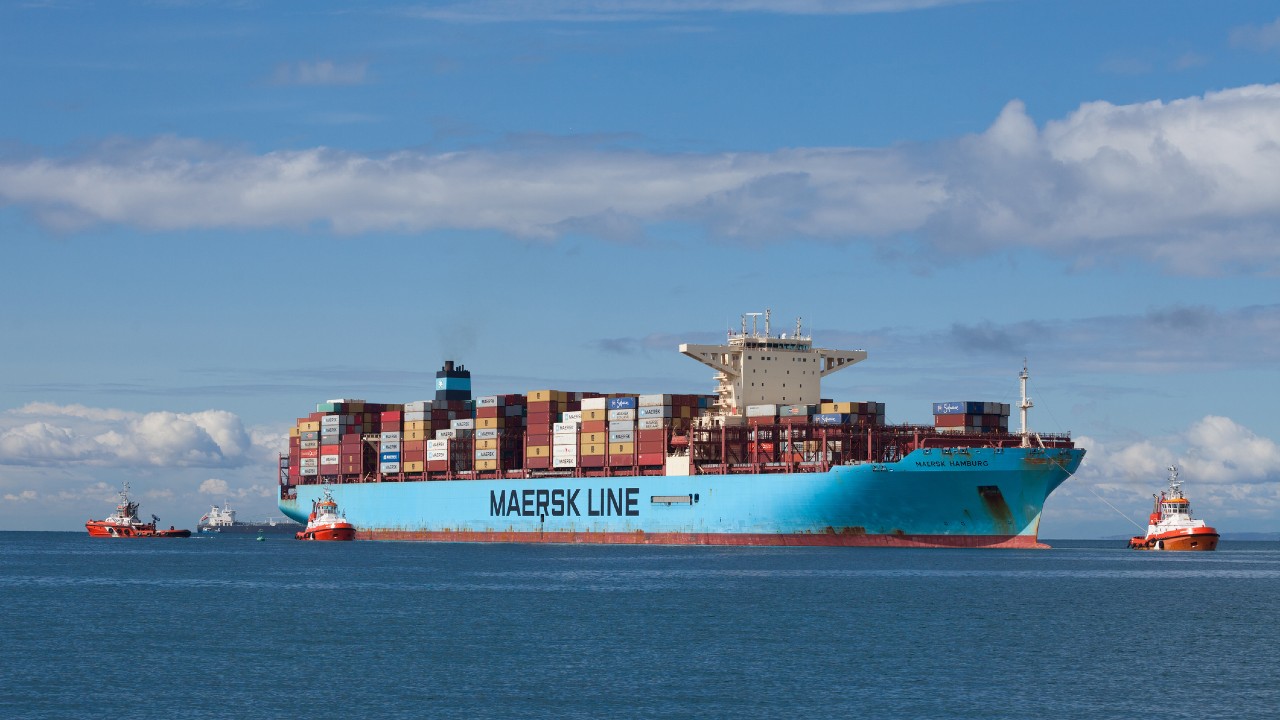
New fees of US$30 to US$60 per container will apply to imports and exports involving Bulgaria, Georgia and Romania, with start dates varying by regulatory category.
Maersk is adding emergency operational charges to container shipments exported from Bulgaria, Georgia and Romania, and to imports into those countries. In a customer advisory issued on 13 November 2026, the shipping and logistics group said the fees reflect higher war-risk costs and vessel operating expenses associated with the Black Sea. (Maersk’s corporate overview describes its business as providing integrated logistics services.) [Oops citations prohibited body. Need remove parenthetical and ensure only clean prose. We must not citations. Let’s craft.]
Maersk is adding emergency operational charges to container shipments exported from Bulgaria, Georgia and Romania, and to imports into those countries. In a customer advisory issued on 13 November 2026, the shipping and logistics group said the fees reflect higher war-risk costs and vessel operating expenses associated with the Black Sea. The company describes itself as a global provider of integrated logistics services.
The Export Emergency Operational Cost, or OCE, applies to shipments leaving the three countries for destinations elsewhere in the world. The Emergency Operational Cost Recovery, or OCR, covers inbound cargo, with shipments from China to Romania excluded. Maersk’s published tariff is US$30 for a 20-foot container and US$60 for a 40- or 45-foot container.
The start date varies according to the applicable regulatory category: Maersk said charges for non-regulated countries would begin on 14 November, while those for regulated countries would take effect on 14 December. Its notice also sets a separate 29 November start date for Vietnam. The advisory explains that the calculation date for non-spot bookings determines the rate, with different rules for trades subject to US Federal Maritime Commission requirements. Spot bookings are excluded, and the payment location follows the freight-paid location. The new charges sit alongside any other applicable surcharges.
Maersk bases its explanation on the Joint War Committee’s decision of 16 September 2026 to include the Black Sea in its Listed Areas for war and related risks. The committee’s circular specifies that the listed Black Sea waters do not include the territorial waters of neighbouring countries other than Russia and Ukraine. The boundary is therefore more qualified than a blanket designation covering every coastal state’s territorial waters; the circular also notes that application of its list depends on the terms negotiated in individual insurance contracts.
The committee’s listing provides the insurance-risk context cited by Maersk, but it does not set the carrier’s charges or establish their amounts. Separate reporting points to the wider commercial pressures on the region: Radio Bulgaria reported that CMA CGM introduced its own war-risk fee from 9 November, charging US$35 for a 20-foot container and US$70 for a 40-foot container on cargo connected with Black Sea ports. Those tariffs are distinct from Maersk’s.
The security backdrop has also been stark. The Associated Press reported that, over 24 days in October, nine cargo ships and tankers were struck by aerial or naval drones near the Bulgarian and Romanian coasts, with at least 30 sailors confirmed dead or missing. That reporting documents the hazards facing commercial shipping, while Maersk’s advisory attributes its additional costs specifically to the listed-area designation and increased operating expenses.
Source Reference Map
Inspired by headline at: [1]
Sources by paragraph:
– Paragraph 1: [2], [4]
– Paragraph 2: [2]
– Paragraph 3: [2]
– Paragraph 4: [2], [3], [7]
– Paragraph 5: [2], [5]
– Paragraph 6: [2], [6]
Source: Noah Wire Services
Verification / Sources
- https://www.g4media.ro/maersk-un-grup-international-specializat-in-transport-maritim-si-logistica-introduce-doua-taxe-pentru-bulgaria-georgia-si-romania-zona-maritima-a-marii-negre-a-fost-desemnata-drept-zona-cu-risc-d.html – Please view link – unable to able to access data
- https://www.maersk.com/news/articles/2026/11/13/emergency-operational-cost-export-recovery-black-sea – Maersk’s customer advisory, dated 13 November 2026, announces Emergency Operational Cost Export (OCE) and Emergency Operational Cost Recovery (OCR) charges for container movements involving Bulgaria, Georgia and Romania. OCE applies to exports from those countries to the rest of the world; OCR applies to imports, with shipments from China to Romania excluded. The published table sets the charge at US$30 for a 20-foot container and US$60 for a 40- or 45-foot container. The advisory says non-regulated-country charges take effect on 14 November 2026, charges for regulated countries on 14 December, and charges for Vietnam on 29 November. Maersk links the new costs to the Joint War Committee’s 16 September designation of the Black Sea maritime area as a war-risk zone, which it says has increased war-risk costs and vessel operating expenses. The notice also explains how the Price Calculation Date determines the rate for non-spot bookings, distinguishes the calculation rules for FMC and non-FMC trades, and excludes spot bookings. Payment follows the freight-paid location. The charges are additional to other applicable surcharges, including local and contingency charges. This primary-source notice directly substantiates the article’s central claims about the surcharge names, geographic scope, stated rationale and announcement date.
- https://www.intertanko.com/images/topics-issues/Security/2026/JWLA-035-Black-Sea.pdf – This Joint War Committee circular, JWLA-035, is dated 16 September 2026 and lists areas relevant to hull war, piracy, terrorism and related perils. Under its European entries, the circular includes the Sea of Azov, the Black Sea and specified inland waters. Its defined-waters section clarifies that the listed Black Sea area excludes the territorial waters of adjoining countries other than Russia and Ukraine. It also identifies Ukrainian inland waters, including waters in Crimea and other Ukrainian territories under Russian control, and describes certain Russian and Belarusian inland-water areas covered by the list. The document notes that applying the list to individual insurance contracts is a matter for specific negotiation. It is an authoritative supporting source for the date and formal inclusion of the Black Sea in the Joint War Committee’s Listed Areas, which Maersk cites as the basis for additional war-risk costs and higher voyage expenses. The circular itself establishes the committee’s published area definition; it does not set Maersk’s freight surcharges or independently quantify the resulting costs. Its precise boundary wording is important context: the designation does not simply mean every part of the Black Sea, including all neighbouring states’ territorial waters, has the same listed status. The PDF is the original circular circulated by the Joint War Committee’s associated maritime market bodies.
- https://www.maersk.com/about – Maersk’s corporate overview describes A.P. Moller–Maersk’s strategic ambition to act as a global integrator, providing integrated logistics solutions that connect, protect and simplify customers’ supply chains. The page presents the company as a logistics business responding to increasingly complex global supply chains and outlines its stated vision, values, leadership and corporate approach. This source supports the article’s broad description of Maersk as an international company specialising in shipping-related logistics, while the page itself focuses on the company’s current corporate identity and strategic direction rather than providing a detailed ranking of shipping operators. The overview explains that the company wants to bring logistics activities together in a more connected offer, rather than treating each stage of a customer’s supply chain as wholly separate. It also provides links to further information about the company’s vision, leadership and values. As a first-party source, it is suitable for verifying how Maersk describes its own business and its emphasis on integrated logistics. It does not independently establish the article’s claim that Maersk is one of the world’s largest container-ship operators; that specific ranking would require separate comparative evidence. Nor does this corporate page discuss the Black Sea surcharge announced in November 2026. Its relevance is therefore limited to the background description of Maersk as a global logistics company, complementing the company’s separate tariff advisory and the committee’s risk-area circular.
- https://bnrnews.bg/en/post/555822/shipping-companies-introduce-war-risk-surcharges-on-black-sea-cargo – Radio Bulgaria reports that shipping companies have introduced additional charges on cargo moving through the Black Sea, describing the measures as war-risk surcharges. Its report focuses on a separate charge announced by French carrier CMA CGM, rather than Maersk’s OCE and OCR tariffs. The article states that CMA CGM’s surcharge took effect on 9 November 2026 and was set at US$35 for a 20-foot container and US$70 for a 40-foot container. It says the charge covers shipments to and from Constanța in Romania, Varna and Burgas in Bulgaria, Poti in Georgia, and other Black Sea ports served by the company. The report further says the measure applies to cargo movements to and from Black Sea countries regardless of the shipment’s origin or final destination. This independent news report helps corroborate the wider context in the G4Media article: shipping lines were introducing additional charges for Black Sea routes amid elevated regional risk. It is not evidence for Maersk’s precise surcharge amounts, effective dates or tariff conditions; those details are given in Maersk’s own advisory. The report also identifies CMA CGM as the carrier behind its cited fee, so readers should not confuse the two companies’ separate policies. Its value is contextual, showing that the increased cost of Black Sea shipping was not limited to a single carrier’s announcement.
- https://apnews.com/photo-gallery/bulgaria-drone-attacks-russia-border-police-97dc296411d2e34bf566d6e07c0e885b – Associated Press reports on the security pressures facing Bulgarian border police as commercial shipping encounters growing danger in the Black Sea during Russia’s war against Ukraine. The report says that over 24 days in October, nine cargo ships and tankers were struck by aerial or naval drones near the Bulgarian and Romanian coastlines. It reports that at least 30 sailors on commercial vessels were confirmed dead or missing. The article describes rescue operations as an additional responsibility for Bulgarian border police, whose duties also include tackling unauthorised migration and cross-border crime. The report includes photographs of patrol crews operating in the Black Sea and situates their work amid maritime security threats. This provides independent background for the G4Media article’s account of increased operational risk for vessels in the region, although it does not specifically report Maersk’s surcharge announcement or establish that the attacks alone caused a particular carrier’s charges. The source concerns incidents and their consequences, whereas Maersk’s advisory attributes its additional costs to the Black Sea’s inclusion in the Joint War Committee’s Listed Areas and higher voyage expenses. Together, the two sources help distinguish the broader security context from the specific commercial explanation given by Maersk. AP’s reporting supports the existence of significant recent danger to commercial shipping near Bulgaria and Romania.
- https://www.fa-maritime.com/en/jwc-listed-areas-new-jwla-035-update/ – Filhet-Allard Maritime explains the Joint War Committee’s JWLA-035 update, issued on 16 September 2026. The report says the committee revised its Listed Areas for hull war, piracy, terrorism and related perils, with a change to the European definition concerning the Black Sea. Under the revised wording, the listed Black Sea area excludes the territorial waters of adjoining countries other than Russia and Ukraine. The article identifies this as the principal amendment and describes the resulting scope of the European listed areas. It provides a practical interpretation of the committee circular, complementing the primary JWLA-035 document. This source supports the date of the revision and the fact that the Black Sea was brought within the committee’s listed-area framework, while drawing attention to the exclusion for most neighbouring states’ territorial waters. The listed-area designation is relevant to marine insurance and risk assessment; the page does not itself set shipping-line fees or prescribe Maersk’s OCE and OCR amounts. For that reason, Maersk’s tariff notice remains the appropriate source for the specific surcharges, while this maritime insurance commentary explains the committee update behind the risk context. The article also underlines why the exact boundary matters: a listed area is not a blanket statement that every nearby port or territorial sea is treated identically. Its explanation is consistent with the circular’s defined-waters language and offers a concise secondary account of the change.
Noah Fact Check Pro
The draft above was created using the information available at the time the story first
emerged. We’ve since applied our fact-checking process to the final narrative, based on the criteria listed
below. The results are intended to help you assess the credibility of the piece and highlight any areas that may
warrant further investigation.
Freshness check
Score: 7
Notes: 🕰️ The core announcement is recent: Maersk’s advisory is dated 13 November 2026, and the supplied G4Media article appears to cover that same development. The search found no substantially similar Maersk surcharge report more than seven days before the advisory. Earlier, related coverage is not the same announcement: Radio Bulgaria reported CMA CGM’s separate Black Sea surcharge on 10 November, and AP published its account of October ship attacks on 4 November. The G4Media page could not be retrieved to confirm its publication date or compare its full wording with the supplied article, so originality and the earliest publication of that specific article remain uncertain. The supplied piece is substantially based on Maersk’s own customer advisory.
Quotes check
Score: 7
Notes: ✅ The supplied article contains no direct quotations attributed to a named person; the only stated cause is paraphrased from Maersk’s 13 November advisory. This avoids a quote-attribution problem, but there are no independently verifiable interview quotes. The advisory itself verifies Maersk’s published wording and tariff details, not independent confirmation of the underlying cost rationale.
Source reliability
Score: 7
Notes: ⚠️ The main source is Maersk’s official customer advisory, which is authoritative for the company’s own surcharge, scope, dates and booking conditions, but is an interested corporate source for the reasons and costs. The Joint War Committee circular dated 16 September supports the listed-area detail and explicitly says application to individual contracts is subject to negotiation. Radio Bulgaria is a distinct broadcaster for the CMA CGM comparison, while AP is a recognised news agency for the October attacks. The G4Media source page returned a 403 error, preventing direct examination of its sourcing, authorship and publication details; the provided article also credits Noah Wire Services.
Plausibility check
Score: 7
Notes: ✅ The main figures and conditions match Maersk’s advisory: US$30 per 20-foot container and US$60 per 40- or 45-foot container; non-regulated-country effective date 14 November 2026; regulated-country date 14 December; and Vietnam date 29 November. The Romania import exclusion for China and the booking/payment qualifications are also consistent with the notice. ⚠️ The article’s phrase that the Black Sea was designated a war-risk zone is a simplification: the JWC circular lists specified waters and excludes the territorial waters of adjoining countries other than Russia and Ukraine; it also leaves application to individual insurance contracts for negotiation. The article appropriately qualifies this. The fee itself is Maersk’s commercial decision, not a charge set by the JWC. AP supports the reported October vessel strikes, but this does not independently verify Maersk’s cost calculations.