
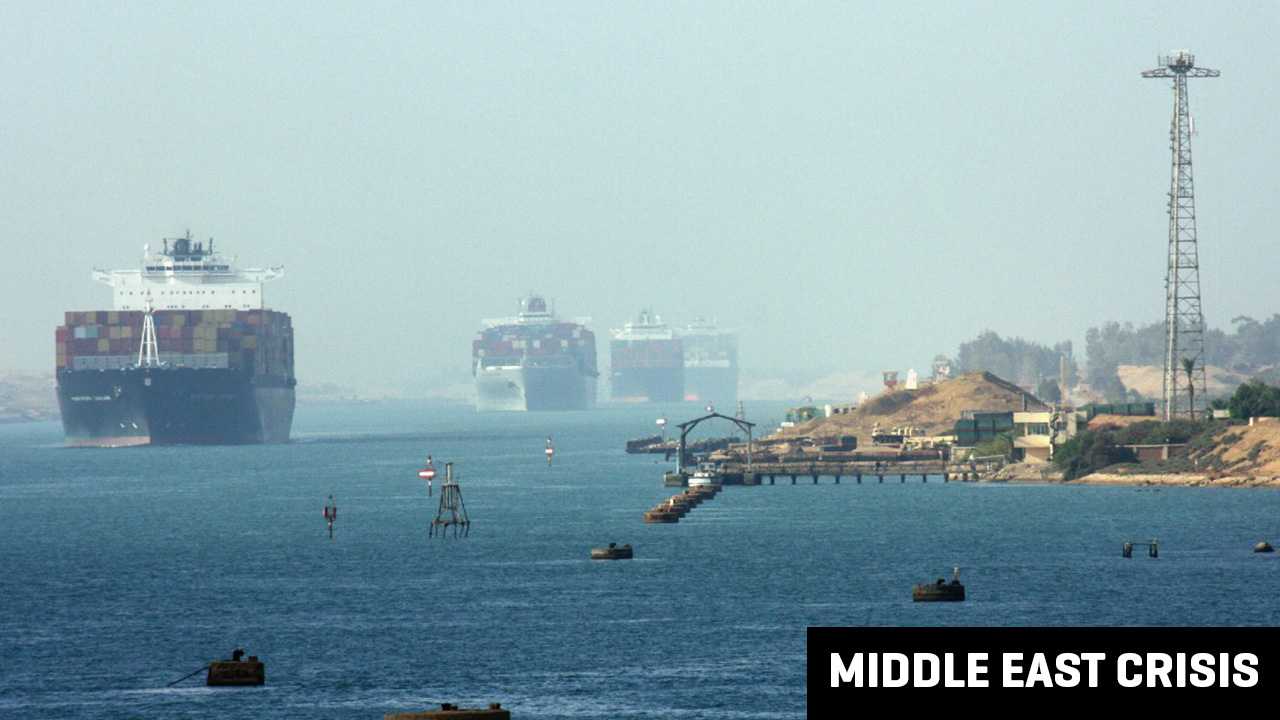
The carriers will switch their remaining Asia–Northern Europe routes from the Cape of Good Hope in a phased move, with the final service scheduled to change in January, subject to security conditions.
Maersk and Hapag-Lloyd plan to move their remaining three Asia–Northern Europe Gemini services back to the Suez Canal between December and January, completing the partnership’s shift away from Cape of Good Hope diversions on those routes.
The first change is scheduled for AE2, with the 18,300 teu Mary Maersk due to depart Ningbo on 4 December. AE3 is set to follow when the 16,300 teu Alette Maersk sails from Shanghai on 20 December. The final service, AE1, is due to switch with the departure of the 23,700 teu Damietta Express from Shanghai on 14 January 2027. Maersk’s customer advisory sets out the dates and says the revised routing is intended to improve transit times between Asia, Europe and the Middle East.
The services will use revised port sequences that include the Suez Canal on both the westbound and eastbound legs. AE2 will call at Rotterdam, Wilhelmshaven and Bremerhaven in Europe; AE3 includes London, Gothenburg, Aarhus, Rotterdam and Southampton; while AE1 is scheduled to serve Rotterdam, Hamburg, Antwerp and London. The announcement follows earlier changes to other Gemini services, and reflects a phased rather than simultaneous return across the network.
The broader shift is also visible in Hapag-Lloyd’s November investor presentation, which describes a gradual restoration of Red Sea routings and shows capacity moving away from Cape of Good Hope deployments during the second half of 2026. Earlier routing notices from Hapag-Lloyd likewise set out staged changes across other services, with implementation dates differing by route and direction.
Using the Suez Canal can shorten voyages compared with sailing around southern Africa, potentially reducing transit times and freeing ships that were tied up on longer rotations. But the return is not uniform across the industry: Kuehne+Nagel’s myKN coverage notes that carriers are changing routes at different speeds and advises customers to check the routing of individual shipments rather than assume that schedules have returned to normal.
Both carriers have made the changes conditional on their assessment of regional security. Maersk says it will continue monitoring conditions in the Middle East, with the safety of crews, vessels and cargo remaining a priority. The possibility of further disruption means the announced schedules may still be subject to change.
Source Reference Map
Inspired by headline at: [1]
Sources by paragraph:
– Paragraph 1: [2], [3]
– Paragraph 2: [2], [3]
– Paragraph 3: [5], [7]
– Paragraph 4: [3], [4]
– Paragraph 5: [2], [4]
Source: Noah Wire Services
Verification / Sources
- https://theloadstar.com/gemini-carriers-target-complete-return-to-suez-transits-by-mid-january/ – Please view link – unable to able to access data
- https://www.maersk.com/news/articles/2026/11/16/structural-changes-ae1-ae2-ae3-gemini-trans-suez – Maersk’s customer advisory, dated 16 November 2026, announces that the AE1, AE2 and AE3 services shared with Hapag-Lloyd will move from routing around the Cape of Good Hope to transiting the Suez Canal. It gives the revised port rotations and the first scheduled sailings. AE2’s rotation begins with Mary Maersk at Ningbo on 4 December; AE3 begins with Alette Maersk at Shanghai on 20 December; and AE1 begins with Damietta Express at Shanghai on 14 January. The advisory lists the ports on each loop, including Singapore and Tanjung Pelepas, and European calls such as Rotterdam, Hamburg, Antwerp and London. Maersk says the Suez route offers more efficient transit times between Asia, Europe and the Middle East. It also stresses that the timetable is conditional: the partners will continue to monitor security in the Middle East, and service changes depend on stability in the Red Sea. The safety of crews, vessels and cargo remains the stated priority. This is the primary source for the announced dates, vessel names, rotations and carriers’ explanation of the routing change. It does not report the article’s vessel-count reductions, schedule-reliability statistics, or freight-rate forecasts.
- https://gcaptain.com/maersk-hapag-lloyd-expand-suez-canal-return-with-three-more-gemini-services/ – This gCaptain report describes Maersk and Hapag-Lloyd’s decision to return three Gemini services to the Red Sea and Suez Canal instead of routing them around the Cape of Good Hope. It identifies the services as AE1, AE2 and AE3 and reports that their changes are scheduled between December 2026 and January 2027. The article gives the sequence: AE2 starts with Mary Maersk from Ningbo on 4 December, AE3 with Alette Maersk from Shanghai on 20 December, and AE1 with Damietta Express from Shanghai on 14 January 2027. It notes that the move follows earlier changes restoring other Gemini routes to the canal, including AE5, AE11, AE12 and ME2, and the return of ME1. The report explains that the Suez route is shorter than the Cape diversion, potentially reducing voyage duration and fuel use, and releasing ships previously occupied by longer voyages. It also cautions that the carriers’ plans depend on regional security and that the companies continue to monitor conditions in the Middle East. The report supports the article’s central account of the service changes and their potential network effects. It does not independently establish Xeneta’s schedule-reliability figures or forecasts for future freight rates.
- https://mykn.kuehne-nagel.com/news/article/more-container-services-return-to-the-suez – Kuehne+Nagel’s myKN article reviews a broader industry shift towards renewed Suez Canal use, covering developments involving Evergreen, Ocean Network Express, Maersk, Hapag-Lloyd and the Premier Alliance. Its Gemini section confirms that Maersk and Hapag-Lloyd are returning AE1, AE2 and AE3 to the canal, replacing the longer Cape of Good Hope route. The article situates the announcement within a wider, gradual recovery of Suez transits rather than describing a complete return by all carriers. It says customers should check the actual route for each shipment and reconsider lead-time assumptions because the transition is occurring at different speeds across services. Shorter rotations could reduce transit times and release vessel capacity into the network, while additional arrivals may shift congestion towards European gateways. The article warns that service predictability remains uncertain: routings differ by service, schedules may change at short notice, and reliability remains challenged. It also reports other carrier activity, including Evergreen’s planned individual transits and the ONE Continuity’s November 2026 crossing, while noting that further Premier Alliance returns were expected. This source supports the broader context and the practical caveat that a return to Suez does not mean every route has normalised. It does not provide the specific Gemini service vessel-count reductions or Xeneta’s rate predictions.
- https://www.hapag-lloyd.com/content/dam/website/downloads/pdf/HLAG_Investor_Presentation_9M_2026.pdf – Hapag-Lloyd’s November 2026 investor presentation includes a section titled “Gradual return to the Red Sea underway”. It describes service-network changes intended to reduce transit times, improve connectivity and strengthen reliability, while stating that the safety of colleagues, vessels and cargo remains the priority. A network graphic distinguishes Suez routings from Cape of Good Hope routings for Asia–Europe services, showing that the network’s return is gradual and does not mean every service has switched. The presentation also includes a chart of capacity deployed on East–West trades by route. The accompanying data representation shows Cape of Good Hope deployment rising sharply after the disruption beginning in 2024, then declining during the second half of 2026, while Red Sea and Gulf of Aden deployment rises. This supports the article’s broader account of a phased return and the changing distribution of shipping capacity. The document also presents Hapag-Lloyd’s wider operational and financial context, including schedule-reliability information and company results; those sections cover broader metrics and should not be treated as confirmation of the article’s particular Xeneta statistics. The investor presentation is an official company document, useful for corroborating that the return was underway and that routing decisions remained incremental. It does not itself list the three November-announced AE service start dates.
- https://arabfinance.com/en/news/newdetails/maersk-hapag-lloyd-to-reroute-3-gemini-services-to-suez-canal – Arab Finance reports that Maersk and Hapag-Lloyd will reroute three Gemini services through the Suez Canal rather than around the Cape of Good Hope. It identifies the services as AE1, AE2 and AE3 and gives each announced first sailing: Damietta Express on AE1 from Shanghai on 14 January, Mary Maersk on AE2 from Ningbo on 4 December, and Alette Maersk on AE3 from Shanghai on 20 December. The report outlines the revised port calls, including Suez, Singapore and European destinations such as Rotterdam, Hamburg, Antwerp, London, Wilhelmshaven and Southampton. It frames the changes as an effort to improve transit times between Asia, Europe and the Middle East. The article also places the news against earlier expectations that Maersk’s wider fleet would return to Suez by March 2027, and notes that Hapag-Lloyd anticipated additional services returning. This is a secondary news account that substantially corroborates the dates, vessels and service rotations stated in Maersk’s advisory. It supports the claims about the planned routing change, but not independent AIS observations, the reductions in ships assigned to individual strings, the Xeneta on-time performance figures, or Peter Sand’s freight-rate scenarios.
- https://www.hapag-lloyd.com/de/services-information/news/2026/09/routing-update-for-our-ne4–se1–se2-and-iex-services.headless.html – Hapag-Lloyd’s September 2026 routing notice provides context for the earlier phase of Gemini’s return to Red Sea routes. It says Maersk and Hapag-Lloyd decided, after assessing the security situation, to move the NE4, SE1, SE2 and IEX services from Cape of Good Hope diversions to Red Sea routing. The notice lists westbound implementation details for SE2, IEX and NE4, including vessels, voyage numbers, prior port calls and September departure dates. It also gives eastbound dates for NE4, SE2 and IEX, with the latest listed transition beginning from Port Tangier on 31 October. The notice says the first SE1 sailing would be communicated later. Hapag-Lloyd describes the Red Sea route as a more efficient connection supporting faster transport between Asia and Europe, but emphasises crew, vessel and cargo safety and says it would continue monitoring the situation. This official notice does not cover the later AE1, AE2 and AE3 schedule; rather, it supports the article’s account of a wider, gradual restoration of Suez routings across Gemini services and the carriers’ security caveat. The listed operational dates and routes show that service changes were staged over time and varied between directions and loops. It does not verify the article’s Xeneta schedule-reliability data, released-capacity estimate, or projected freight-rate effects.
Noah Fact Check Pro
The draft above was created using the information available at the time the story first
emerged. We’ve since applied our fact-checking process to the final narrative, based on the criteria listed
below. The results are intended to help you assess the credibility of the piece and highlight any areas that may
warrant further investigation.
Freshness check
Score: 8
Notes: ✅ The central announcement is supported by Maersk’s customer advisory dated 16 November 2026, which gives the three sailings and their dates. gCaptain published a substantially similar report on the same date, apparently based on that advisory, so the article is timely but not demonstrably first. (maersk.com) 🕰️ The wider expectation of a phased return, and earlier Gemini service changes, had been reported before; for example, The Loadstar reported other route changes on 14 September and further return-to-Suez developments on 28 September. Those are background, not evidence that this specific three-service announcement is recycled from more than seven days earlier. (theloadstar.com) The supplied article page could not be fetched, so its publication timestamp and whether it preceded or followed the 16 November reporting could not be confirmed. The specific port calls and dates are corroborated by the carrier advisory; ship capacities in the supplied text were not verified from the sources reviewed.
Quotes check
Score: 6
Notes: ✅ The article contains no direct quotations presented in quotation marks, so there are no attributed quotes whose earliest use or wording can be compared. Its statements about improved transit times and monitoring regional security closely paraphrase Maersk’s 16 November advisory. (maersk.com) ⚠️ As these are paraphrases of a company announcement, they verify what Maersk announced, not the independent accuracy of the carrier’s operational or commercial claims.
Source reliability
Score: 7
Notes: ✅ Maersk’s advisory is a primary source for the announced dates, vessel names and port rotations. Hapag-Lloyd’s official routing page independently confirms the same vessel/date sequence, though it uses different service labels. (maersk.com) gCaptain provides relevant specialist coverage, but its article explicitly relies on Maersk’s advisory for the timetable, so it is not independent corroboration of the announcement itself. (gcaptain.com) ⚠️ The Loadstar page returned a 403 error in this check; its publication details and exact text could not be inspected. The supplied source attribution to Noah Wire Services also leaves unclear who wrote or edited this particular text. No evidence found here establishes that the article is fabricated, but the lead article’s provenance could not be fully assessed.
Plausibility check
Score: 7
Notes: ✅ The announced dates and rotations broadly match Maersk’s advisory, and Hapag-Lloyd’s page lists the same vessels and dates. (maersk.com) ⚠️ There is a material naming difference: Maersk calls the services AE1, AE2 and AE3, while Hapag-Lloyd labels the corresponding services NE2, NE1 and NE3 respectively. The article reports Maersk’s AE labels without explaining the partner’s different naming, which could confuse readers but does not by itself invalidate the route changes. The article says Hapag-Lloyd’s November investor presentation “shows capacity moving away from Cape of Good Hope deployments during the second half of 2026”; the presentation does show a gradual Red Sea return, but the extracted text alone does not clearly establish that precise capacity trend. (hapag-lloyd.com) ⚠️ Claims that Suez can shorten voyages and free vessel capacity are plausible, but the article gives no route-specific quantified transit-time or capacity estimate. The proposed sailings are future schedules and remain conditional on security conditions, as the carriers themselves state. (maersk.com)