
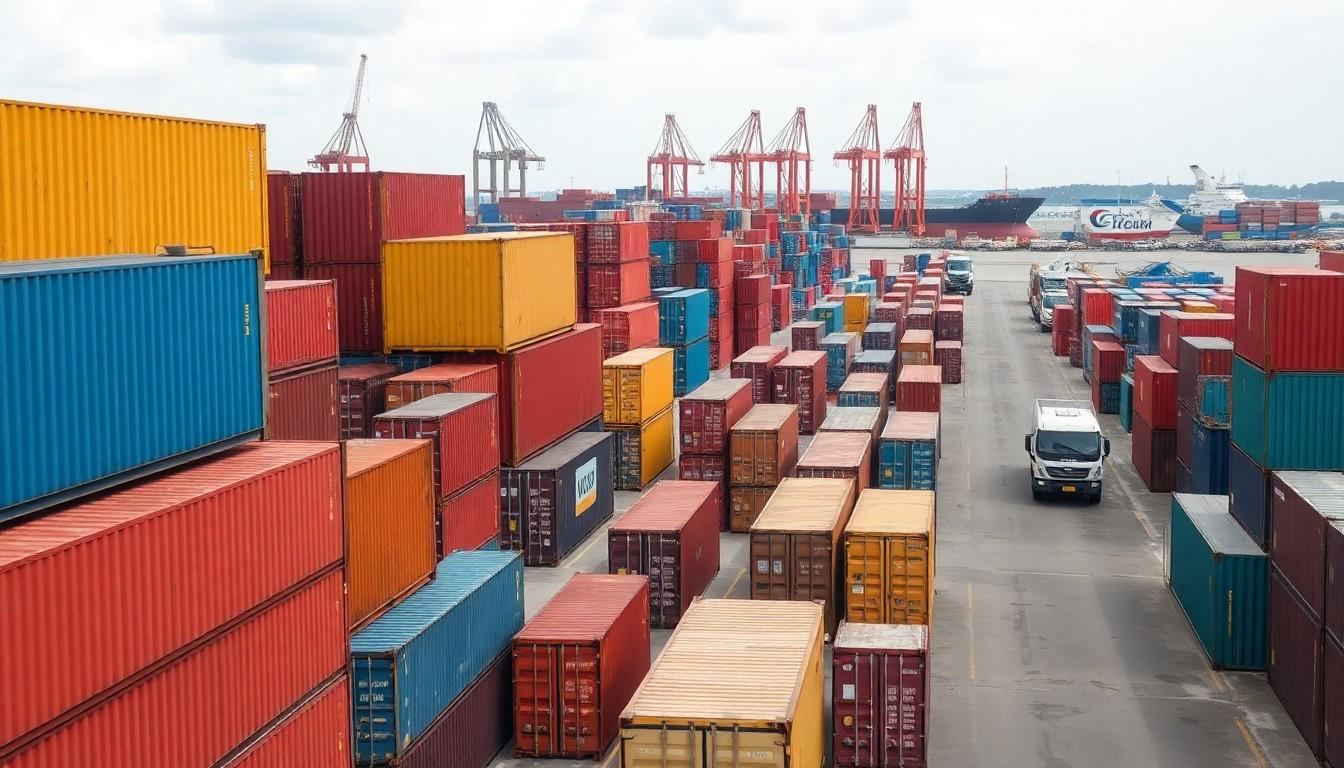
Hapag-Lloyd’s latest figures show import boxes spending more than four times as long at Abidjan’s terminal, while delays ease at Durban Pier 1 but persist elsewhere.
Container congestion across Africa remains uneven, with Abidjan facing a sharp rise in the time imported boxes spend at the terminal even as some delays ease at Durban’s Pier 1. Hapag-Lloyd’s operational update for 6 November puts Abidjan’s import-container dwell time at 22 days, up from five days in its previous report.
Ships with scheduled berthing windows are waiting three to four days, suggesting that the main holdup is now within the terminal rather than at the quay. Africa Ports & Ships reported the figures from the carrier’s bulletin, which cautions that they reflect conditions reported by Hapag-Lloyd rather than independently verified averages. [2]
South Africa’s picture is mixed. Delays at Durban Container Terminal Pier 1 have shortened to between six and nine days, compared with 10 to 12 days in the previous update. At Durban Gateway Terminal, the former Pier 2 facility, delays remain at 12 to 14 days.
Separate logistics reporting cited in the Africa Ports & Ships bulletin described a substantial vessel backlog at Durban, despite an increase in national container-terminal throughput during the week ending 1 November. That suggests better handling volumes have yet to deliver a broad reduction in congestion. [2]
Conditions elsewhere also vary. Cape Town’s container terminal is reporting delays of up to 72 hours, while its multi-purpose terminal is experiencing waits of up to 24 hours. Weather is affecting operations at Port Elizabeth and Ngqura, with reported delays of one to two days and two to three days respectively.
In East Africa, vessels are waiting for up to 48 hours at the two reported Dar es Salaam facilities; at Mombasa, waits reach three days on the EA2 service and six days or more on other services. [2]
In West Africa, the latest figures show berthing delays of six to eight days at Monrovia and 16 to 20 days at Conakry. Tema is reporting delays of two to three days, with reefer-plug use above 85 per cent.
The contrast between Abidjan’s long terminal dwell time and the vessel queues reported at other ports matters to cargo owners: containers held for longer can delay deliveries and keep terminal equipment occupied, while ships waiting offshore disrupt schedules. [2]
The operational strains come as Hapag-Lloyd seeks to expand its business across the continent. The company says its African transport volumes exceeded one million TEUs in 2026 and that it aims to reach 1.7 million a year by 2030. It serves 27 African countries and describes its South African operation, established in 2006, as a foundation for regional growth.
The target is a company ambition, not an independently assessed forecast, and its delivery will depend in part on reliable port capacity and logistics connections. [3]
New shipping links and infrastructure projects may widen the options available to carriers and cargo interests, but they do not offer an immediate remedy for current bottlenecks.
DP World says its China Africa Link is scheduled to start in late November, connecting Chinese ports with Dar es Salaam and Maputo. In Morocco, Nador West Med’s East Container Terminal has begun operations, with planned capacity of 3.5 million TEUs by 2030; a second terminal is expected to add further capacity in 2027. [4], [5]
For now, the latest operating data points to sharply different pressures across the region: extended container dwell times in Abidjan, persistent constraints at Durban Gateway Terminal, and weather-related disruption in parts of South Africa’s Eastern and Western Cape.
Hapag-Lloyd’s figures offer a snapshot from one carrier’s perspective, rather than a complete measure of conditions at every port. The central challenge for shipping lines and cargo owners is turning investment and network expansion into more dependable cargo flows through terminals already under pressure. [2]
Source Reference Map
Inspired by headline at: [1]
Sources by paragraph:
– Paragraph 1: [2]
– Paragraph 2: [2]
– Paragraph 3: [2]
– Paragraph 4: [2]
– Paragraph 5: [3]
– Paragraph 6: [4], [5]
– Paragraph 7: [2]
Source: Noah Wire Services
Verification / Sources
- https://africaports.co.za/2026/11/09/africa-ports-ships-maritimne-news-8-9-november-2026/ – Please view link – unable to able to access data
- https://africaports.co.za/2026/11/09/africa-ports-ships-maritimne-news-8-9-november-2026/ – The Africa Ports & Ships bulletin brings together reports on shipping, ports, logistics and trade across Africa. It describes worsening container dwell times in Abidjan and varied operating conditions at Durban, Cape Town, Eastern Cape, East African and West African ports, based on Hapag-Lloyd’s 6 November operational update. Other articles cover Hapag-Lloyd’s ambition to raise African container volumes to 1.7 million TEUs annually by 2030; the start of operations at Nador West Med’s East Container Terminal; and the proposed China–Africa service linking China with Dar es Salaam and Maputo. The bulletin also discusses RUSAL’s proposed Ghanaian bauxite and alumina ventures, the fire-damaged HMM Platinum awaiting a port of refuge, and continuing congestion at Durban and Beira. Its wider logistics coverage includes South Africa’s first private test train under the open-access rail framework, a Mozambique transport investment forum, and a proposed fuel-storage and pipeline project at Walvis Bay. Additional reports address maritime security in the Middle East, a revised Suez route for the Gemini ME1 service, South Africa’s AGOA trade position, seafarer mental wellbeing initiatives in Nigeria, and a reported Somali pirate hijacking. The stories combine company announcements, operational data and industry commentary; figures and projections should be understood in the context and attribution given within each report.
- https://www.hapag-lloyd.com/en/company/press/releases/2026/11/hapag-lloyd-marks-20-years-in-south-africa-and-targets-further-g.html – Hapag-Lloyd’s announcement marks twenty years of the company’s operations in South Africa and sets out its ambitions for business growth across Africa. The company says its transport volumes on the continent passed one million TEUs for the first time in 2026, and it aims to reach 1.7 million TEUs annually by 2030. Hapag-Lloyd currently serves 27 African countries. Its first dedicated South African office opened in 2006, and the local operation now has 52 employees. The release describes South Africa as a cornerstone of the company’s African business and notes that the acquisition of Deutsche Afrika-Linien’s container liner business in 2022 strengthened connections between South Africa, Europe and the Indian Ocean. The announcement presents the 2030 target as part of a broader effort to expand the company’s network in response to customer demand. It provides primary-source support for the article’s claims about Hapag-Lloyd’s African volume milestone, country coverage, South African anniversary, staffing and growth target. The release is a company statement, so its figures and ambitions are attributed to Hapag-Lloyd rather than independently assessed forecasts.
- https://www.porttechnology.org/news/ports-and-terminals/morocco-opens-first-container-terminal-at-nador-west-med/ – This report covers the start of operations at Nador West Med’s East Container Terminal in Morocco. It says Crown Prince Moulay El Hassan launched operations on 31 October, with the first container unloaded from a commercial vessel. The terminal is operated under a 25-year concession by West Med Container Terminal, a joint venture between Marsa Maroc and MSC’s Terminal Investment Limited. The article gives the facility’s investment value as about MAD5 billion and describes its 1,520 metres of quay, 18-metre draft and 70-hectare yard. It says the terminal is expected to reach capacity of 3.5 million TEUs by 2030. The report also outlines the planned West terminal, to be operated by Marsa Maroc and CMA CGM, with 1.8 million TEUs of capacity and an expected opening in April 2027. Together, the two terminals are planned to provide 5.3 million TEUs of capacity. The wider development includes substantial public and private investment and energy, industrial and logistics facilities, positioning Nador West Med as a complement to Tanger Med and a potential Mediterranean transhipment hub.
- https://www.dpworld.com/en/news/dp-world-strengthens-chinaafrica-corridor-with-new-shipping-link – DP World announces the China Africa Link, a weekly shipping service intended to strengthen maritime connections between China and East and Southern Africa. The company says the service is scheduled to begin in late November 2026 and will call at Shanghai, Ningbo and Nansha in China; Port Klang Westport in Malaysia; Dar es Salaam in Tanzania; Maputo in Mozambique; and Singapore before returning to Shanghai. DP World presents the service as part of its Connected Trade Corridors approach, combining maritime transport with ports and inland logistics to give customers more routing choices and improve supply-chain resilience. The announcement says the service will carry a range of goods, including machinery, electronics, construction materials and automotive components from China, as well as agricultural products, minerals and other commodities from Africa. It also links the new shipping connection to DP World’s investments in African infrastructure, including expansion of Maputo’s container terminal and modernisation work at Dar es Salaam. This company release supports the reported route, intended launch timing and strategic purpose of the service, but does not independently confirm the later vessel deployment and rotation details attributed elsewhere to Linerlytica.
- https://africaports.co.za/listing-success-2/?lang=en&pr=343048&q=international-monetary-fund-imf-staff-conclude-article-iv-discussions-and-reach-stafflevel-agreement-on-the-third-review-of-the-extended-credit-facility-for-ethiopia – This Africa Ports & Ships page contains several reports relevant to the supplied bulletin, including coverage of RUSAL’s proposed bauxite and alumina development in Ghana. The report says RUSAL plans majority stakes in joint ventures with Ghana’s state-owned Ghana Integrated Aluminium Development Corporation to develop the Nyinahin deposit, estimated to hold more than 100 million tonnes of bauxite. It describes a proposed mine producing up to five million tonnes annually and a later refinery capable of processing 1.2 million tonnes of alumina each year. The page reports that RUSAL is expected to finance the project, while Ghana would retain minority interests, including a non-dilutable 10 per cent stake. The refinery is estimated to cost over US$1.5 billion and take about 36 months to complete, using natural gas. The report explains the potential significance for Ghana’s ambition to process bauxite domestically and for future rail, port and mineral-export flows, while noting that outcomes depend on infrastructure, production and markets. The page also contains other shipping and logistics coverage from the same period.
- https://www.transnet.net/getFile.ashx?id=15869 – Transnet’s announcement concerns the establishment of open access for private freight train operators on South Africa’s rail network. It states that Transnet Rail Infrastructure Manager concluded Rail Access Agreements with 11 Train Operating Companies, a key preparatory step for private-sector participation. The document identifies the selected operators and describes the agreements as enabling them to access the national network under the new framework. This provides official background for the supplied article’s account of rail reform and the transition from policy preparation towards operational participation. The announcement is not, by itself, a detailed report of Grindrod’s specific November test train or its cargo movement; rather, it supports the underlying access-agreement and operator framework that made such a test possible. The distinction matters: the source confirms the agreements and participation programme, while operational details such as the Komatipoort test, its dates, freight tonnage and planned commercial services require separate reporting. As a primary-source document from Transnet, it is useful for verifying the institutional and contractual context of South Africa’s open-access rail changes.
Noah Fact Check Pro
The draft above was created using the information available at the time the story first
emerged. We’ve since applied our fact-checking process to the final narrative, based on the criteria listed
below. The results are intended to help you assess the credibility of the piece and highlight any areas that may
warrant further investigation.
Freshness check
Score: 8
Notes: 🕰️ The main operating figures are tied to Hapag-Lloyd’s Africa operational update for 6 November 2026, and the substantially similar Africa Ports & Ships report appears to have been added on 8 November. The supplied article is dated 9 November, so the material appears current and the core congestion narrative has not been shown to predate the seven-day threshold. The underlying update is available directly from Hapag-Lloyd. However, much of the article closely follows that single bulletin, so freshness of the reporting should not be mistaken for independently gathered reporting. The Nador West Med and China–Africa service material is also based on announcements reported earlier in November, rather than new developments in this article.
Quotes check
Score: 6
Notes: ✅ No direct quotations are used in the supplied article, so there are no quote attributions or verbatim wording to match against earlier coverage. ⚠️ This limits the scope of quote verification; the article’s figures and paraphrases still depend substantially on the cited Hapag-Lloyd operational bulletin and company announcements, rather than separately interviewed or independently corroborated sources.
Source reliability
Score: 6
Notes: ⚠️ Africa Ports & Ships is a specialist maritime publication, not a major general-news organisation. Its report gives a specific date and names the carrier bulletin, but the supplied page could not be independently opened during this check; search indexing surfaced related Africa Ports content instead. The primary Hapag-Lloyd source confirms the cited company growth claims and is directly attributable, but is a corporate press release and presents the company’s own target. Port Technology International supports the Nador West Med description, while DP World’s own announcement supports its planned shipping link; both are relevant but interested sources. No evidence was found that the named companies are fabricated. The article’s wording and source map identify Noah Wire Services, but the relationship between that service and the article’s original reporting is not explained.
Plausibility check
Score: 7
Notes: ✅ The key Abidjan figures—import-container dwell time rising from five to 22 days, with scheduled-window vessel delays of three to four days—match Hapag-Lloyd’s Week 45 Africa operational update. That same primary update supports the listed port-delay figures. Hapag-Lloyd’s company release confirms it exceeded one million TEUs in Africa in 2026, serves 27 African countries, and targets 1.7 million TEUs by 2030; the article appropriately labels the target as an ambition. ⚠️ These are carrier-reported operational conditions, not independently verified port-wide averages, as the article itself acknowledges. The comparison with national throughput and the interpretation that higher throughput has not broadly eased congestion need their own underlying logistics source, which is not identified clearly in the supplied text. The article’s Nador West Med account is broadly supported by the cited trade report, but the cited source describes the East terminal’s capacity as expected to reach 3.5 million by 2030 and the West terminal as scheduled for April 2027; these are plans/capacity projections, not proof of realised throughput. No obvious regional spelling or tonal anomaly is apparent.