
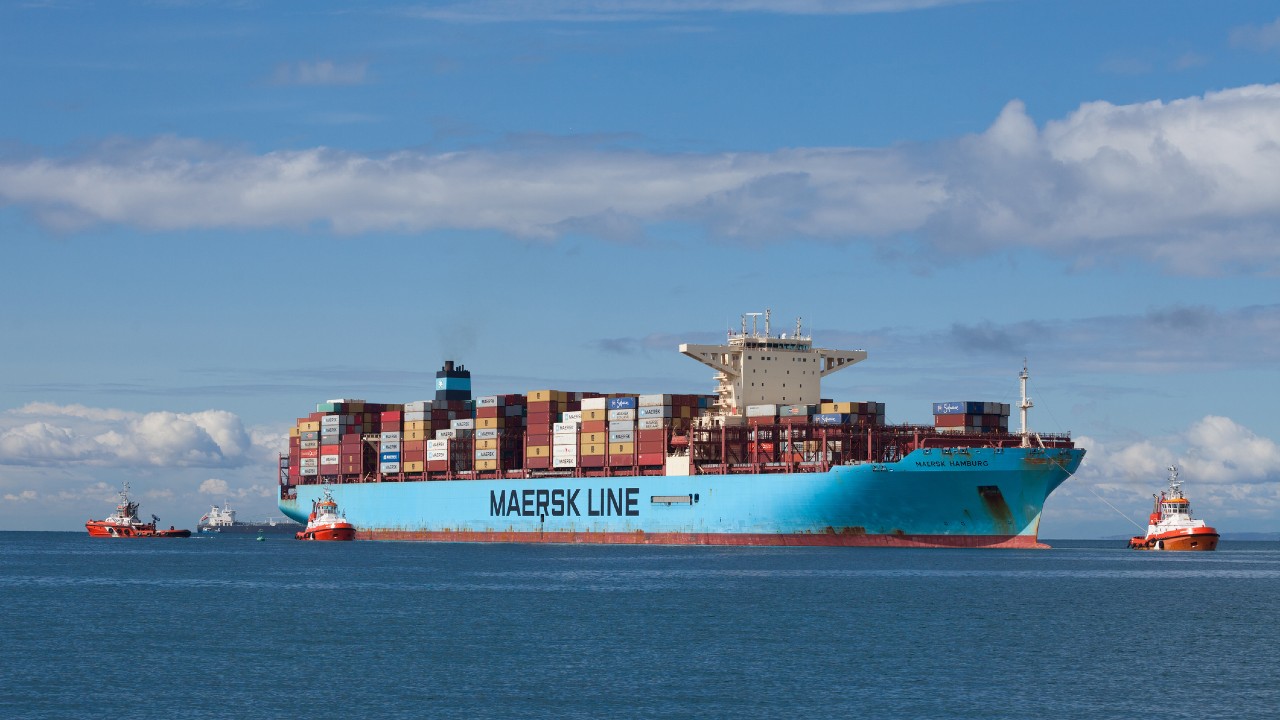
The carrier is reviewing bookings and routes through Khor Fakkan, Fujairah and some Upper Gulf destinations amid Strait of Hormuz disruption and regional congestion, with no end date set.
Maersk is changing how it accepts bookings and routes cargo through Khor Fakkan, Fujairah and some Upper Gulf destinations, citing disruption near the Strait of Hormuz and congestion at regional ports. The carrier’s customer advisory, issued on 30 October, gives no end date for the measures and does not name every affected Upper Gulf destination. Maersk says it will review the arrangements as conditions change and keep customers informed.
Customers with existing bookings that may be affected are to be contacted by their Maersk representative with shipment-specific guidance, including possible alternatives. Cargo already under way could face delays; the company says it will share available status updates and flag when onward transport or a revised arrival date cannot yet be confirmed. A change to a booking should not be assumed to mean that cargo has automatically been moved to the next sailing.
New bookings remain possible where capacity allows. If an alternative route is feasible, Maersk says it will discuss expected transit times and costs with customers. Whether cargo can travel on its original route will depend on operational conditions and available space, so arrangements need to be confirmed for each shipment.
The booking changes come amid wider pressure on the UAE’s port and transport network. Kuehne+Nagel reported on 30 October that congestion at Khor Fakkan, Fujairah and Sharjah was affecting vessel operations, terminal transfers and cargo dwell times. It also described longer transfers from the east-coast ports to Jebel Ali, Sharjah and Abu Dhabi, adding strain to yard capacity. The company said some carriers were reducing allocations, while alternative gateway options were proving difficult.
Khor Fakkan and Fujairah are on the UAE’s eastern seaboard, beyond the Strait of Hormuz. The UAE Ministry of Culture identifies Khor Fakkan as a city in Sharjah on the eastern coast, with a port serving international trade. Fujairah Port describes itself as the country’s only multipurpose maritime facility on the east coast, around 70 nautical miles outside the Strait. Their location and commercial roles help explain why changes to cargo flows at either port can affect regional shipping and onward distribution.
Alternative routes may involve additional inland transport, but they are not necessarily available for every shipment. Abu Dhabi Ports Group describes a service moving cargo from Khor Fakkan or Fujairah by road or rail to Khalifa Port under customs-bonded transit. Shippers would need to confirm with the relevant carrier and logistics providers whether such an option is suitable, and check its capacity, timing, cost and customs requirements. UN Trade and Development’s maritime review explains more broadly that congestion and disruption can lengthen port turnaround times, reduce effective vessel capacity and undermine schedule reliability.
Exporters and freight forwarders should therefore verify whether new bookings are being accepted, whether existing cargo needs rerouting, and whether shipments in transit have revised schedules. They should also check the cost and timing of any alternative gateway or inland transfer rather than rely on the original booking alone. Kuehne+Nagel recommends allowing extra lead time and considering different carrier or gateway options where appropriate; for time-sensitive cargo, early communication with customers may help manage the risk of delay.
Source Reference Map
Inspired by headline at: [1]
Sources by paragraph:
– Paragraph 1: [2]
– Paragraph 2: [2]
– Paragraph 3: [2]
– Paragraph 4: [3]
– Paragraph 5: [4], [5]
– Paragraph 6: [6], [7]
– Paragraph 7: [3]
Source: Noah Wire Services
Verification / Sources
- https://www.seanews.com.tr/article/maersk-implements-temporary-booking-restrictions-at-key-middle-east-ports-mw415dab – Please view link – unable to able to access data
- https://www.maersk.com/news/articles/2026/10/30/temporary-booking-restrictions-khor-fakkan-fujairah – Maersk’s customer advisory, dated 30 October 2026, announces temporary adjustments to booking acceptance and cargo flows for Khor Fakkan, Fujairah and selected Upper Gulf destinations. It attributes the changes to continued disruption around the Strait of Hormuz and congestion at regional ports, which are affecting cargo movement and delivery timelines. The advisory explains that customers with affected existing bookings will be contacted by their Maersk representative with shipment-specific information and guidance, including possible alternatives. Cargo already in transit remains subject to delays; customers will receive available status information, and Maersk will say when onward movement or a revised delivery date cannot yet be confirmed. New bookings will be accepted subject to available capacity. Where feasible, Maersk will discuss alternative arrangements, expected timing and applicable costs. The advisory cautions that a revised booking should not be treated as automatically transferred to a later sailing. It says the temporary measures will be reviewed as conditions evolve and that customers will be kept informed. This is the most direct source for the article’s account of the carrier’s restrictions and customer guidance. It does not give a complete list of affected Upper Gulf destinations or a fixed end date.
- https://mykn.kuehne-nagel.com/news/article/uae-port-congestion-intensifies-as-delays – Kuehne+Nagel reports elevated congestion at Khor Fakkan, Fujairah and Sharjah, describing effects on vessel operations, terminal transfers and cargo dwell times across the UAE. Its figures, dated 30 October 2026, indicate substantial vessel waiting and schedule delays at Khor Fakkan and Fujairah. The report also says cargo transfers from those ports to Jebel Ali, Sharjah and Abu Dhabi have lengthened, adding pressure to yard capacity and the wider logistics network. It notes that some carriers are reducing allocations in response to congestion, while alternative carrier gateway solutions are proving challenging. The article recommends that shippers diversify carrier and gateway choices, consider alternatives such as Salalah or Duqm where suitable, and allow additional lead time. This source supports the article’s broader discussion of congestion-related delays, the possible effects on onward transport and the practical need to check shipment status and routing rather than rely on initial plans. Its operational figures are a snapshot for the stated date and may not reflect later conditions; they should not be taken as a guarantee of delays for any individual shipment. The report identifies Kuehne+Nagel and seaexplorer as its sources.
- https://moc.gov.ae/en/archaeological_site/mokaa-khorfkan/ – The UAE Ministry of Culture’s page describes Khor Fakkan as a city belonging to the Emirate of Sharjah, situated about 100 kilometres east of Sharjah city on the eastern coast overlooking the Gulf of Oman. It identifies Khor Fakkan Port as a prominent feature of the city and notes its role as a hub for international trade and an active economic centre. The page also gives historical and archaeological background, including discoveries from excavations that revealed a settlement dating to the second millennium BC. It describes the settlement’s location near the sea and mountains and mentions archaeological finds such as pottery, stone tools, metal tools and fishing equipment. Most of this historical material is not directly relevant to Maersk’s booking measures. The page is useful here for verifying the geographical context: Khor Fakkan is on the UAE’s eastern seaboard, outside the inner Gulf coastline, and its port has a recognised trade role. It supports the article’s statement about the port’s location and helps explain why it may serve as a maritime gateway for regional cargo movements. It does not report the October 2026 booking restrictions, port congestion levels or Maersk’s shipment-specific procedures.
- https://fujairahport.ae/about-us/ – The Port of Fujairah’s official “About Us” page presents the port as a major shipping hub for the Gulf and surrounding regions. It states that the port is the UAE’s only multipurpose maritime facility on the country’s east coast and is located approximately 70 nautical miles outside the Strait of Hormuz. The page describes its role as an economic link between Europe and Asia and as a point of access to markets in the Indian subcontinent and North-East Africa. It also lists facilities and services for container operations, general and project cargo, and dry and liquid bulk cargo, and says that operations began in 1983. This information supports the article’s geographic and commercial context for Fujairah, including its position outside the Strait and its importance to regional and international shipping. It helps explain why disruptions or rerouting involving Fujairah may matter to cargo flows through the Gulf region. The page is not a notice about Maersk’s temporary booking measures and does not independently establish current congestion or shipment delays; those operational details should be checked against carrier and logistics advisories.
- https://www.adports.ae/alternative-cargo-routing-via-khorfakkan-fujairah/ – Abu Dhabi Ports Group describes an alternative cargo-routing arrangement using Khor Fakkan Port and Fujairah Terminals in response to Strait of Hormuz disruption. The page says cargo can be discharged at either east-coast gateway and moved inland under customs-bonded transit, using truck convoys or rail services, to Khalifa Port for customs processing and onward distribution. It presents this routing as a way to maintain trade flows into Abu Dhabi and the wider GCC when maritime routes face challenges. The information is relevant to the article’s discussion of alternative routing, inland transshipment and the possibility that cargo arrangements may involve additional transport steps. It also supports the description of Khor Fakkan and Fujairah as important gateways for cargo entering the UAE and nearby markets. The page outlines a specific Abu Dhabi Ports Group service and should not be read as proof that the same option is available for every Maersk shipment or destination. Customers would need to confirm route feasibility, costs, transit times, customs requirements and capacity with the relevant carrier, port operator and logistics providers. The page describes the organisation’s service rather than Maersk’s booking policy.
- https://unctad.org/system/files/official-document/rmt2025ch3_en.pdf – This chapter from UN Trade and Development’s Review of Maritime Transport 2025 discusses port congestion, freight rates and disruptions to maritime networks. It explains that congestion can strain port operations, lengthen turnaround times and delays, reduce effective vessel capacity and weaken schedule reliability. The chapter also notes that disruption or closure around the Strait of Hormuz could affect feeder services and transshipment operations in the Arabian Gulf and northern Indian Ocean, potentially prompting rerouting and contributing to congestion or higher freight rates. These general findings provide background for the article’s explanation of why regional disruption and port congestion can affect cargo routing, vessel schedules, delivery times and transport costs. The report is a broad industry analysis, not a current operational update on Khor Fakkan, Fujairah or Maersk’s October 2026 restrictions. Its discussion of Hormuz-related risks concerns the conditions assessed in the report and should not be treated as confirmation of the specific current events in the article. It is best used to support the general mechanisms linking maritime disruption, port congestion, rerouting and reduced schedule reliability, rather than to establish shipment-level details or present-day port status.
Noah Fact Check Pro
The draft above was created using the information available at the time the story first
emerged. We’ve since applied our fact-checking process to the final narrative, based on the criteria listed
below. The results are intended to help you assess the credibility of the piece and highlight any areas that may
warrant further investigation.
Freshness check
Score: 7
Notes: ✅ The article is dated 5 November 2026 and its central claim is supported by Maersk’s own advisory, published on 30 October 2026. The advisory is the earliest primary-source publication located for the specific booking measures. Earlier reporting substantially similar to the broader narrative appeared on 30 October, including Kuehne+Nagel’s UAE port congestion update; a further summary appeared on MARYTEAM on 30 October. Those reports pre-date this article by more than seven days only if the dates are misread: they are six days earlier, so the seven-day threshold is not met. The article is largely a contextual rewrite of a recent official notice, not an original discovery. Search results also show recycled or derivative coverage on lower-profile shipping sites, which should not be mistaken for independent confirmation.
Quotes check
Score: 6
Notes: ⚠️ The supplied article contains no direct quotation marks or attributed verbatim statements; it paraphrases Maersk and Kuehne+Nagel. The main operational details closely track Maersk’s 30 October advisory, including the capacity condition and warning that a booking change does not guarantee transfer to the next sailing. This verifies the substance against the company’s notice, but not any spoken remarks or independently sourced quotations. The article should not be presented as having independently confirmed customer communications.
Source reliability
Score: 6
Notes: ⚠️ The primary facts are anchored to an authentic, publicly accessible Maersk customer advisory, which is strong evidence for what Maersk announced but is a corporate source describing its own actions. Kuehne+Nagel is a substantial logistics provider with operational knowledge, but its congestion report is also commercially interested and not independent journalism. The UAE Ministry of Culture, Fujairah Port, AD Ports Group and UN Trade and Development support background or general context, not independent confirmation of Maersk’s specific booking measures. SeaNews is a specialist maritime outlet rather than a major general-news organisation; its page identifies the author only as SeaNews. The supplied source attribution to Noah Wire Services is not explained on the article page, which names SeaNews as author.
Plausibility check
Score: 8
Notes: ✅ The main claim is plausible and directly confirmed by Maersk’s 30 October advisory: it says booking acceptance and cargo flows are being adjusted for Khor Fakkan, Fujairah and selected Upper Gulf destinations, with new bookings subject to capacity and cargo in transit potentially delayed. Kuehne+Nagel separately reports congestion and longer transfer times at relevant UAE ports. ⚠️ Maersk does not identify all affected Upper Gulf destinations or give an end date, so the scope and duration remain uncertain. The article appropriately warns that route alternatives, cost and capacity must be confirmed shipment by shipment. Its final practical recommendations are advice, not independently measurable facts.