
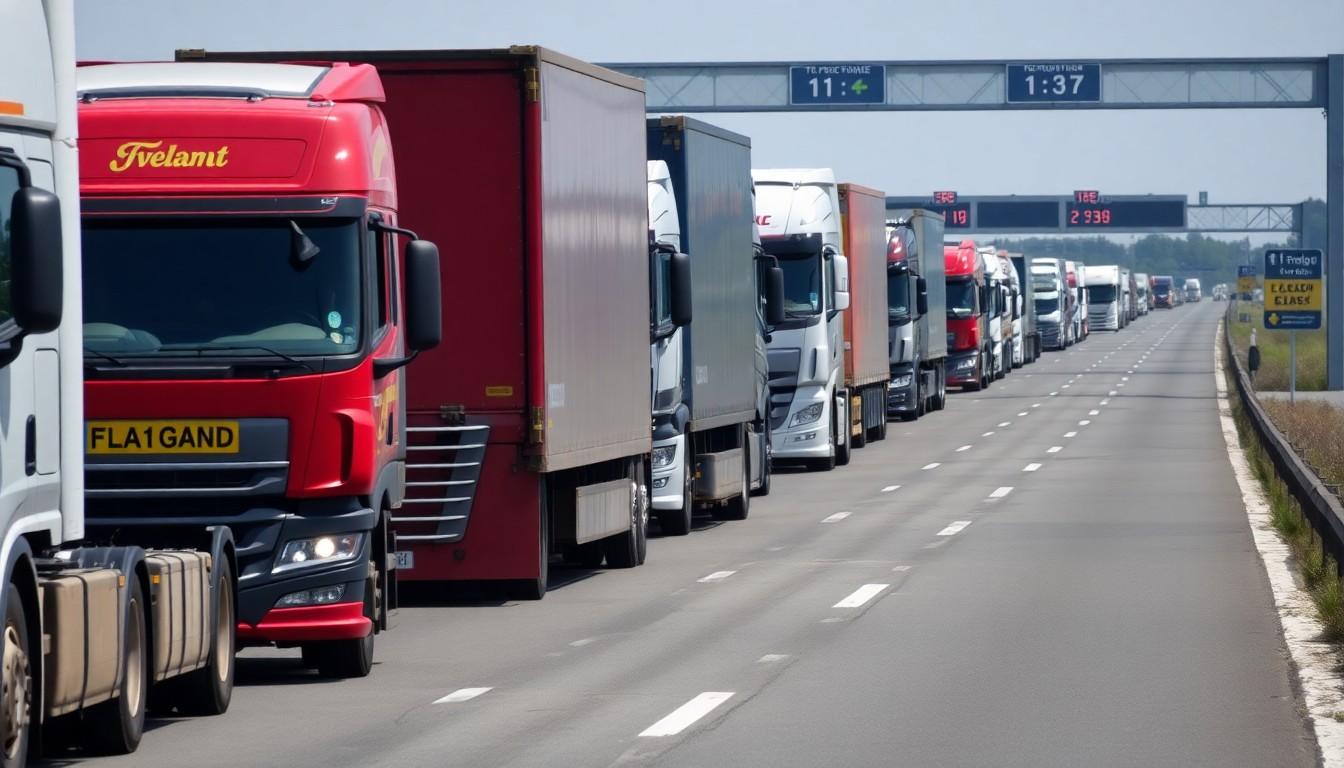
Rising distance-based and emissions-linked charges across Europe are adding to Irish hauliers’ costs, forcing operators to rethink route planning and contract pricing.
European truck tolls have climbed by about 20 per cent since 2023, according to analysis by the International Road Transport Union, adding another layer of cost pressure for Irish hauliers already facing expensive diesel, rising labour costs and persistently tight margins. The trade body says the increase is not a single tariff change but the result of a broader shift across Europe, as governments extend distance-based charging and tie heavy goods vehicle rates more closely to carbon dioxide emissions.
The pattern has been moving quickly. IRU says toll regimes changed almost every month somewhere in the European Union during 2026, with more substantial reforms expected in 2027. Industry commentary from Eurojungle and Transconnect points in the same direction, saying operators are dealing with a steady stream of new charges and revised systems as member states implement the revised Eurovignette framework and expand CO₂-differentiated tolling. IRU’s own transport-rate benchmarks have also flagged toll increases as a meaningful factor in freight pricing since late 2023.
For operators, the practical effect is that route planning has become far more complex than simply choosing the shortest distance. Across Europe, hauliers now face a patchwork of motorway tolls, vignettes, satellite-based charging systems and bridge or tunnel fees, with the final bill shaped by distance, axle configuration, vehicle weight, emissions class, road type and even time of travel. The Netherlands moved from the Eurovignette to kilometre-based truck charging in 2026, while Flanders introduced a CO₂-linked element to its toll structure. According to industry guides from Eurowag, the EU’s CO₂ classes are being rolled out progressively and zero-emission vehicles can qualify for lower rates, or in some cases full exemption.
The commercial danger for Irish firms is that these charges may be passed on only if contracts are written to allow it. Fuel surcharges do not usually cover road tolls, so operators on fixed-price work can end up absorbing repeated increases unless tolls, ferry costs and other statutory route expenses are separately indexed. That makes accurate classification critical: if a toll provider lacks correct registration, axle or emissions data, a truck can be placed in a higher-priced default band. The lesson, for many hauliers, is to review route-costing systems, check every vehicle’s details and treat European tolls as a variable expense rather than a background assumption.
Source Reference Map
Inspired by headline at: [1]
Sources by paragraph:
– Paragraph 1: [2], [3]
– Paragraph 2: [2], [5], [7]
– Paragraph 3: [3], [4], [5]
– Paragraph 4: [1], [4], [6]
Source: Noah Wire Services
Verification / Sources
- https://www.hgvireland.com/european-truck-tolls-have-risen-around-20-since-2023/ – Please view link – unable to able to access data
- https://www.iru.org/news-resources/newsroom/eu-truck-tolls-what-changed-2026-and-what-s-coming-2027 – The International Road Transport Union (IRU) reports that European truck tolls have increased by approximately 20% since 2023. This rise is attributed to the expansion of distance-based charging and the integration of CO₂ pricing. Toll regimes have been changing almost monthly across the EU in 2026, with further substantial changes scheduled for 2027. The trend indicates a shift towards more kilometre-based charging and CO₂ differentiation, impacting transport costs and operators’ bottom lines.
- https://eurojungle.com/en/news/toll-road-costs-rising-across-europe-operators-face-e0-45-km-in-new-charges/ – Eurojungle.com reports that truck operators across the European Union are facing new toll road increases as member states implement the revised Eurovignette Directive and introduce distance-based, CO₂-differentiated charging schemes. Analysis by the International Road Transport Union (IRU) shows that average per-kilometre costs for a fully laden 40-tonne truck on major European corridors have risen by 18% since 2023, reaching €0.45/km on high-standard motorways in Germany, Austria, and the Czech Republic.
- https://www.eurowag.com/blog/latest-toll-rate-changes-across-european-countries-due-to-the-implementation-of-co2-classes – Eurowag provides a country-by-country guide on CO₂ emission classes and European truck toll rates. The guide explains how EU Directive 2022/362 introduces CO₂-based tolling for trucks across member states, with five CO₂ emission classes determining toll rates. Zero-emission vehicles qualify for the lowest rates or full exemption in some regions. An increasing number of EU member states have integrated CO₂ emission classes into their truck toll structures, with more rolling out the system progressively.
- https://transconnect.com/en/blog/european-tolls-2027-what-carriers-need-to-arrange – Transconnect discusses the evolving European toll landscape, noting that toll costs for a reference truck in mid-September 2026 were around 17% above early 2023. Rates change somewhere in Europe almost every month, with new rates or systems arriving in countries like the Netherlands, Flanders, Bulgaria, and Romania in 2026. A new wave of changes is expected on 1 January 2027, indicating a trend towards more distance-based charging and increased emphasis on CO₂ considerations.
- https://www.iru.org/news-resources/newsroom/three-key-trends-defining-european-road-freight-rates-q2-q4-2024 – The IRU highlights three key trends defining European road freight rates from Q2 to Q4 2024. One significant trend is the impact of CO₂ tolls, with countries like Germany, Austria, Hungary, and the Czech Republic implementing CO₂ truck tolls. These new tolls are part of a broader initiative under the revised Eurovignette Directive aiming to incentivise lower emissions, despite a lack of enabling conditions for a significant uptake of zero-emission vehicles.
- https://www.iru.org/intelligence/road-transport-intelligence/european-road-freight-rate-development-benchmark-q4-2023 – The IRU’s European Road Freight Rate Development Benchmark for Q4 2023 indicates that the Q4 spot rate index was down 14.8 points year over year. However, the quarter-over-quarter fall in the contractual rates index was limited to 0.9 points, due to high costs and, in particular, the toll increases in Q4 2023. This suggests that toll increases are a significant factor influencing freight rates in the European market.
Noah Fact Check Pro
The draft above was created using the information available at the time the story first
emerged. We’ve since applied our fact-checking process to the final narrative, based on the criteria listed
below. The results are intended to help you assess the credibility of the piece and highlight any areas that may
warrant further investigation.
Freshness check
Score: 8
Notes: The article was published on 13 October 2026, referencing data from the International Road Transport Union (IRU) dated 6 October 2026. (iru.org) The information is current and not recycled from older sources. However, the article’s reliance on a single source (IRU) raises concerns about source independence.
Quotes check
Score: 7
Notes: The article includes direct quotes from the IRU’s analysis. While these quotes are attributed to the IRU, they cannot be independently verified without access to the original IRU publication. The lack of independent verification of these quotes is a concern.
Source reliability
Score: 6
Notes: The primary source, the IRU, is a reputable organisation in the road transport sector. (en.wikipedia.org) However, the article’s heavy reliance on a single source without cross-referencing with other independent sources reduces the overall reliability.
Plausibility check
Score: 8
Notes: The claim that European truck tolls have increased by approximately 20% since 2023 aligns with reports from other sources, such as TrasportoEuropa, which also cites the IRU’s analysis. (trasportoeuropa.it) However, the article’s focus on the impact on Irish hauliers may not fully represent the broader European context.