
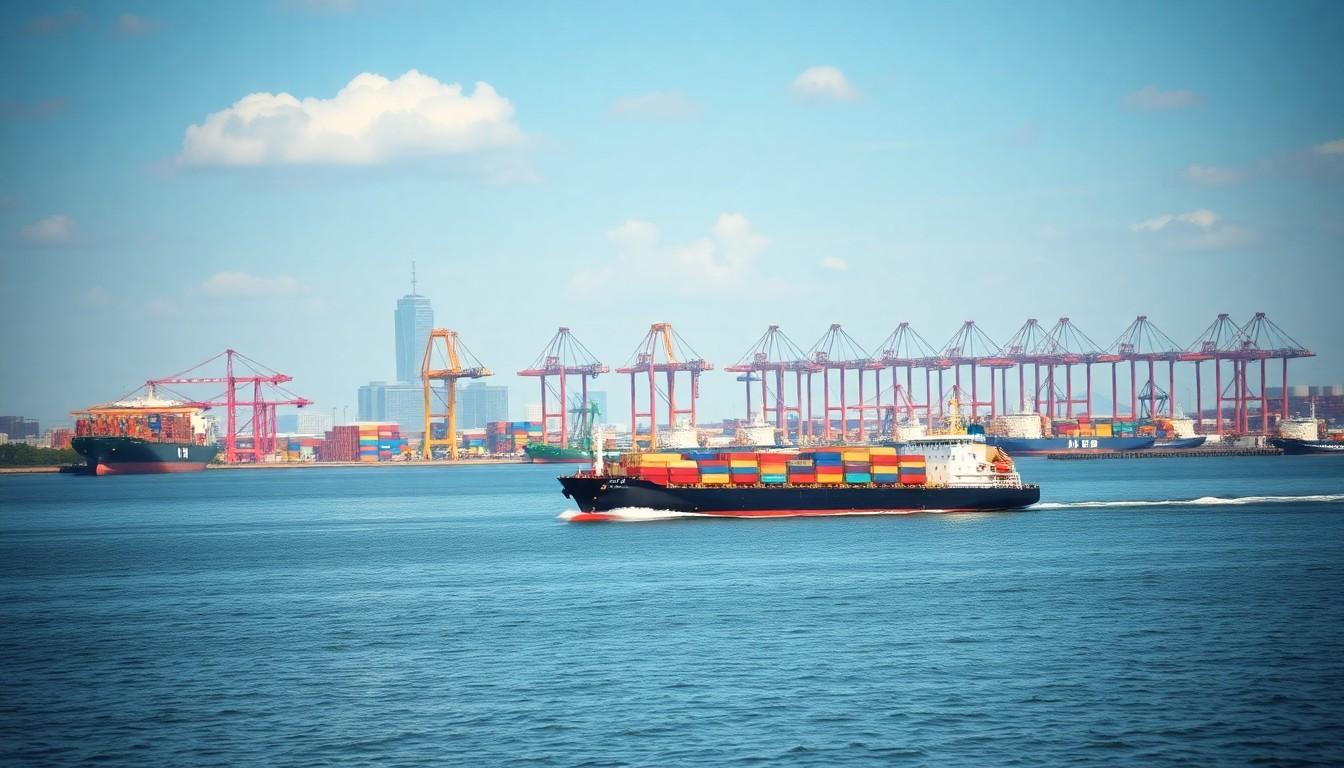
Freight rates from Shanghai continue to climb for a sixth consecutive week, driven by strategic rerouting, geopolitical tensions, and pre-emptive shipments ahead of tariffs, signalling a tightening of global shipping capacity.
Spot freight rates out of Shanghai have climbed for a sixth straight week, lifting the Shanghai Containerised Freight Index to its highest level in nearly two years as disruption in the Red Sea continues to squeeze available capacity and exporters accelerate shipments ahead of potential tariff changes. According to the Shanghai Shipping Exchange, the index reached 2,726.48 points for the week to June 5, up 154.75 points, or 6.02 per cent, from the previous week.
The strongest gains were on transpacific routes, underlining firmer demand to North America. Rates from the Far East to the US west coast rose to $4,552 per FEU, up 9.71 per cent, while the US east coast route climbed to $5,741 per FEU. European lanes also advanced, with the Far East to Europe route at $2,605 per TEU and the Mediterranean route at $3,832 per TEU, both higher than a week earlier. Short-haul routes were steadier, with Japan services unchanged and only modest movement elsewhere.
Market analysts say the rebound that began in April has accelerated through May as geopolitical risk, annual contract pricing, route reconfiguration and higher fuel and inland haulage costs all tightened vessel supply. Mid-month spot indications quoted in the market put west coast US rates in the $4,350 to $4,850 range per FEU, east coast shipments at roughly $5,550 to $6,050, and Europe at about $4,300 to $4,500. Drewry said this year’s seasonal upturn has arrived earlier than usual, helped by shippers bringing forward bookings ahead of a possible US tariff change in July, as well as cargo tied to World Cup preparations and inventory restocking ahead of major retail promotions.
The wider squeeze is being reinforced by the Middle East crisis, which has pushed many carriers to reroute around Africa rather than transit the Red Sea and nearby chokepoints. S&P Global Market Intelligence has said that those diversions are adding pressure to other maritime bottlenecks, including the Panama Canal and the Malacca Strait, making it harder for the industry to absorb shocks simply by shifting sailings elsewhere. Carriers have responded by levying peak-season surcharges and raising all-in rates, while capacity discipline remains visible, with only three transpacific blank sailings currently planned.
Source Reference Map
Inspired by headline at: [1]
Sources by paragraph:
– Paragraph 1: [2], [3]
– Paragraph 2: [1]
– Paragraph 3: [1], [3]
– Paragraph 4: [2], [4]
Source: Noah Wire Services
Verification / Sources
- https://www.cdns.com.tw/articles/1413399 – Please view link – unable to able to access data
- https://www.spglobal.com/market-intelligence/en/news-insights/research/2026/04/maritime-chokepoints-tighten-global-supply-chain-risk-rises – This article discusses how rerouting from the Strait of Hormuz is increasing pressure on secondary maritime chokepoints, including the Panama Canal and Malacca Strait. It highlights the growing interconnectedness of global supply chains and the rising risks associated with network congestion, especially during peak shipping seasons. The piece emphasizes the need for firms to account for broader, interconnected network risks that extend beyond a single geopolitical flashpoint, as simple rerouting strategies become less effective.
- https://www.spglobal.com/market-intelligence/en/news-insights/research/2026/03/middle-east-war-impacts-container-shipping – This article examines the impact of the Middle East conflict on container shipping, noting that while the war has disrupted the Persian Gulf and Strait of Hormuz, the scale of the problem is not as severe as previous disruptions like the pandemic. It discusses the rerouting of vessels around Africa, the implementation of emergency surcharges by carriers, and the broader implications for global trade, including potential congestion effects in Asia and the Pacific.
- https://www.spglobal.com/market-intelligence/en/news-insights/research/2026/03/middle-east-conflict-disrupts-key-shipping-routes-raising-trade-risk – This article reports on the suspension of critical shipping routes through the Gulf and the Strait of Hormuz by major global shipping lines due to escalating regional tensions. It details the rerouting of container vessels around Africa’s Cape of Good Hope, leading to significant delays, increased fuel and operational costs, and congestion at ports. The piece also highlights the broader impact on global trade, with around 20% of global crude oil and container cargo volumes typically transiting through these chokepoints.
- https://www.spglobal.com/market-intelligence/en/news-insights/research/2026/04/maritime-chokepoints-tighten-global-supply-chain-risk-rises – This article discusses how rerouting from the Strait of Hormuz is increasing pressure on secondary maritime chokepoints, including the Panama Canal and Malacca Strait. It highlights the growing interconnectedness of global supply chains and the rising risks associated with network congestion, especially during peak shipping seasons. The piece emphasizes the need for firms to account for broader, interconnected network risks that extend beyond a single geopolitical flashpoint, as simple rerouting strategies become less effective.
- https://www.spglobal.com/market-intelligence/en/news-insights/research/2026/03/middle-east-war-impacts-container-shipping – This article examines the impact of the Middle East conflict on container shipping, noting that while the war has disrupted the Persian Gulf and Strait of Hormuz, the scale of the problem is not as severe as previous disruptions like the pandemic. It discusses the rerouting of vessels around Africa, the implementation of emergency surcharges by carriers, and the broader implications for global trade, including potential congestion effects in Asia and the Pacific.
- https://www.spglobal.com/market-intelligence/en/news-insights/research/2026/03/middle-east-conflict-disrupts-key-shipping-routes-raising-trade-risk – This article reports on the suspension of critical shipping routes through the Gulf and the Strait of Hormuz by major global shipping lines due to escalating regional tensions. It details the rerouting of container vessels around Africa’s Cape of Good Hope, leading to significant delays, increased fuel and operational costs, and congestion at ports. The piece also highlights the broader impact on global trade, with around 20% of global crude oil and container cargo volumes typically transiting through these chokepoints.
Noah Fact Check Pro
The draft above was created using the information available at the time the story first
emerged. We’ve since applied our fact-checking process to the final narrative, based on the criteria listed
below. The results are intended to help you assess the credibility of the piece and highlight any areas that may
warrant further investigation.
Freshness check
Score: 8
Notes: The Shanghai Containerized Freight Index (SCFI) reached 2,726.48 points for the week ending June 5, 2026, marking a 6.02% increase from the previous week. (sse.net.cn) This data is current and aligns with recent reports on rising freight rates. However, the article’s reliance on a single source raises concerns about originality and potential recycling of content.
Quotes check
Score: 6
Notes: The article includes specific figures and percentages, such as the 6.02% increase in the SCFI. (sse.net.cn) While these figures are verifiable, the absence of direct quotes from industry experts or officials limits the ability to assess the originality and independence of the content.
Source reliability
Score: 7
Notes: The primary source, the Shanghai Shipping Exchange, is a reputable institution. (sse.net.cn) However, the article’s heavy reliance on this single source without cross-referencing with other independent outlets raises concerns about source diversity and potential bias.
Plausibility check
Score: 7
Notes: The reported surge in freight rates is consistent with recent industry trends, including the early arrival of the peak season and increased surcharges. (logisticsnews.ph) However, the article’s lack of detailed analysis or additional sources makes it difficult to fully assess the plausibility of the claim.