
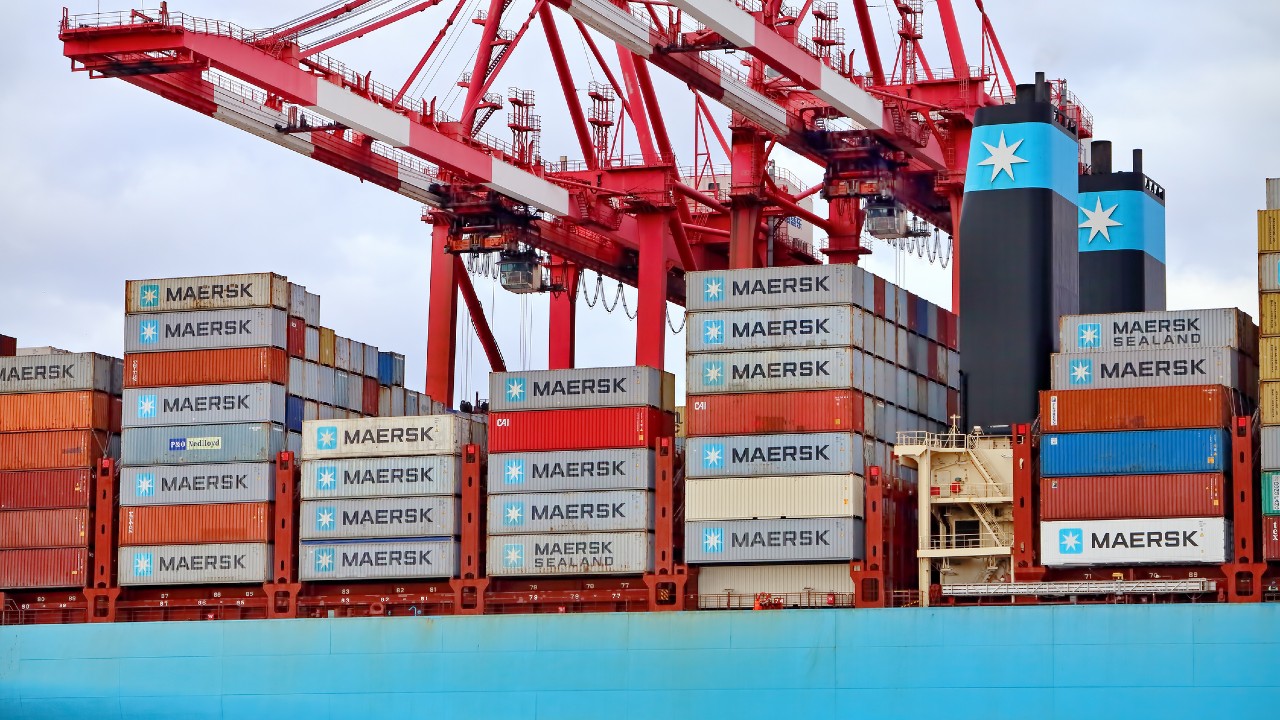
Maersk’s launch of a new China-India ocean freight service underscores ongoing commercial demand that continues to unite the two economies despite geopolitical strains, with enhanced connectivity and capacity boosting bilateral trade prospects.
Maersk’s decision to open a new China-India ocean freight service is being read as a sign that commercial demand is still pulling the two economies closer together, even as political relations remain tense. According to Business Today, the world’s largest container shipping line has launched the FI2 feeder route, and the move has already been seized on by China’s embassy in India as evidence that cargo volumes, not geopolitics, are driving the market.
The development comes against a backdrop of record bilateral trade between India and China, which Business Today says reached $155.6 billion in 2025. China remains a key supplier of industrial inputs to India, including machinery, electronics, active pharmaceutical ingredients and manufacturing parts, while India continues to ship commodities and raw materials, such as iron ore, to China.
Maersk says the first westbound sailing on the new service will leave Shanghai on 4 June 2026. The weekly route will link Shanghai, Ningbo and Nansha with Nhava Sheva and Pipavav on India’s west coast, before moving on to Port Qasim in Pakistan via the transshipment hub at Tanjung Pelepas in Malaysia. The line will use six vessels with a nominal capacity of 4,500 TEU each.
A key attraction of the service is its connection with India’s Dedicated Freight Corridor through Pipavav in Gujarat, which should shorten inland transit times to northern industrial centres such as Delhi-NCR, Gurugram and Noida. Thomas Theeuwes, managing director for Maersk South Asia, said the route was designed to meet customer demand for ‘capacity, consistency, and connectivity’, and added that combining the sea leg with rail access would provide an integrated logistics offering. Business Today says the new service will sit alongside Maersk’s FI3 route, giving shippers two direct Far East-India options and greater flexibility at a time when supply chains remain under pressure.
Source Reference Map
Inspired by headline at: [1]
Sources by paragraph:
– Paragraph 1: [1]
– Paragraph 2: [1]
– Paragraph 3: [1]
– Paragraph 4: [1]
Source: Noah Wire Services
Verification / Sources
- https://www.businesstoday.in/india/story/when-the-worlds-largest-container-line-bets-on-china-hails-maersks-new-india-trade-corridor-533757-2026-05-28?utm_source=rssfeed – Please view link – unable to able to access data
Noah Fact Check Pro
The draft above was created using the information available at the time the story first
emerged. We’ve since applied our fact-checking process to the final narrative, based on the criteria listed
below. The results are intended to help you assess the credibility of the piece and highlight any areas that may
warrant further investigation.
Freshness check
Score: 10
Notes: The article reports on Maersk’s recent announcement of the FI2 ocean service, with the first westbound sailing scheduled for June 4, 2026. This information is current and has not been previously reported.
Quotes check
Score: 8
Notes: The article includes a direct quote from Yu Jing, spokesperson of the Chinese Embassy in India, highlighting Maersk’s decision to launch the FI2 feeder service. While the quote is attributed, it cannot be independently verified through other sources.
Source reliability
Score: 7
Notes: The article is published by Business Today, a reputable Indian news outlet. However, the reliance on a single source for the quote from the Chinese Embassy raises concerns about the completeness and independence of the information.
Plausibility check
Score: 9
Notes: The launch of the FI2 service aligns with Maersk’s strategic initiatives to enhance connectivity between Far East Asia and the Indian Subcontinent. The inclusion of Pipavav port and the Dedicated Freight Corridor is a plausible and strategic move to improve logistics efficiency.