
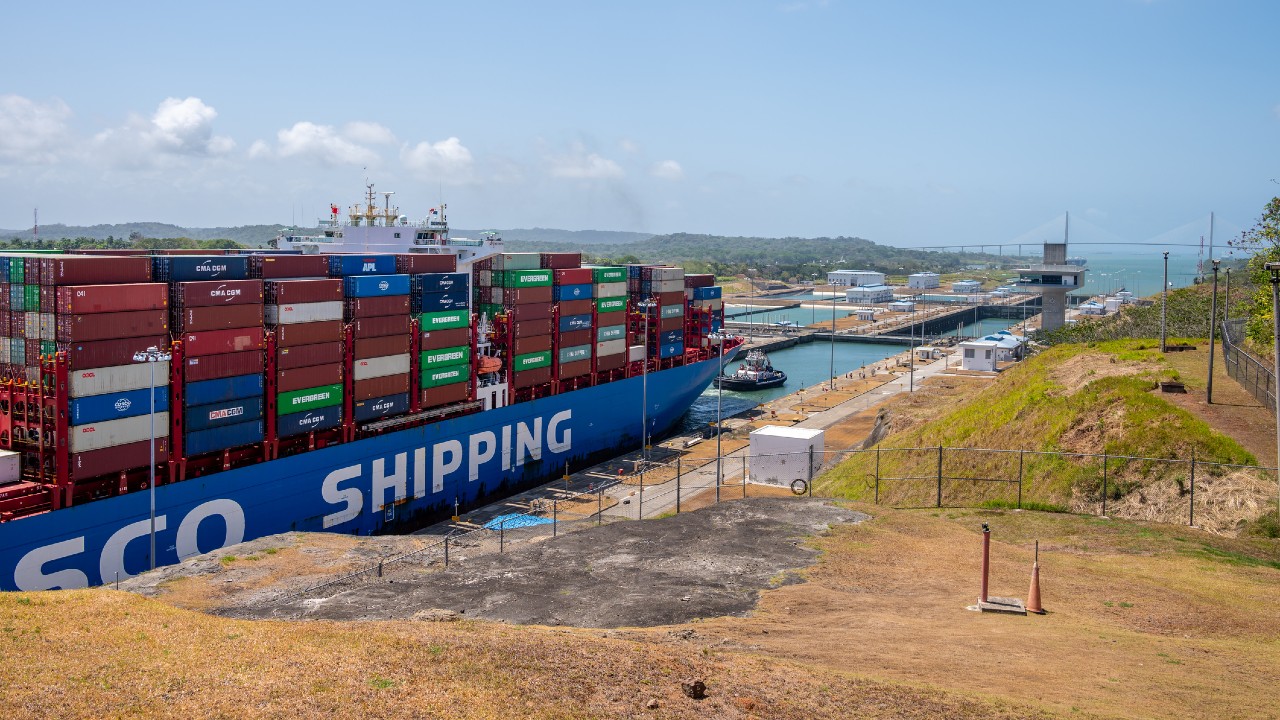
Despite increased traffic and soaring auction prices driven by Middle East conflicts, officials insist the Panama Canal remains operational and not facing systemic congestion, as regional trade flows continue to expand steadily.
The Panama Canal is telling shippers that a recent rise in traffic does not amount to a new bottleneck, even as conflict in the Middle East has pushed more cargo, especially energy shipments, towards the waterway and driven some auction prices for short-notice crossings sharply higher.
Officials said in a market update that the canal handled 6,288 transits in the first half of fiscal 2026, covering the period from October 2025 to March 2026, up from the same stretch a year earlier. Tonnage also rose by about 5 per cent to 254 million PC/UMS tons, while daily averages increased to 34 vessels in January and 37 in March, with some recent days topping 40 transits. According to the Panama Canal Authority, that pattern reflects stronger demand rather than systemic congestion.
Administrator Ricaurte Vásquez Morales said the canal was ‘open and fully operational’ and described it as ‘open and reliable’ despite wider trade disruption. The authority said container shipping and liquefied petroleum gas were among the strongest contributors to growth, underlining the canal’s continued importance to both consumer goods and energy flows.
The sharpest attention has centred on the auction system for last-minute reservations, where prices have risen dramatically since the Middle East conflict intensified rerouting across global shipping lanes. Victor Vial, the canal’s vice president of finance, said average auction prices had climbed from about $135,000 to $140,000 before the conflict to roughly $385,000 between March and April, with some individual bids going above $1 million. Recent reporting by the Washington Post said one vessel paid as much as $4 million to secure faster passage, although canal officials say such results are exceptional and do not indicate a queue in the conventional sense.
That distinction matters because the canal is still being compared with the drought-hit conditions of 2023 and 2024, when draft limits and lower transit numbers forced many operators to change routes and absorb higher costs. This time, officials say most vessels are still moving through pre-booked systems, including long-term slot allocations and dedicated LNG reservations, which they argue keeps the canal orderly even when auction prices surge.
Water supply, once the biggest constraint on operations, is also less alarming than it was two years ago. Deputy Administrator Ilya Espino de Marotta said unusually heavy dry-season rainfall has kept Gatún and Alhajuela lakes at maximum levels, leaving the canal better placed to withstand any El Niño-related pressure later in the year. She said the authority did not expect anything significant before December but would continue to watch conditions closely.
The broader regional picture shows the canal’s growing role as a logistics hub, not just a transit chokepoint. Panama’s port traffic rose 3.6 per cent in 2025 to 9.9 million TEU, according to the country’s maritime authority, with the main terminals on both coasts recording gains. Analysts and shipping executives say that wider container and empty-box flows reinforce Panama’s importance in regional redistribution, even as the canal itself tries to reassure customers that higher demand is being managed without the kind of gridlock that rattled markets during the drought crisis.
Source Reference Map
Inspired by headline at: [1]
Sources by paragraph:
– Paragraph 1: [2], [3], [4]
– Paragraph 2: [1], [6]
– Paragraph 3: [4], [5], [7]
– Paragraph 4: [1], [4], [6]
– Paragraph 5: [1], [6]
– Paragraph 6: [2], [3]
Source: Noah Wire Services
Verification / Sources
- https://gcaptain.com/panama-canal-traffic-climbs-as-officials-downplay-congestion-fears/ – Please view link – unable to able to access data
- https://newsroompanama.com/2026/01/18/panama-sees-steady-growth-in-canal-container-traffic-for-2026/ – Panama’s port traffic rose 3.6% in 2025 to 9.9 million TEU containers compared to the previous year, according to the country’s Maritime Authority. The SSA Marine Manzanillo International Terminal, on Panama’s Atlantic coast, handled 2.9 million TEU, up five percent from 2024. Panama Ports Company’s (PPC) Balboa terminal saw 2.7 million TEU containers, up two percent, while its Cristobal terminal recorded a nine percent rise in traffic and moved 1.2 million TEU. The Colon Container Terminal saw the biggest increase in traffic last year, handling 1.7 million TEUs. This represented a 10 percent spike compared to 2024. Panama International Terminal moved 1.4 million TEU, down two percent compared to 2024. According to the maritime authorities, this was the only port to see a dip in traffic. ‘We also saw an increase in the repositioning of empty containers, which reaffirms the importance of the Panamanian hub as a strategic point for the redistribution of equipment in the region,’ Max Florez, general director of ports and auxiliary maritime industries, said.
- https://newsroompanama.com/2026/04/18/global-energy-routes-shift-amid-mideast-war-oil-and-gas-tanker-traffic-explodes-at-the-panama-canal/ – A surge of oil tankers and liquefied natural gas (LNG) carriers is crowding the Panama Canal, as shifting global energy routes driven by conflict in the Middle East push the strategic waterway to near-maximum capacity. Videos circulating online this week show long lines of vessels waiting to transit the canal after loading crude oil and gas shipments from US Gulf Coast ports, underscoring a sharp rise in traffic bound for Asia. Canal authorities say daily transits have climbed to between 36 and 38 vessels, above earlier projections, with energy shipments accounting for much of the increase. Reuters reported that demand has been particularly strong among LNG and liquefied petroleum gas (LPG) carriers transporting US exports to Asian markets. The congestion follows disruptions linked to tensions between Iran and the United States, including the effective closure of the Strait of Hormuz—a critical shipping route.
- https://logistics.maritimeprofessional.com/central-america/2026/04/23/panama-canal-says-1-millionplus-auction-slots-reflect-temporary-surge-in-demand – The Panama Canal Authority announced on Thursday that some ships paid over $1 million at an auction for crossing slots, but the high prices were due to a temporary increase in demand rather than a persistent congestion of the waterway. After the Middle East conflict began, the authority reported that the average auction price had increased to $385,000, up from $135,000-$140,000. This was due to the increase in traffic, which boosted the demand for reservations. Last week, the authority downplayed reports stating that an LPG vessel paid up to $4 million in an auction for faster passage. Victor Vial is the vice president of finance at the canal. He said in a press release that certain vessels have paid over $1 million during recent auctions. However, he described these results as exceptional, and linked to a temporary rise in demand. He said that many ships pre-book their transits, avoiding queues.
- https://www.bloomberg.com/news/articles/2026/04/16/panama-canal-traffic-jam-spurs-4-million-line-jumping-payment – Tankers and cargo ships are facing three-and-a-half day waits to enter the Panama Canal as the Iran war sparks a surge in traffic, prompting one vessel to plunk down an extra $4 million to jump to the front of the line.
- https://container-mag.com/update/panama-canal-records-5-tonnage-growth-in-h1-fy2026-as-demand-surges – The Panama Canal recorded 6,288 transits in the first half of fiscal year 2026 (October 2025 to March 2026), an increase of 224 year-on-year, with 254 million PC/UMS tonnes passing through the waterway—approximately 5% more than the 243 million tonnes in the same period of the prior fiscal year. Performance strengthened in recent months, with daily averages reaching 34 vessels in January and 37 in March, while peak days recently exceeded 40 transits. Panama Canal Administrator Dr. Ricaurte Vásquez Morales said container traffic and liquefied petroleum gas had been particularly strong, adding that energy products are playing an increasingly important role in volumes handled at the waterway. Slot auction prices have risen sharply amid heightened demand. Victor Vial, Vice President of Finance at the Panama Canal Authority, said average auction prices climbed from US$135,000-US$140,000 before the Middle East conflict to approximately US$385,000 between March and April, though he described the surge as reflecting temporary conditions. Deputy Administrator Ilya Espino de Marotta said preventive water conservation measures had been implemented in anticipation of a possible El Niño event, but unusually heavy dry-season rainfall had kept Gatún and Alhajuela Lakes at maximum levels. ‘We don’t anticipate anything significant between now and December, but we continue to monitor the situation closely,’ she said.
- https://www.washingtonpost.com/business/2026/04/24/panama-canal-trade-strait-of-hormuz-iran-war-middle-east-shipment/cb88c9c8-3f9b-11f1-bb46-ed564688d953_story.html – Businesses have doled out up to $4 million to move boats through the Panama Canal with the Strait of Hormuz effectively closed, according to the Panama Canal Authority, in a move that has created a seismic shift in global trade flows. While passage through the waterway usually comes at a flat rate via reservations, companies without reservations can cross by paying an additional fee in an auction for slots, which are awarded to the highest bidder rather than waiting for days off the coast of Panama City.
Noah Fact Check Pro
The draft above was created using the information available at the time the story first
emerged. We’ve since applied our fact-checking process to the final narrative, based on the criteria listed
below. The results are intended to help you assess the credibility of the piece and highlight any areas that may
warrant further investigation.
Freshness check
Score: 8
Notes: The article presents recent data on Panama Canal traffic and auction prices, with publication dates ranging from April 23 to April 24, 2026. The earliest known publication date of substantially similar content is April 18, 2026, from Newsroom Panama. (newsroompanama.com) The article includes updated data but recycles older material, which raises concerns about freshness.
Quotes check
Score: 7
Notes: The article includes direct quotes from Panama Canal officials, such as Administrator Ricaurte Vásquez Morales and Vice President of Finance Víctor Vial. These quotes appear in multiple sources, including Reuters and Newsroom Panama, suggesting potential reuse. (investing.com) The wording of the quotes varies slightly between sources, indicating possible paraphrasing or selective quoting.
Source reliability
Score: 6
Notes: The article originates from gCaptain, a niche maritime news outlet. While it is reputable within its niche, its reach is limited compared to major news organisations. The article cites multiple sources, including Reuters and Newsroom Panama, which are more established and independent. However, the reliance on a single niche source for the lead narrative raises concerns about source diversity.
Plausibility check
Score: 7
Notes: The claims about increased Panama Canal traffic and rising auction prices align with reports from other reputable sources, such as Reuters and Newsroom Panama. However, the article lacks specific factual anchors, such as exact dates and figures, which makes independent verification challenging. The tone and language are consistent with industry reporting, but the lack of detailed supporting evidence raises questions about the report’s completeness.