
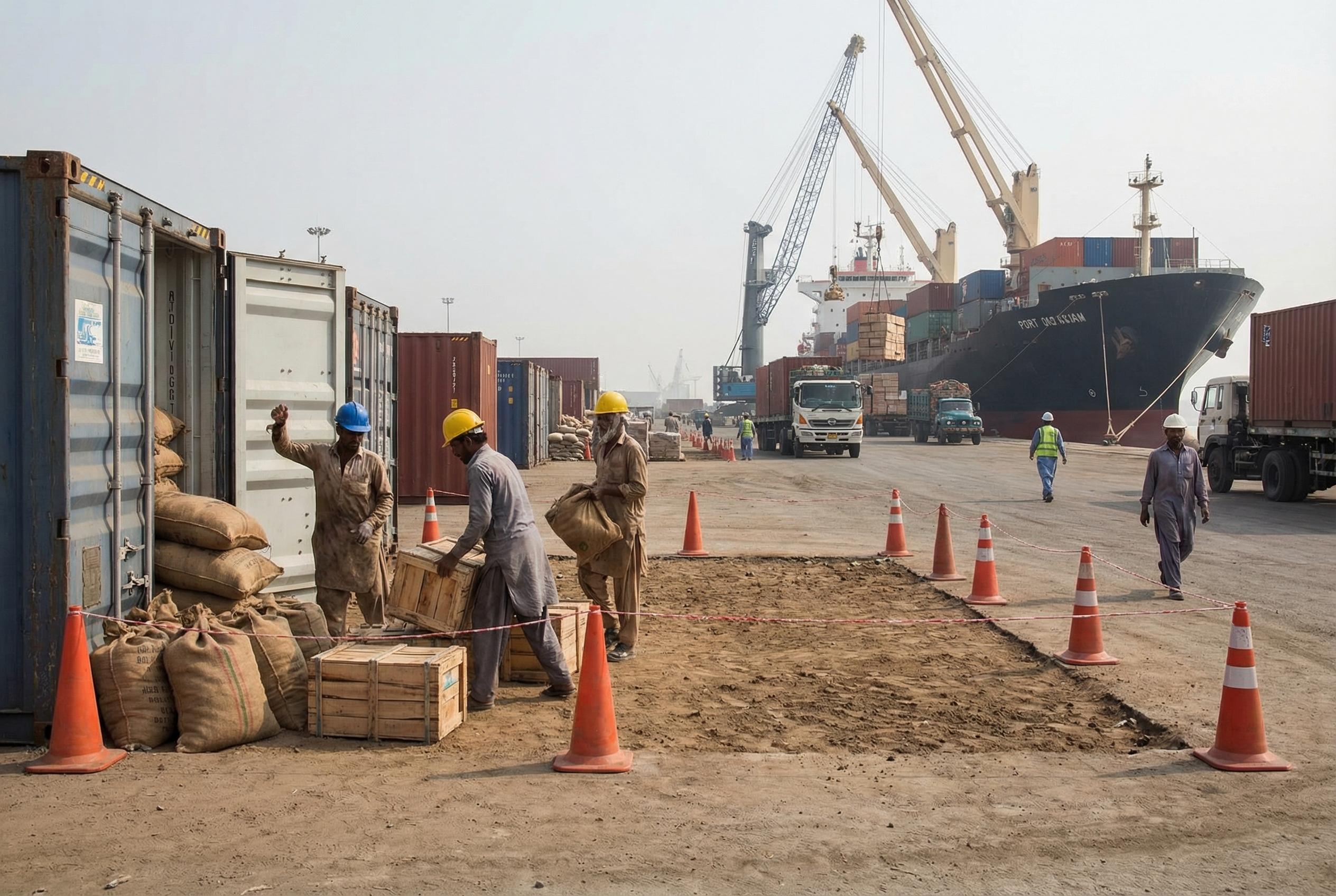
In response to security disruptions in the Gulf region, Pakistan’s Federal Board of Revenue has revised transhipment procedures and allocated a temporary storage area at Port Qasim, aiming to ease port congestion and maintain trade throughput amidst regional tensions.
The Federal Board of Revenue has moved to ease mounting pressure on Pakistan’s seaborne supply chains by revising transhipment procedures and allocating a large temporary storage area at Port Qasim in response to the ongoing security disruption in the Gulf region. According to Pakistan Today, the tax authority issued two customs notifications , one authorising use of a 16.9-acre berth-backup site in the North Eastern Industrial Zone at Port Qasim for temporary storage and another amending the Customs Rules 2001 to tighten oversight of transhipment consignments.
The site has been designated for use by M/s DP World, which already operates terminal facilities at Port Qasim, signalling a reliance on established private operators to absorb rerouted and delayed cargo. Pakistan Today reports the move is intended to reduce congestion at on-dock terminals and provide a controlled space for international transhipment containers arriving amid the Gulf crisis.
Alongside the storage allocation, the FBR’s regulatory amendments introduce more stringent monitoring, documentation and liability requirements for transhipment cargo, measures framed as necessary to preserve customs control while permitting exceptional handling arrangements. The notifications, issued as SRO518 of 2026 and SRO525 of 2026, alter existing practice to reflect what the authority describes as emergency and war-like conditions affecting maritime traffic.
The changes come against a background of chronic capacity and coordination challenges at Karachi-area ports. Recent FBR and port directives have already sought to restrict inter-port movement of international transhipment cargo to authorised bonded carriers and to set tighter procedural controls for transfers between on-dock terminals, while allowing supervised cross-stuffing under specified conditions at strategic ports. Industry reporting and FBR circulars detail these earlier steps as part of a broader attempt to regulate container flows and reduce terminal bottlenecks.
Port Qasim’s role as a deep-water gateway that handles a significant share of Pakistan’s transhipment and international trade makes it a logical focus for contingency measures, but the measures also intersect with disruptions to regional and domestic transit traffic. Over the last year authorities have at times suspended or redirected Afghan transit shipments because inland customs stations at Quetta and Peshawar reached capacity, and convoy and bonded-transport rules have been invoked to manage movement of stranded consignments to Karachi for re-export under customs supervision. Such episodes underline the limited slack in Pakistan’s hinterland handling capacity and the need for temporary terminals and stricter controls to prevent spill-over congestion.
Officials say the twin notifications aim to strike a balance between keeping trade corridors open and maintaining regulatory oversight. The allocation of the 16.9-acre area to DP World and the tightened Customs Rules are positioned as emergency measures to sustain throughput while preserving customs accountability; whether the temporary arrangements will fully prevent knock-on delays at inland depots and along road corridors will depend on implementation and enhanced coordination between port operators, customs and the Ministry of Maritime Affairs.
Source Reference Map
Inspired by headline at: [1]
Sources by paragraph:
– Paragraph 1: [2]
– Paragraph 2: [2]
– Paragraph 3: [2]
– Paragraph 4: [5], [7]
– Paragraph 5: [3], [4], [6]
– Paragraph 6: [2], [7]
Source: Noah Wire Services
Verification / Sources
- https://www.pakistantoday.com.pk/2026/03/20/fbr-revises-transhipment-rules-allocates-temporary-storage-at-port-qasim-amid-gulf-crisis – Please view link – unable to able to access data
- https://www.pakistantoday.com.pk/2026/03/20/fbr-revises-transhipment-rules-allocates-temporary-storage-at-port-qasim-amid-gulf-crisis – The Federal Board of Revenue (FBR) has revised international transhipment procedures and designated a temporary storage facility at Port Qasim to manage cargo disruptions caused by the ongoing security situation in the Gulf region. The FBR issued two customs notifications—SRO525 of 2026 and SRO518 of 2026—amending existing rules to address the emergency conditions in the Gulf that have disrupted cargo flows and port operations. Under one notification, the FBR authorised M/s DP World to use a 16.9-acre berth backup area in the North Eastern Industrial Zone of Port Qasim for the temporary storage of international transhipment cargo. This facility aims to alleviate congestion and ensure smoother handling of transhipment consignments arriving at the port. Through the second notification, SRO525, the FBR introduced wide-ranging amendments to the Customs Rules 2001, significantly tightening monitoring, documentation, and liability requirements related to transhipment cargo. These measures reflect the government’s effort to respond swiftly to the disruption in maritime trade caused by the prevailing security environment in the Gulf. With cargo flows to and from the region facing significant hurdles, the revised rules and the allocation of additional storage space are intended to keep trade moving through Pakistani ports without major bottlenecks. Port Qasim, one of Pakistan’s key deep-water ports located near Karachi, handles a substantial volume of the country’s transhipment and international trade cargo. The temporary measures announced by the FBR are expected to provide relief to importers, exporters, and shipping lines dealing with rerouted or delayed consignments as a result of the Gulf crisis. The move to assign the 16.9-acre area to DP World—a major global port operator that already manages terminal operations at Port Qasim—signals the authorities’ reliance on existing infrastructure and private-sector partnerships to manage the logistical challenges posed by the regional security situation. By amending the Customs Rules 2001, the FBR has also sought to ensure that the temporary arrangements do not compromise regulatory oversight, with stricter documentation and monitoring protocols now in place for all transhipment cargo passing through the facility.
- https://internews.pk/eng/2025/10/16/fbr-suspends-afghan-transit-trade-transport-from-karachi-ports/ – The Federal Board of Revenue (FBR) has ordered an immediate suspension of Afghan Transit Trade transportation from Karachi ports, citing severe congestion and a lack of storage capacity at customs stations in Quetta and Peshawar. According to officials, the decision was made during a high-level meeting at the Directorate of Transit Trade Headquarters, Customs House Karachi, chaired by the Director General of Afghan Transit Trade. Directors from Quetta and Peshawar participated in the session via Zoom. Following the meeting, the Customs General Order (CGO) No. 98/2025 was issued, announcing that the movement of Afghan transit cargo has been suspended indefinitely. The order stated that both Quetta and Peshawar customs stations have reached full capacity, with no space left to accommodate additional containers. The directive instructed all terminals to offload containers already loaded on trucks and cancel all gate passes related to Afghan Transit Trade until further notice. As a result, both Karachi Port and Port Qasim have halted clearance operations for Afghan transit shipments. According to customs sources, hundreds of containers are lined up at South Asia Pakistan Terminals (SAPT) and other port facilities, while many trucks loaded with goods are stranded along routes to Quetta and Peshawar. Truck drivers are reportedly waiting for the resumption of border movement. Officials said the suspension will remain in place until the congestion at inland customs depots is cleared and normal operations can safely resume.
- https://www.thenews.com.pk/latest/1351347-cargo-transportation-from-karachi-ports-suspended – The Federal Board of Revenue (FBR) has issued directives to stop cargo transportation under the Afghan transit trade from Karachi ports. Following the order, all port terminals have begun offloading containers already loaded onto vehicles. A meeting was held at the Directorate of Transit Trade Headquarters, Customs House Karachi, under chairmanship of Director General (DG) Afghan Transit Trade. The directors of Afghan Transit, Quetta and Peshawar, participated in the meeting via Zoom. After the meeting, a Customs General Order was issued, stating cargo transportation under Afghan transit trade is being suspended indefinitely, as customs stations at Quetta and Peshawar have no remaining capacity to accommodate additional containers. All the terminals have been directed to offload containers already loaded on vehicles for Afghan transit trade, cancel all Afghan transit gate passes, and halt the transportation. All the terminals at Karachi Port and Port Qasim have stopped clearance operations for Afghan transit trade. According to customs sources, there are long queues of TP (transit) containers at South Asia Pakistan Terminal (SAPT), with hundreds of containers loaded on trucks waiting. Many others are stuck en route to Quetta and Peshawar. Drivers are waiting for the border to reopen.
- https://www.brecorder.com/news/40331777 – The Federal Board of Revenue (FBR) will allow inter-port movement of international transshipment cargoes from terminals of Karachi Port and Port Muhammad Bin Qasim to other terminals of these ports through only authorized bonded carriers. The FBR has issued an SRO 1789(I)/2024 to propose amendments in the Customs Rules for guiding procedure on inter-port movement of international transshipment cargo. Under the new rules, the inter-port movement of international transshipment cargo may only be allowed from any on-dock terminal of Karachi Port and Port Muhammad Bin Qasim to another on-dock terminal of any of the said ports, through authorized bonded carriers licensed under Chapter XIV of these rules. The FBR has also issued a “Transport Note” on information required against cargo removed from one port terminal and destined to another port terminal of Karachi Port/Port Muhammad Bin Qasim. The FBR has also issued a separate procedure for removal of international transshipment cargo from the original port of entry or sending port terminal to another terminal of departure or receiving terminal. According to SRO 1789(I)/2024, the cross-stuffing by way of transfer of international transshipment goods from one container to another container, in the approved places within Custom bonded premises, at Gwadar Port, shall be allowed under Customs supervision. The option of cross-stuffing of international transshipment cargo at Gwadar Port shall be available to the owner of goods or his authorized representative or shipping lines, through filing necessary details and particulars of containers and cargo online through the CCS. The cross-stuffing of containerized international transshipment cargo shall be allowed inside especially demarcated areas of the Gwadar port. The cross-stuffing of containerized international transshipment cargo shall take place under Customs supervision from one container to another container of the same size, the FBR rules added.
- https://8am.media/eng/pakistan-allows-transfer-of-afghan-transit-shipments-to-karachi-ports/ – Pakistan’s Federal Board of Revenue (FBR) has announced that Afghan transit trade shipments that had been stranded for months in Chaman and Quetta are now permitted to be moved to the ports of Karachi for re-export. The Express Tribune reported on Wednesday night, February 18, that key border crossings between Pakistan and Afghanistan had been closed since October 10, 2025, following border clashes, leading to the suspension of Afghan transit trade through Karachi’s ports. In a statement, the Federal Board of Revenue said that the “reverse transfer” of all stranded consignments for re-export via Karachi Port and Port Qasim has been authorized. According to the FBR, commercial goods halted in Chaman and Quetta will be transported to Karachi’s ports in accordance with regulations, and the process will be carried out under the supervision of customs officials. Under the directive, bonded transport companies must submit a formal request to move the goods, and each convoy, consisting of no more than 15 trucks, will travel under the escort of a customs officer. The suspension of transit trade in recent months has inflicted heavy financial losses on Afghan and Pakistani traders, with thousands of shipments left stranded at Karachi Port.
- https://profit.pakistantoday.com.pk/2025/11/08/maritime-ministry-enforces-berthing-policy-to-ease-port-qasim-congestion/ – The Ministry of Maritime Affairs has directed immediate measures to ease congestion at Port Qasim, including enforcing a first-come, first-served berthing policy and improving coordination between the Trading Corporation of Pakistan (TCP) and port authorities. The directives follow reports of delays in sugar and cement handling operations caused by the slow discharge of sugar consignments, according to an official statement issued Saturday. Federal Minister for Maritime Affairs Muhammad Junaid Anwar Chaudhry chaired a high-level meeting to review the situation and its impact on exports, particularly cement and clinker shipments. He urged all ports to enhance operational efficiency and align management with national logistics priorities to avoid supply chain disruptions. The meeting was informed that sugar unloading rates were below port capacity. The minister directed the Port Qasim Authority (PQA) to increase the discharge rate to around 4,000 to 4,500 tons per day and implement performance monitoring with penalties for delays. It was agreed that vessels at Port Qasim and Karachi Port would be berthed strictly on a first-come, first-served basis. The meeting also reviewed Prime Minister’s Office directives to route up to 60% of sugar imports through Gwadar Port to ease pressure on Karachi terminals. TCP and other state importers were instructed to coordinate freight movement plans with the Ministry of Maritime Affairs ahead of cargo arrivals to ensure timely clearance and efficient turnaround of ships.
Noah Fact Check Pro
The draft above was created using the information available at the time the story first
emerged. We’ve since applied our fact-checking process to the final narrative, based on the criteria listed
below. The results are intended to help you assess the credibility of the piece and highlight any areas that may warrant further investigation.
Freshness check
Score: 8
Notes: The article was published on March 20, 2026, which is within the past seven days, indicating freshness. However, the content heavily relies on a single source, Pakistan Today, which may limit the originality and independence of the information presented. Additionally, the article references two customs notifications (SRO525 and SRO518 of 2026) without providing direct links or access to these documents, raising concerns about the transparency and verifiability of the claims.
Quotes check
Score: 6
Notes: The article does not include direct quotes from officials or other sources, which limits the ability to verify the information independently. The lack of direct quotations also makes it difficult to assess the accuracy and context of the statements attributed to the Federal Board of Revenue (FBR).
Source reliability
Score: 7
Notes: Pakistan Today is a known news outlet in Pakistan. However, its reputation and editorial standards are not as established as major international news organizations. The article’s reliance on a single source without cross-referencing with other reputable outlets raises concerns about the reliability and potential biases in the reporting.
Plausibility check
Score: 7
Notes: The claims about the FBR revising transhipment rules and allocating temporary storage at Port Qasim amid the Gulf crisis are plausible given the context of regional security disruptions. However, the lack of corroborating reports from other reputable sources makes it difficult to fully assess the accuracy of these claims. The article also does not provide specific details about the nature of the Gulf crisis, which would be essential for understanding the context of the FBR’s actions.