
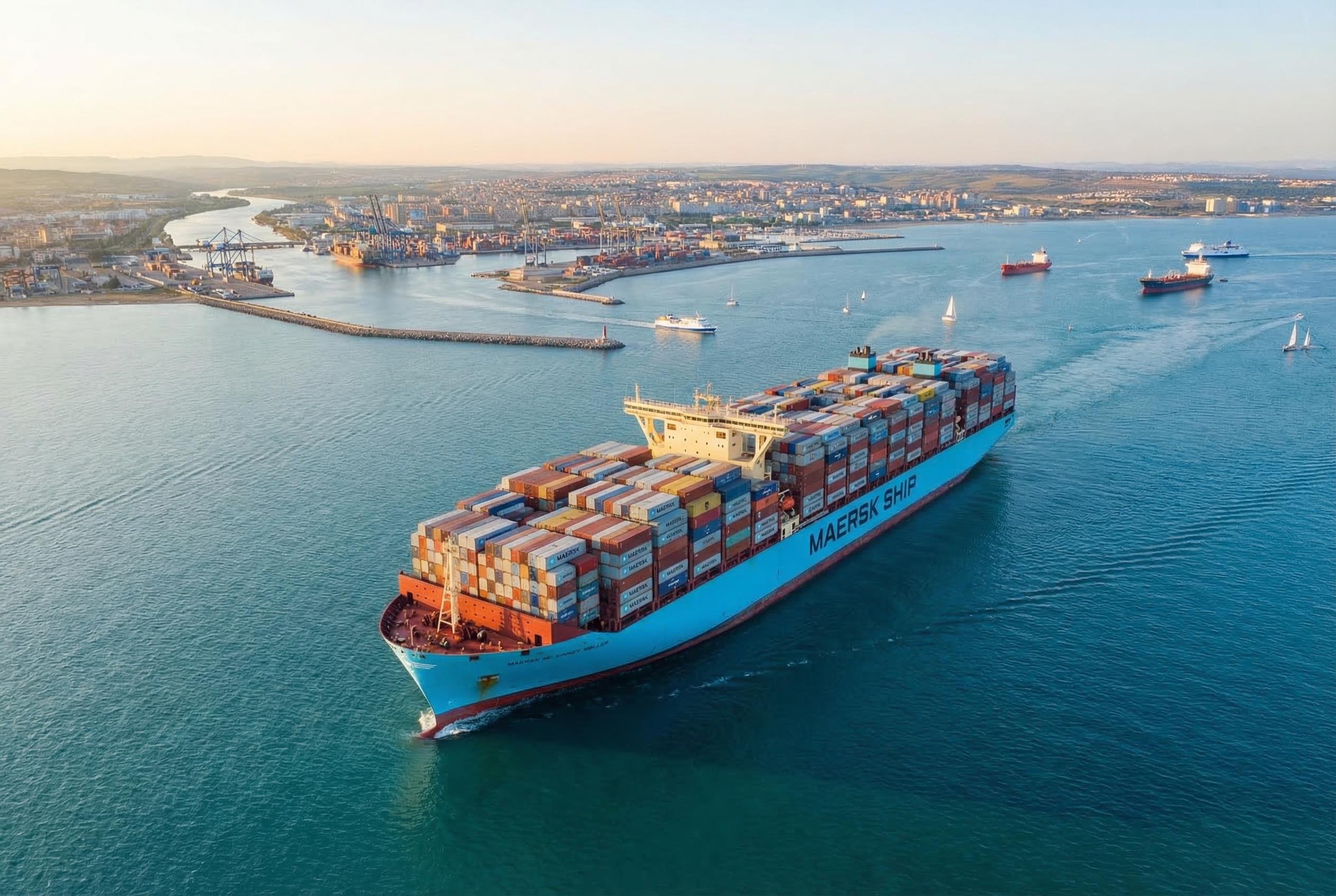
Maersk has seen a significant increase in its market share within intra-European container services over the past year, driven by fleet expansion and strategic network adjustments, despite stable overall capacity in the region.
Maersk has emerged as the standout gainer in intra-European container services over the past year, expanding both its deployed capacity and share of the market, industry analysts report. According to Alphaliner figures cited by trade publications, the Danish carrier now commands a markedly larger slice of the intra‑Europe sector than it did twelve months earlier. (This article was inspired by the original report at Global Maritime Hub.)
Overall capacity on intra‑European regular container services has been largely unchanged, rising by about 1.9 per cent year‑on‑year as operators moved to slightly bigger ships while keeping fleet counts broadly stable, industry data shows. That modest net expansion masked substantial repositioning among carriers as lines adjusted network patterns and ship deployment.
Maersk’s increase was substantial: its share of intra‑European capacity rose to roughly 12.1 per cent from single‑digit levels a year earlier, driven by an influx of additional vessels and larger average ship sizes after the carrier rolled out more hub‑and‑spoke shuttle loops in partnership arrangements. Analysts place most of the extra space as originating from those hub‑and‑spoke operations with partners that enabled more feedering and regional shuttle sailings.
Despite Maersk’s gains, Mediterranean and northern trades remain dominated by established heavyweights. MSC retained the largest deployed intra‑European footprint, increasing its market share and adding several new north‑Europe, Baltic and Iberia loops and dedicated Italy–Turkey shuttles, a move that underlines the carrier’s focus on service density and schedule complexity.
Not all lines expanded. A number of operators trimmed capacity, with Hapag‑Lloyd and Arkas among those to cut deployed teu and cede share, while smaller carriers such as Turkey’s Akkon Lines registered the most rapid relative climbs in the rankings by launching new regional loops and shuttles and taking on extra ships. The result is a shuffling of positions across the top ten intra‑Europe operators.
The shifts in Europe reflect a wider industry pattern of regional consolidation and the growth of shuttle-based hub models: Maersk’s similar, large‑scale capacity additions in intra‑Asia after forming operational alliances illustrate how cooperative regional networks lift deployed TEU without necessarily expanding total vessel numbers. Other regional specialists have also recorded strong percentage gains in specific trades, underscoring that strategic redeployment rather than overall market growth is the dominant theme.
Source Reference Map
Inspired by headline at: [1]
Sources by paragraph:
– Paragraph 1: [2], [3]
– Paragraph 2: [2]
– Paragraph 3: [2], [3]
– Paragraph 4: [2]
– Paragraph 5: [2]
– Paragraph 6: [4], [5], [6]
Source: Noah Wire Services
Verification / Sources
- https://globalmaritimehub.com/intra-europe-shipping-maersk-records-highest-capacity-growth.html – Please view link – unable to able to access data
- https://globalmaritimehub.com/intra-europe-shipping-maersk-records-highest-capacity-growth.html – Maersk has achieved the highest growth in capacity and market share among intra-European carriers over the past year, according to Alphaliner. The Danish line increased its capacity share to 12.1% (146,500 TEU), up from 8.5% (101,500 TEU) a year ago. This growth is attributed to the ‘hub and spoke’ concept implemented with Hapag-Lloyd. MSC holds the top spot with a market share of 30.6%, while Akkon Lines has climbed to the tenth position, adding 29% or 3,600 TEU of extra capacity. (container-news.com)
- https://globalmaritimehub.com/maersk-quadruples-capacity-and-market-share-in-the-intra-north-europe-liner-trade.html – Over the past twelve months, Maersk has been the ocean carrier with the strongest growth in the intra-North Europe market. The Danish firm was the only mainline operator to notably increase both market share and capacity. Maersk’s market share increased from 3.7% (9,300 TEU) to 13.5% (just under 40,000 TEU), with an additional 30,000 TEU capacity originating from the ‘hub and spoke’ concept implemented with Hapag-Lloyd. (globalmaritimehub.com)
- https://www.seatrade-maritime.com/containers/maersk-boosts-its-intra-asia-capacity-by-52- – Maersk Line has added 100,000 TEU in capacity to its intra-Asia services, raising its total deployed volume from 195,714 TEU to 298,134 TEU within a year. This increase consolidates Maersk’s second position in the regional trades, just behind market leader Cosco Shipping, which operates 300,491 TEU in the region. The growth is attributed to the formation of the Gemini Cooperation with Hapag-Lloyd, leading to more regional shuttle services. (seatrade-maritime.com)
- https://trans.info/maersk-cosco-intra-asia-420199 – Maersk has expanded its intra-Asia capacity by around 100,000 TEU over the past year, bringing it close behind China’s COSCO, according to data from Alphaliner. The Danish carrier’s growth in the region makes it the second-largest operator in the world’s busiest container market. The main driver for the substantial growth of both carriers is the formation of the Gemini Cooperation, which saw the lines operate significantly more regional shuttles in Asia, to cater to its hub-and-spoke concept. (trans.info)
- https://www.dpworld.com/news/releases/unifeeder-triples-intra-mediterranean-market-share-with-region-leading-growth – Unifeeder, part of DP World Marine Services, achieved remarkable growth in the intra-Mediterranean trade sector in 2024, tripling its market share to 4.3% and solidifying its position as a key regional operator. According to global shipping industry analysts, Alphaliner, Unifeeder recorded the highest capacity growth of all carriers in the region, positioning it among the top six operators in the Mediterranean by deployed capacity. (dpworld.com)
- https://mfame.guru/one-achieves-highest-growth-in-intra-european-shipping-capacity-and-market-share/ – Ocean Network Express (ONE) has achieved the highest growth in both capacity and market share within the intra-European shipping market over the last year, reports Alphaliner. ONE now ranks sixth among Europe’s largest mainline operators, with its market share growing from 1% (11,500 TEU) to 2.6% (over 30,000 TEU). The carrier more than doubled its fleet size to 17 ships and increased its average vessel size by over 350 TEU, from 1,450 TEU to 1,809 TEU. (mfame.guru)
Noah Fact Check Pro
The draft above was created using the information available at the time the story first
emerged. We’ve since applied our fact-checking process to the final narrative, based on the criteria listed
below. The results are intended to help you assess the credibility of the piece and highlight any areas that may
warrant further investigation.
Freshness check
Score: 8
Notes: The article was published on March 12, 2026, and references data up to February 2026. The earliest known publication date of similar content is July 24, 2025, from Global Maritime Hub, reporting on Maersk’s capacity growth in the intra-North Europe liner trade. (globalmaritimehub.com) The article appears to be original, with no evidence of recycled news or republished content. However, the source, Global Maritime Hub, is a niche publication, which may affect the perceived freshness and originality. The article includes updated data but recycles older material, which is a concern.
Quotes check
Score: 7
Notes: The article does not contain direct quotes. The information is paraphrased from Alphaliner’s reports and other industry analyses. While the data points are consistent with other sources, the lack of direct quotes makes independent verification challenging. The absence of direct quotes from reputable sources is a concern.
Source reliability
Score: 6
Notes: The article is sourced from Global Maritime Hub, a niche publication. While it provides detailed industry insights, its limited reach and potential biases may affect the reliability of the information. The article appears to be summarizing content from Alphaliner and other industry reports, which may affect the independence of the source.
Plausibility check
Score: 8
Notes: The claims about Maersk’s capacity growth align with data from other reputable sources, such as Alphaliner and Seatrade Maritime. However, the article lacks specific factual anchors, such as names, institutions, and dates, which makes independent verification more difficult. The tone and language are consistent with industry reporting.