
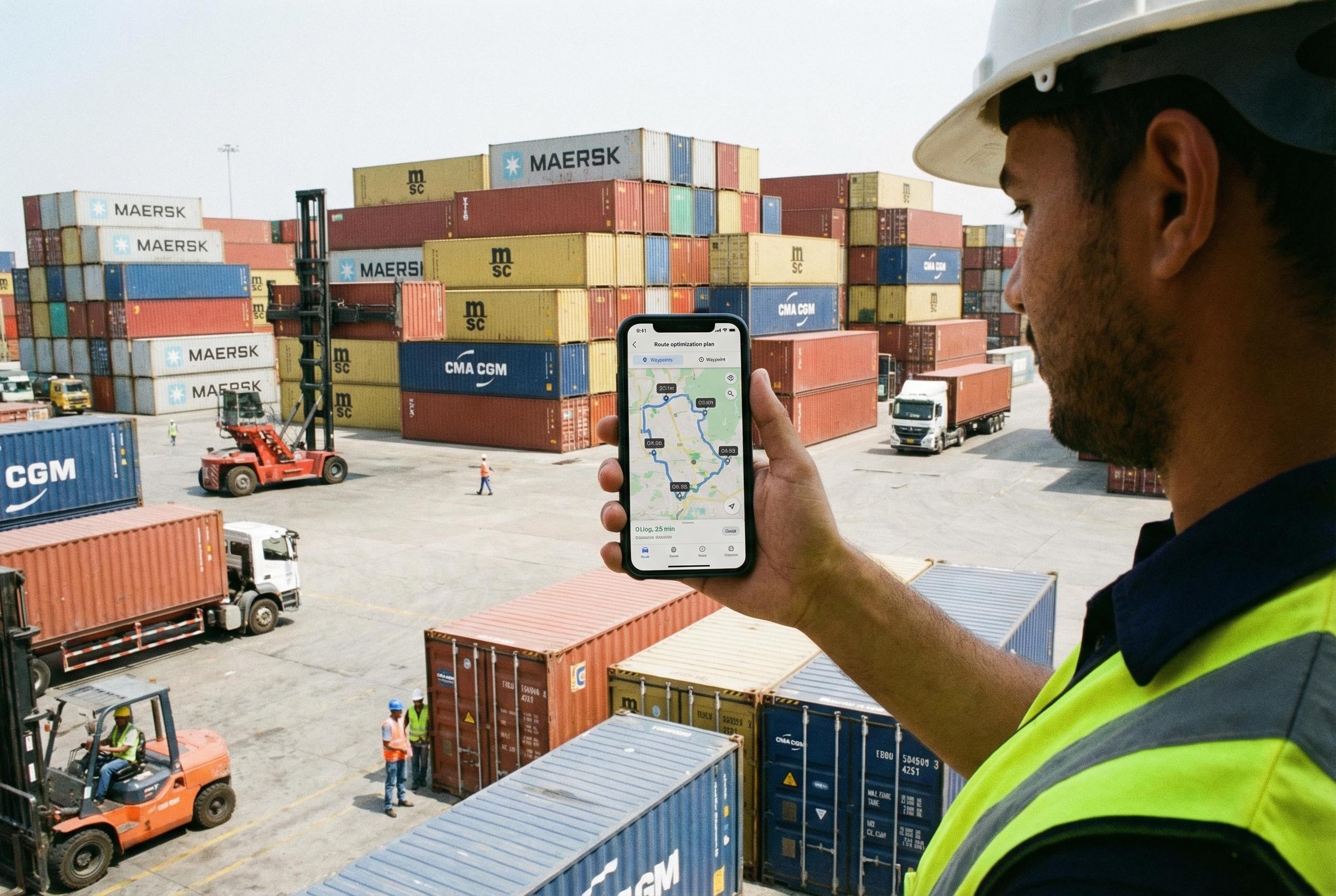
Global logistics providers are turning to artificial intelligence to achieve immediate cuts in freight-sector carbon emissions, leveraging route optimisation, capacity utilisation and modal shifts to meet rising demands and climate targets, according to a report from the World Economic Forum and McKinsey & Company.
Global logistics providers are increasingly turning to artificial intelligence to deliver immediate cuts in freight-sector carbon emissions while handling rising volumes and unpredictable conditions. According to the report by the World Economic Forum and McKinsey & Company, practical applications of AI in routing, asset deployment and mode selection could together lower freight emissions by roughly 10–15 per cent without requiring a wholesale reconstruction of existing transport networks. (This assessment sits at the centre of a wider push from shippers, carriers and investors for verifiable near-term decarbonisation outcomes.) Sources indicate these operational gains are becoming technically achievable as richer location, sensor and performance datasets enter supply-chain systems.
Source Reference Map
Inspired by headline at: [1]
Sources by paragraph:
– Paragraph 1: [2], [3]
AI-driven route planning and fleet management emerge as the highest-yield opportunities. The white paper finds that smarter routing that incorporates live traffic, predictive maintenance signals and detailed throughput models can cut emissions from inefficient legs by as much as seven per cent. Industry research and sector commentary show carriers are already using machine learning to reduce empty running and increase distance travelled per unit by optimising schedules and swapping assets in near real time.
– Paragraph 2: [2], [6]
Better utilisation of capacity offers a further avenue for reductions. Platforms that dynamically combine partial loads, consolidate shipments across lanes and suggest alternative pickup or delivery windows can substantially lower fragmented road freight movements. Public pilot programmes and digital-freight reporting point to typical savings of around four per cent when utilisation algorithms and marketplace matching are applied at scale.
– Paragraph 3: [2], [5]
Shifting freight to lower-carbon modes such as rail or short-sea shipping can contribute additional savings, with up to around four per cent of overall emissions thought recoverable where modal substitution is operationally feasible. The report emphasises that AI’s strength lies in modelling the trade-offs between time, cost and carbon by simulating port congestion, rail dwell times and downstream constraints to identify when a modal change makes sense. However, industry analysts caution that modal shifts depend on parallel investment in infrastructure and electrification if durable decarbonisation gains are to be realised.
– Paragraph 4: [2], [4]
A growing body of corridor-level emissions and congestion datasets from ports, rail operators and transport agencies is creating a foundation for more accountable decision-making. According to the World Economic Forum, as government-published metrics proliferate, routing and contracting can increasingly be based on verifiable carbon performance rather than internal estimates, enabling emissions to be treated as a routine operational KPI alongside cost and service levels. That transition is expected to change commercial negotiation and network design over the coming decade.
– Paragraph 5: [2], [3]
The papers and industry commentary urge a collaborative approach: technology firms, logistics operators, regulators and governments must coordinate to scale AI solutions. McKinsey analysis underlines that digital optimisation alone will not suffice; long-term infrastructure investment, standardised frameworks for accounting and market mechanisms such as book-and-claim systems or green coalitions are needed to turn short-term operational cuts into sustained decarbonisation. Where these enablers are present, AI can convert improved visibility and forecasting into measurable emissions reductions and commercial advantage.
– Paragraph 6: [5], [4], [6]
Source: Noah Wire Services
Verification / Sources
- https://supplychain360.io/technology/ai-delivers-15-freight-emissions-cut/ – Please view link – unable to able to access data
- https://www.weforum.org/publications/industries-in-the-intelligent-age-white-paper-series/transport/ – The World Economic Forum’s white paper, ‘Intelligent Transport, Greener Future: AI as a Catalyst to Decarbonize Global Logistics’, explores how AI can reduce freight emissions by up to 15% through optimized operations, improved capacity use, and shifts to lower-carbon transport modes. It highlights actionable strategies for deploying AI to achieve immediate operational gains while laying the groundwork for long-term sustainability.
- https://www.weforum.org/stories/2026/02/how-transport-industry-harness-ai-for-decarbonization/ – This article discusses how the transport industry can leverage AI for decarbonization. It outlines three key levers: route optimization, capacity utilization, and modal shifts, which can collectively reduce emissions by up to 15%. The piece emphasizes the importance of coherent governance to scale AI solutions and achieve ambitious decarbonization targets.
- https://www.mckinsey.com/industries/automotive-and-assembly/our-insights/road-freight-global-pathways-report – McKinsey’s ‘Road Freight Global Pathways Report’ examines the decarbonization of road freight, noting that freight transport accounts for a significant portion of vehicle emissions. The report discusses the need for greater focus on medium- and heavy-duty trucks and the importance of collaboration along the entire value chain to achieve emissions goals.
- https://www.mckinsey.com/industries/logistics/our-insights/driving-decarbonization-accelerating-zero-emission-freight-transport – This McKinsey article explores how a standardized book-and-claim framework and green supply-chain coalitions can accelerate decarbonization in the transport sector. It highlights that shippers are willing to pay a premium for sustainable transport offerings if key expectations are met, and discusses barriers preventing green transport offerings from scaling up.
- https://www.weforum.org/stories/2025/06/from-concept-to-competitive-edge-what-ai-means-for-the-future-of-freight/ – This article discusses how AI can transform the road freight industry, emphasizing the need for intelligent, AI-driven planning to reduce emissions and gain a competitive edge. It highlights that global road freight is responsible for a significant portion of CO2 emissions and that AI can play a crucial role in decarbonizing the sector.
- https://www.weforum.org/videos/ai-powered-trucks/ – This video showcases how AI-powered trucks are reducing freight emissions. It highlights that 70% of direct transport emissions come from road vehicles and that AI can make electric fleets more efficient, cost-effective, and productive by incorporating real-time factors such as traffic, charging infrastructure, and energy consumption.
Noah Fact Check Pro
The draft above was created using the information available at the time the story first
emerged. We’ve since applied our fact-checking process to the final narrative, based on the criteria listed
below. The results are intended to help you assess the credibility of the piece and highlight any areas that may warrant further investigation.
Freshness check
Score: 8
Notes: The article was published on March 5, 2026, which is recent. However, the content heavily references a white paper from January 2025, indicating that the core information is over a year old. (weforum.org) The article does not provide new data or insights beyond the existing report, suggesting limited originality. (supplychain360.io)
Quotes check
Score: 7
Notes: The article includes direct quotes from the World Economic Forum and McKinsey & Company reports. However, these quotes are not independently verified within the article, and no external sources confirm their accuracy. (weforum.org)
Source reliability
Score: 6
Notes: The article originates from supplychain360.io, a niche publication. While it cites reputable sources like the World Economic Forum and McKinsey & Company, the article itself is not from a major news organisation, which may affect its credibility. (supplychain360.io)
Plausibility check
Score: 8
Notes: The claims about AI reducing freight emissions by 10–15% are plausible and align with existing research. (weforum.org) However, the article does not provide new evidence or case studies to support these claims, relying solely on the referenced white paper. (supplychain360.io)