
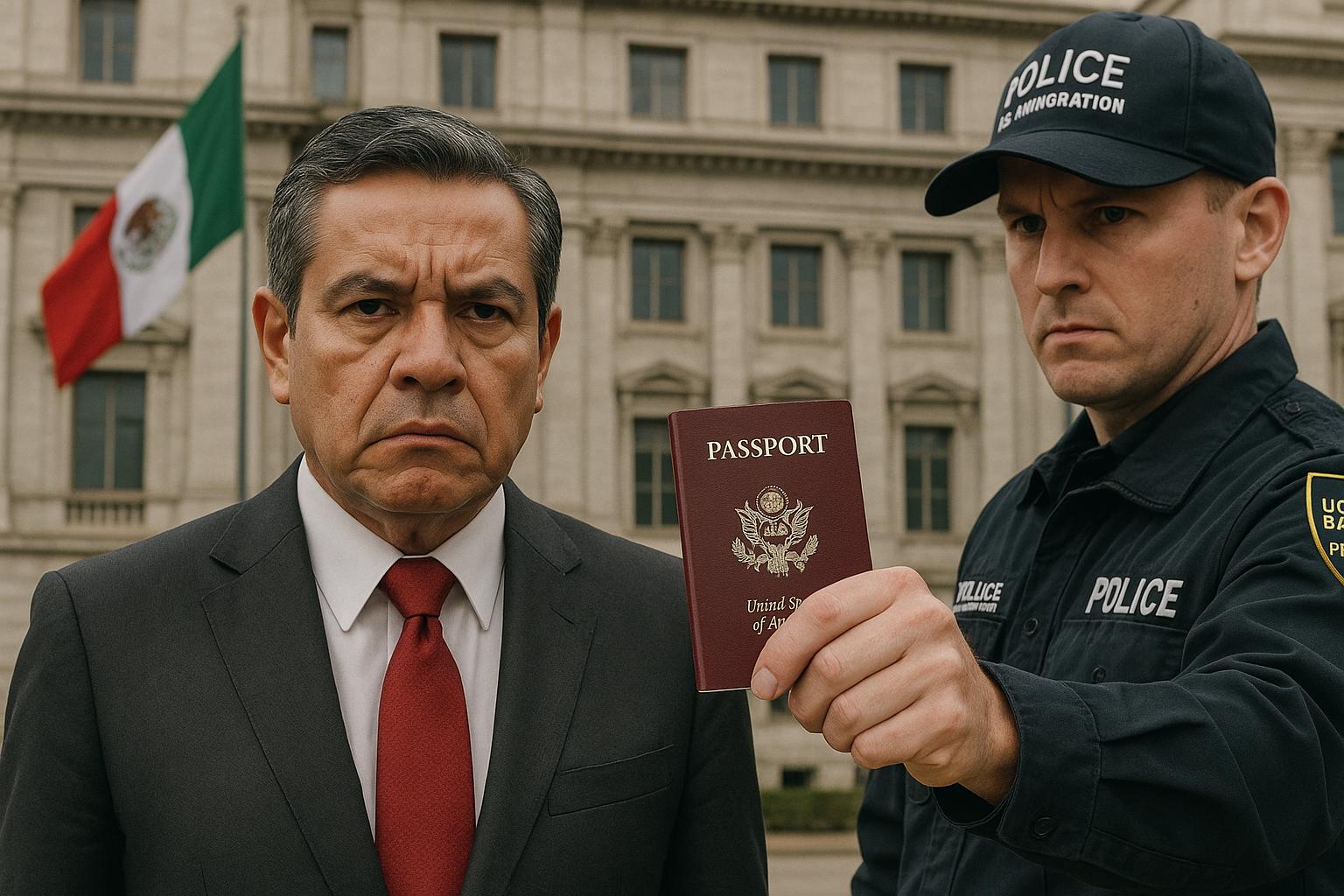
The US’s increasing use of visa cancellations as a political tool is altering Mexico–US relations, targeting politicians, cracking down on organised crime, and raising human rights concerns amidst growing tensions.
The steady erosion of travel by Mexico’s ruling party to the United States has become one of the clearest indicators of a widening, covert confrontation between Washington and elements of Mexico’s political class. What began as travel warnings in the final year of Andrés Manuel López Obrador’s presidency has hardened into targeted visa revocations, starting with the high‑profile case of Baja California’s governor Marina del Pilar Ávila in May of last year and, by United States government tallies, swelling to more than 100,000 visas cancelled since President Donald Trump’s return to office in January 2025. According to the report by El Financiero, those cancellations have continued to grow and have chilled routine diplomatic and personal travel. [1][3][4]
The cancellations are not merely administrative: they have been used as an instrument of pressure and intelligence gathering. El Financiero reports that Mexican citizens with connections to public figures have been detained on arrival, questioned for hours by the FBI and Department of Homeland Security and in some cases deported; others, notably relatives of senior politicians, have been admitted only after being summoned to FBI offices for follow‑up interviews. The article describes how the revocations function as a de facto certificate of suspicion and a warning that subjects are under investigation. [1]
Washington’s campaign, which officials say dates to the Trump administration’s earlier efforts, has taken on new scale and machinery. According to El País, the State Department set up a Continuous Vetting Centre that monitors foreign nationals in real time and has contributed to the record number of visa revocations in 2025. The centre, and wider tightening of vetting procedures including social media screening reported by other outlets, has been credited by US officials with enabling far more frequent cancellations than in previous years. Critics have argued these moves raise questions about due process and human rights. [4][5][3]
The policy has also been explicitly political. El Financiero cites a US official who described the revocations as discretionary actions carried out in coordination with the Department of Homeland Security under a proclamation by President Trump that restricts entry of “ciertos” foreigners to prevent “amenazas de seguridad nacional y de salud pública”. That language, El Financiero notes, has been used to justify case‑by‑case cancellations that target not only alleged criminal actors but also figures whose rhetoric or positions are judged inimical to US policy. Washington, the piece says, has provided lists of suspected links between Morena figures and organised crime to President Claudia Sheinbaum and urged domestic action or risk public indictments. [1]
The strategy has produced notable political reverberations inside Mexico. Reports collected by El Financiero and Mexico‑focused outlets describe governors and other officials negotiating with US authorities to avoid revocation, providing information in exchange for temporary protections, or taking dramatic personal steps to limit exposure, from family relocations to divorce. According to Mexico News Daily and other reporting, at least 50 politicians affiliated with Morena had visas revoked by October 2025, a move that sent shockwaves through the party and broadened concerns about reputational and legal consequences for public careers. [1][7][2][6]
US officials frame the approach as part of a broader crackdown on narco‑political networks. The Guardian and Firstpost reported in October 2025 that dozens of politicians and officials were targeted as the Trump administration expanded anti‑narcotics measures to include active political figures once regarded as diplomatically sacrosanct. The revocations were presented as tools to disrupt the flow of protection and impunity that allows organised crime to operate. Yet human‑rights advocates and legal experts have warned that such measures, especially when coupled with pervasive social‑media vetting, risk entangling innocent people and eroding transparent legal safeguards. [2][6][5]
The cumulative effect is a new, quieter diplomacy that relies on mobility control rather than public indictments. As El Financiero argues, for a Mexican politician the loss of a US visa is immediate and tangible: it reduces interlocution, constrains manoeuvre and can destroy credibility. The US administration appears to view visa control as a surgical lever, punitive but deniable, that can correct conduct without escalating bilateral conflict. The growing numbers tracked by US and international reporting suggest that, whether aimed at crime, corruption or dissent, the policy has already reshaped the practical contours of Mexico–US engagement. [1][3][4]
The consequences extend beyond individual careers to institutional trust. Government lists, embassy scrutiny and a steady drumbeat of revocations have prompted an aversion to travel among party officials and a public narrative of being blacklisted in Washington that many in Morena publicly dismiss. Yet the practical reality described by diplomats, prosecutors and those who have been questioned is that visa policy has become a formidable lever of US foreign policy toward Mexico, one whose use and expansion will continue to reverberate through both countries’ political systems. [1][2][3]
📌 Reference Map:
Reference Map:
- – [1] (El Financiero) – Paragraph 1, Paragraph 2, Paragraph 4, Paragraph 5, Paragraph 7, Paragraph 8
- – [3] (Al Jazeera) – Paragraph 1, Paragraph 3, Paragraph 8
- – [4] (El País) – Paragraph 3, Paragraph 8
- – [5] (El País) – Paragraph 3, Paragraph 6
- – [2] (The Guardian) – Paragraph 6, Paragraph 8
- – [6] (Firstpost) – Paragraph 6
- – [7] (Mexico News Daily) – Paragraph 5
Source: Noah Wire Services
Verification / Sources
- https://www.elfinanciero.com.mx/opinion/raymundo-riva-palacio/2026/01/20/100-mil-visas-canceladas/ – Please view link – unable to able to access data
- https://www.theguardian.com/us-news/2025/oct/14/us-revokes-visas-mexican-trump-drug-cartel-crackdown – In October 2025, the US government revoked the visas of at least 50 Mexican politicians and government officials amid a crackdown on drug cartels and their suspected political allies. This move marked a significant broadening of US anti-narcotics action, with the Trump administration targeting active politicians usually seen as too diplomatically sensitive. The revocations have sent shockwaves through Mexico’s political elite, many of whom regularly travel to the US. Previous administrations had revoked visas, but not to this extent, indicating President Trump’s willingness to use this diplomatic tool to achieve policy goals.
- https://www.aljazeera.com/news/2026/1/13/us-revokes-more-than-100000-visas-since-trumps-return-to-office – As of January 2026, the US State Department announced the revocation of over 100,000 visas since President Donald Trump’s return to office in January 2025. This represents a 150% increase compared to 2024. The revocations were attributed to offences such as overstays, driving under the influence, assault, and theft. The administration has also adopted stricter policies for granting visas, including tightened social media vetting and expanded screening. Critics have raised concerns about due process and human rights implications of these actions.
- https://english.elpais.com/usa/2026-01-13/the-united-states-government-revoked-a-record-100000-visas-in-2025.html – In January 2026, the US State Department announced that it had revoked over 100,000 visas in 2025, setting a new record. This surge in revocations is driven by the State Department’s new Continuous Vetting Centre, which monitors foreign nationals in real-time even after they have entered the United States. The revocations reflect the administration’s hardline immigration policy and have raised concerns about due process and human rights.
- https://english.elpais.com/usa/2025-11-09/the-visa-remover-christopher-landaus-scrutiny-of-mexican-social-media-accounts.html – In November 2025, Christopher Landau, the US Ambassador to Mexico, was reported to be scrutinising Mexican social media accounts as part of the US government’s efforts to monitor and potentially revoke visas. The US Embassy in Mexico clarified that a visa is a privilege, not a right, and can be cancelled at any time if the holder has committed certain violations, such as overstaying their authorised period in the United States, participating in criminal activities, or posing a risk to public safety.
- https://www.firstpost.com/world/us-revokes-visas-of-over-50-mexican-politicians-in-major-crackdown-on-cartel-ties-13942087.html – In October 2025, the US government revoked the visas of at least 50 Mexican politicians and government officials amid a crackdown on drug cartels and their suspected political allies. This move marked a significant broadening of US anti-narcotics action, with the Trump administration targeting active politicians usually seen as too diplomatically sensitive. The revocations have sent shockwaves through Mexico’s political elite, many of whom regularly travel to the US. Previous administrations had revoked visas, but not to this extent, indicating President Trump’s willingness to use this diplomatic tool to achieve policy goals.
- https://mexiconewsdaily.com/news/50-morena-affiliated-politicians-have-had-their-us-visas-revoked/ – As of October 2025, more than 50 politicians affiliated with Mexico’s ruling Morena party had their US visas revoked. Among those affected were Baja California Governor Marina del Pilar Ávila, who has denied any wrongdoing, and Juan Francisco Gim, the mayor of Nogales, Sonora. A senior US State Department official stated that visas may be revoked at any time for activities that run contrary to America’s national interest, including drug trafficking, visa overstay, corruption, spying, or aiding illegal immigration.
Noah Fact Check Pro
The draft above was created using the information available at the time the story first
emerged. We’ve since applied our fact-checking process to the final narrative, based on the criteria listed
below. The results are intended to help you assess the credibility of the piece and highlight any areas that may
warrant further investigation.
Freshness check
Score: 8
Notes: The article was published on January 20, 2026, and references events up to that date. However, the information about over 100,000 visa cancellations has been reported by multiple sources since January 13, 2026, indicating that the narrative is not entirely fresh. (aljazeera.com)
Quotes check
Score: 7
Notes: The article includes direct quotes from El Financiero, but these cannot be independently verified due to the lack of access to the original source.
Source reliability
Score: 6
Notes: El Financiero is a reputable Mexican news outlet. However, the article is an opinion piece, which may introduce bias. Additionally, the reliance on unverified quotes from El Financiero raises concerns about the independence of the information.
Plausibility check
Score: 7
Notes: The claims about over 100,000 visa cancellations align with reports from other reputable sources. (aljazeera.com) However, the article’s reliance on unverified quotes and the lack of independent verification of some claims reduce the overall plausibility.
Overall assessment
Verdict (FAIL, OPEN, PASS): FAIL
Confidence (LOW, MEDIUM, HIGH): MEDIUM
Summary: The article presents information about over 100,000 visa cancellations, a claim corroborated by other reputable sources. However, the reliance on unverified quotes from El Financiero, the opinion piece format, and the lack of independent verification of some claims raise significant concerns about the reliability and objectivity of the information presented.