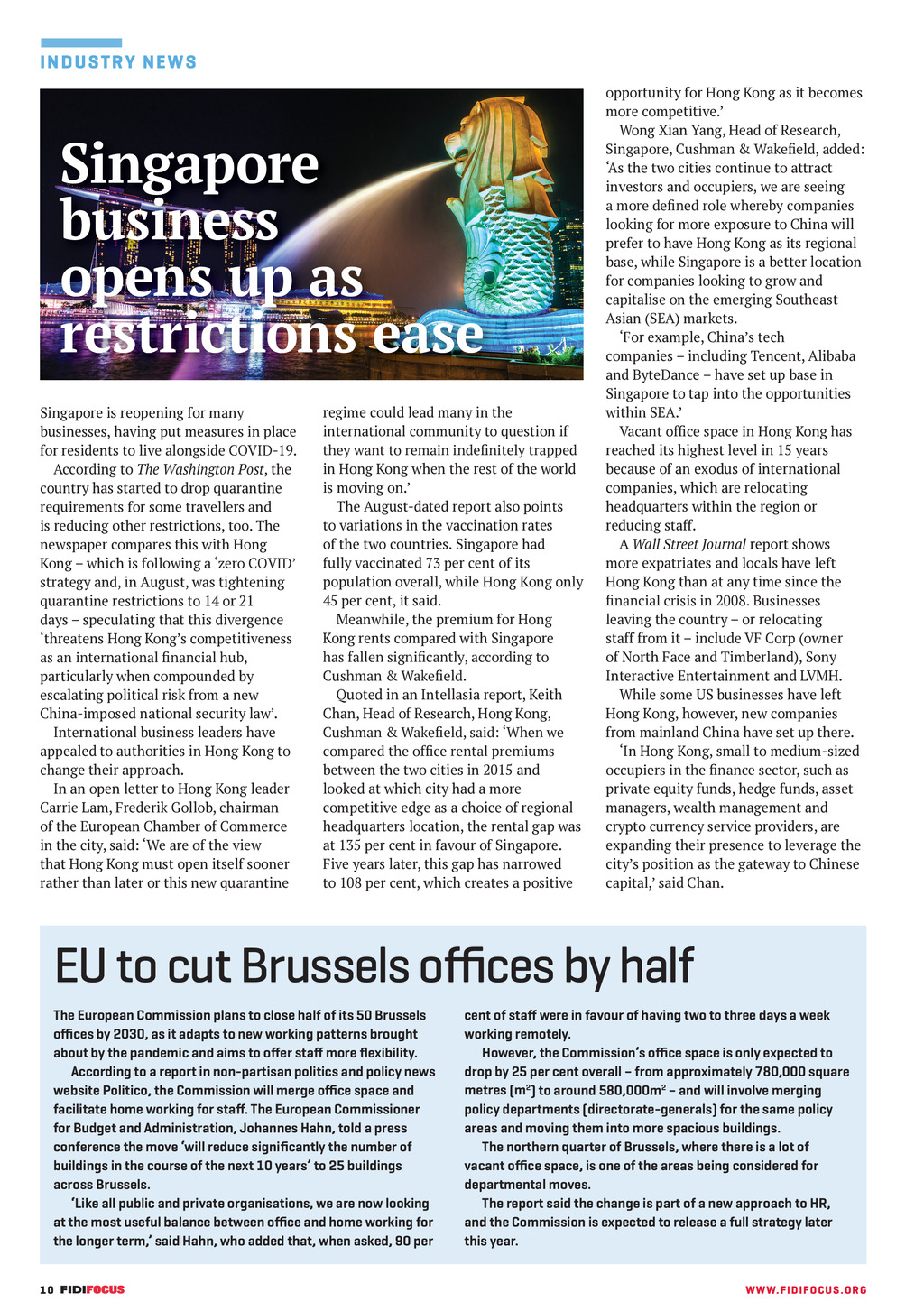


INDU ST RY N EW S Singapore business opens up as restrictions ease Singapore is reopening for many businesses, having put measures in place for residents to live alongside COVID-19. According to The Washington Post, the country has started to drop quarantine requirements for some travellers and is reducing other restrictions, too. The newspaper compares this with Hong Kong which is following a zero COVID strategy and, in August, was tightening quarantine restrictions to 14 or 21 days speculating that this divergence threatens Hong Kongs competitiveness as an international financial hub, particularly when compounded by escalating political risk from a new China-imposed national security law. International business leaders have appealed to authorities in Hong Kong to change their approach. In an open letter to Hong Kong leader Carrie Lam, Frederik Gollob, chairman of the European Chamber of Commerce in the city, said: We are of the view that Hong Kong must open itself sooner rather than later or this new quarantine regime could lead many in the international community to question if they want to remain indefinitely trapped in Hong Kong when the rest of the world is moving on. The August-dated report also points to variations in the vaccination rates of the two countries. Singapore had fully vaccinated 73 per cent of its population overall, while Hong Kong only 45 per cent, it said. Meanwhile, the premium for Hong Kong rents compared with Singapore has fallen significantly, according to Cushman & Wakefield. Quoted in an Intellasia report, Keith Chan, Head of Research, Hong Kong, Cushman & Wakefield, said: When we compared the office rental premiums between the two cities in 2015 and looked at which city had a more competitive edge as a choice of regional headquarters location, the rental gap was at 135 per cent in favour of Singapore. Five years later, this gap has narrowed to 108 per cent, which creates a positive opportunity for Hong Kong as it becomes more competitive. Wong Xian Yang, Head of Research, Singapore, Cushman & Wakefield, added: As the two cities continue to attract investors and occupiers, we are seeing a more defined role whereby companies looking for more exposure to China will prefer to have Hong Kong as its regional base, while Singapore is a better location for companies looking to grow and capitalise on the emerging Southeast Asian (SEA) markets. For example, Chinas tech companies including Tencent, Alibaba and ByteDance have set up base in Singapore to tap into the opportunities within SEA. Vacant office space in Hong Kong has reached its highest level in 15 years because of an exodus of international companies, which are relocating headquarters within the region or reducing staff. A Wall Street Journal report shows more expatriates and locals have left Hong Kong than at any time since the financial crisis in 2008. Businesses leaving the country or relocating staff from it include VF Corp (owner of North Face and Timberland), Sony Interactive Entertainment and LVMH. While some US businesses have left Hong Kong, however, new companies from mainland China have set up there. In Hong Kong, small to medium-sized occupiers in the finance sector, such as private equity funds, hedge funds, asset managers, wealth management and crypto currency service providers, are expanding their presence to leverage the citys position as the gateway to Chinese capital, said Chan. EU to cut Brussels offices by half The European Commission plans to close half of its 50 Brussels offices by 2030, as it adapts to new working patterns brought about by the pandemic and aims to offer staff more flexibility. According to a report in non-partisan politics and policy news website Politico, the Commission will merge office space and facilitate home working for staff. The European Commissioner for Budget and Administration, Johannes Hahn, told a press conference the move will reduce significantly the number of buildings in the course of the next 10 years to 25 buildings across Brussels. Like all public and private organisations, we are now looking at the most useful balance between office and home working for the longer term, said Hahn, who added that, when asked, 90 per 10 FF303 Sept_Nov 21 pp10-17 News.indd 10 cent of staff were in favour of having two to three days a week working remotely. However, the Commissions office space is only expected to drop by 25 per cent overall from approximately 780,000 square metres (m2) to around 580,000m2 and will involve merging policy departments (directorate-generals) for the same policy areas and moving them into more spacious buildings. The northern quarter of Brussels, where there is a lot of vacant office space, is one of the areas being considered for departmental moves. The report said the change is part of a new approach to HR, and the Commission is expected to release a full strategy later this year. WWW. F I D I FOC U S . OR G 15/09/2021 10:55