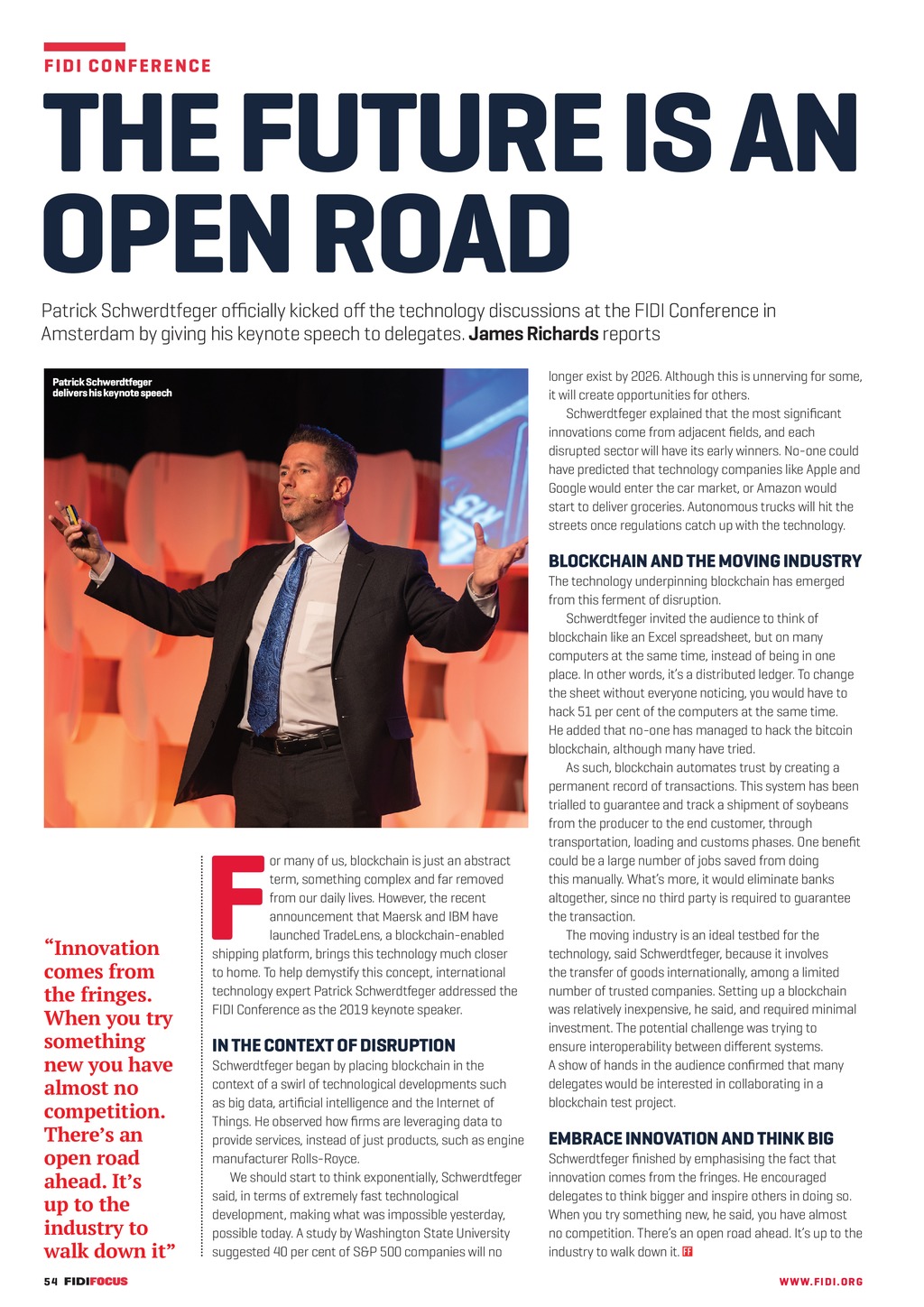
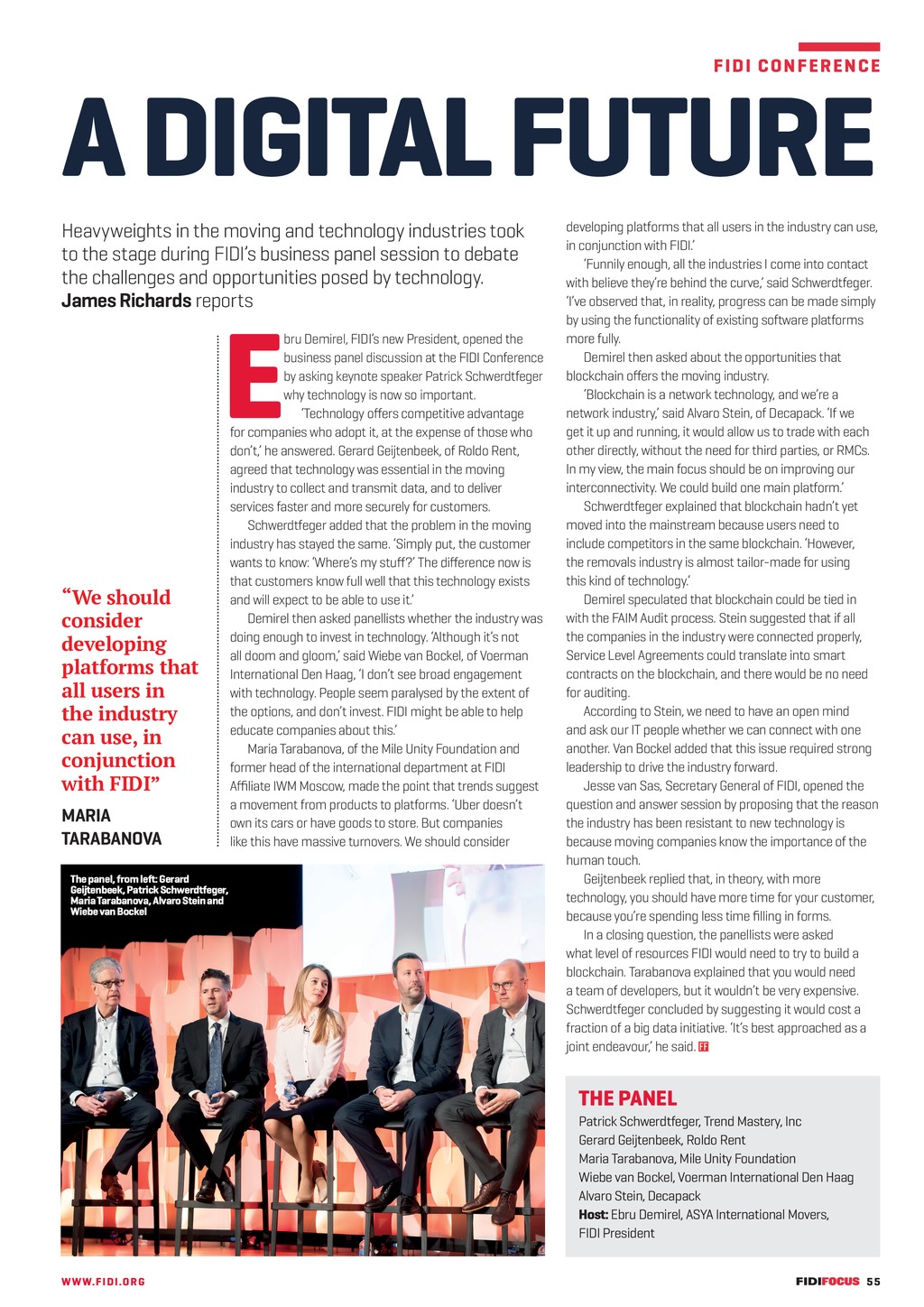

F ID I C O N FE R ENCE THE FUTURE IS AN OPEN ROAD Patrick Schwerdtfeger officially kicked off the technology discussions at the FIDI Conference in Amsterdam by giving his keynote speech to delegates. James Richards reports longer exist by 2026. Although this is unnerving for some, it will create opportunities for others. Schwerdtfeger explained that the most significant innovations come from adjacent fields, and each disrupted sector will have its early winners. No-one could have predicted that technology companies like Apple and Google would enter the car market, or Amazon would start to deliver groceries. Autonomous trucks will hit the streets once regulations catch up with the technology. Patrick Schwerdtfeger delivers his keynote speech BLOCKCHAIN AND THE MOVING INDUSTRY Innovation comes from the fringes. When you try something new you have almost no competition. Theres an open road ahead. Its up to the industry to walk down it F or many of us, blockchain is just an abstract term, something complex and far removed from our daily lives. However, the recent announcement that Maersk and IBM have launched TradeLens, a blockchain-enabled shipping platform, brings this technology much closer to home. To help demystify this concept, international technology expert Patrick Schwerdtfeger addressed the FIDI Conference as the 2019 keynote speaker. IN THE CONTEXT OF DISRUPTION Schwerdtfeger began by placing blockchain in the context of a swirl of technological developments such as big data, artificial intelligence and the Internet of Things. He observed how firms are leveraging data to provide services, instead of just products, such as engine manufacturer Rolls-Royce. We should start to think exponentially, Schwerdtfeger said, in terms of extremely fast technological development, making what was impossible yesterday, possible today. A study by Washington State University suggested 40 per cent of S&P 500 companies will no 54 FF291JunJul19 pp54 Keynote Speaker.indd 54 The technology underpinning blockchain has emerged from this ferment of disruption. Schwerdtfeger invited the audience to think of blockchain like an Excel spreadsheet, but on many computers at the same time, instead of being in one place. In other words, its a distributed ledger. To change the sheet without everyone noticing, you would have to hack 51 per cent of the computers at the same time. He added that no-one has managed to hack the bitcoin blockchain, although many have tried. As such, blockchain automates trust by creating a permanent record of transactions. This system has been trialled to guarantee and track a shipment of soybeans from the producer to the end customer, through transportation, loading and customs phases. One benefit could be a large number of jobs saved from doing this manually. Whats more, it would eliminate banks altogether, since no third party is required to guarantee the transaction. The moving industry is an ideal testbed for the technology, said Schwerdtfeger, because it involves the transfer of goods internationally, among a limited number of trusted companies. Setting up a blockchain was relatively inexpensive, he said, and required minimal investment. The potential challenge was trying to ensure interoperability between different systems. A show of hands in the audience confirmed that many delegates would be interested in collaborating in a blockchain test project. EMBRACE INNOVATION AND THINK BIG Schwerdtfeger finished by emphasising the fact that innovation comes from the fringes. He encouraged delegates to think bigger and inspire others in doing so. When you try something new, he said, you have almost no competition. Theres an open road ahead. Its up to the industry to walk down it. WWW. F I D I . OR G 13/05/2019 12:50